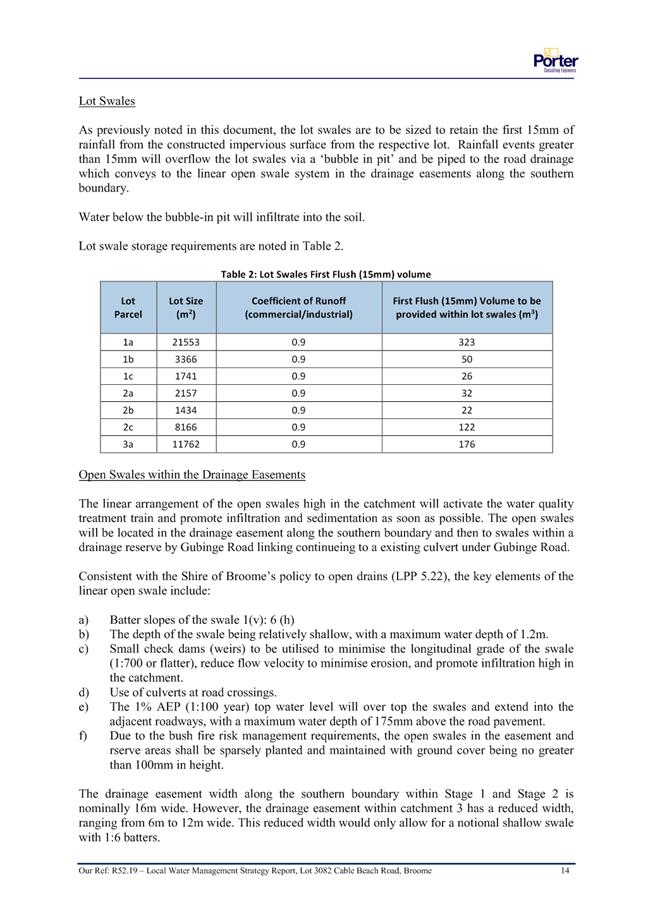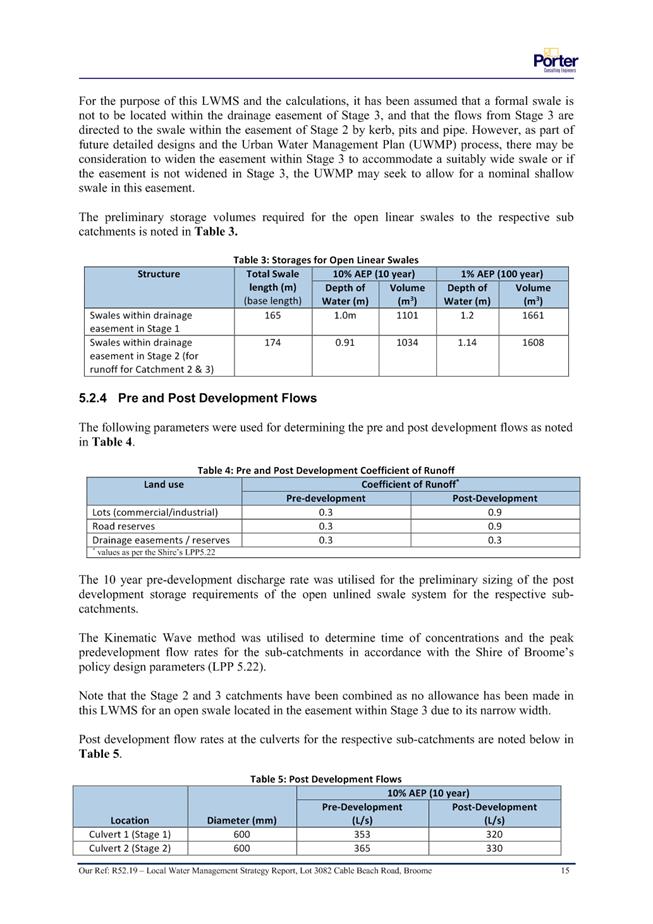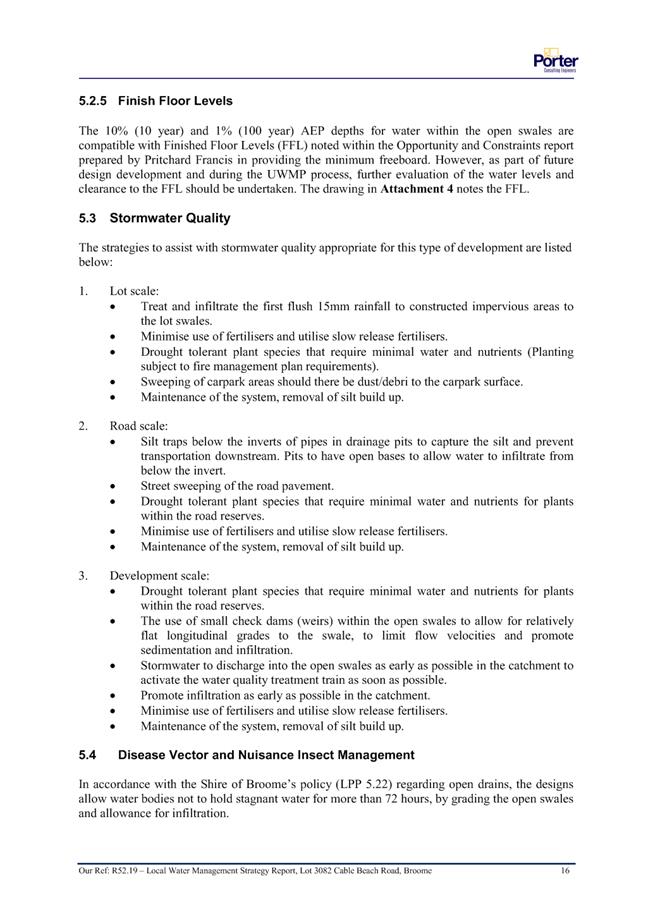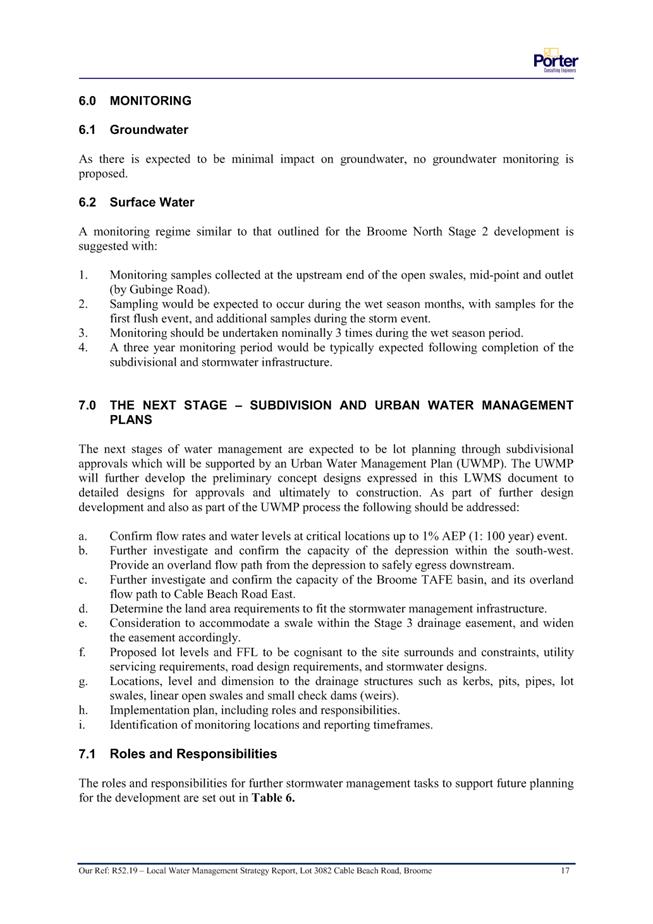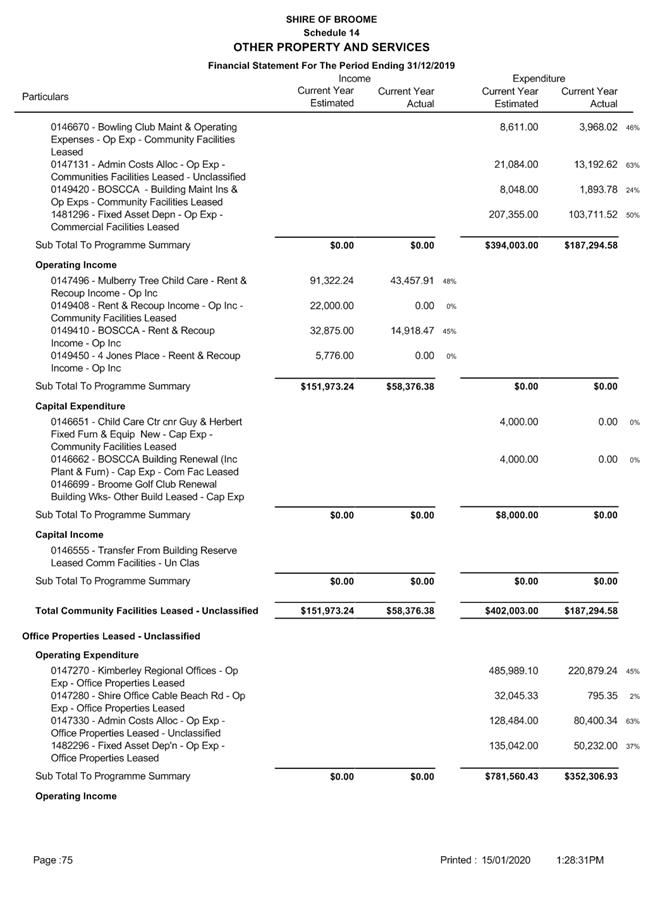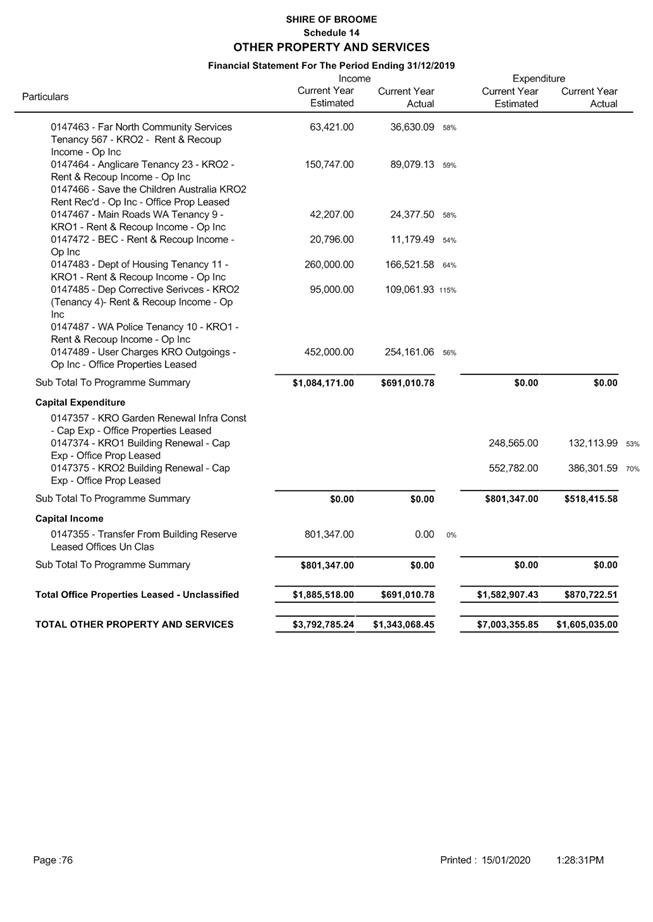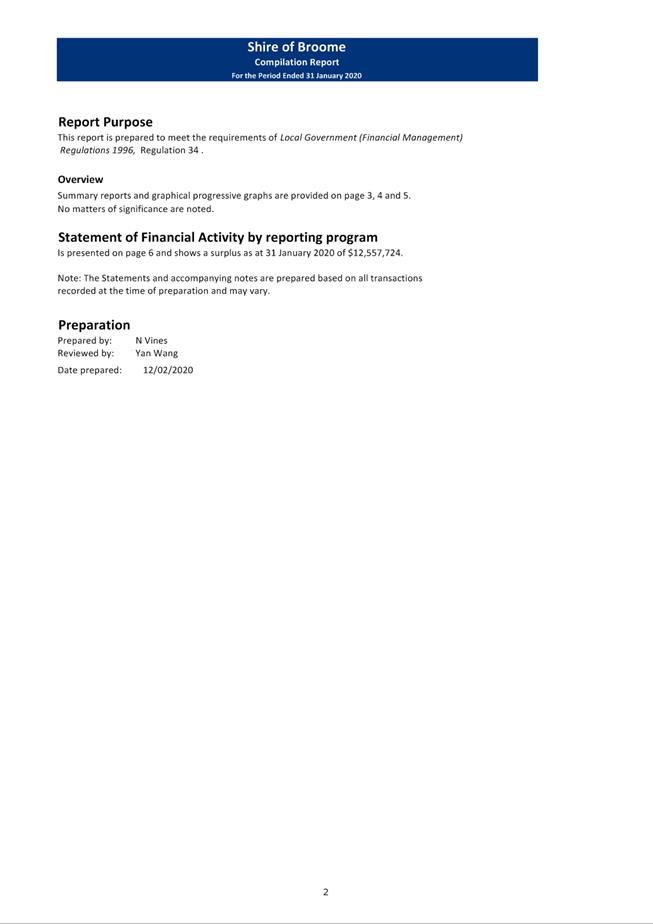
CONFIRMED
MINUTES
OF THE
Ordinary Meeting of Council
27 February 2020
NOTICE OF MEETING
Dear Council Member,
The next Ordinary Meeting of the Shire of Broome will be held on Thursday, 27 February 2020 in the Council Chambers, Corner Weld and Haas Streets, Broome, commencing at 5:00 PM.
Regards,
S MASTROLEMBO
Chief Executive Officer
20/02/2020
OUR MISSION
“To deliver affordable and quality Local Government services.”
CORE VALUES OF THE SHIRE
The core values that underpin the achievement of the
mission will be based on a strong customer service
focus and a positive attitude:
|
Communication |
Integrity |
|
Respect |
Innovation |
|
Transparency |
Courtesy |
DISCLAIMER
The purpose of Council Meetings is to discuss, and where possible, make resolutions about items appearing on the agenda. Whilst Council has the power to resolve such items and may in fact, appear to have done so at the meeting, no person should rely on or act on the basis of such decision or on any advice or information provided by a Member or Officer, or on the content of any discussion occurring, during the course of the meeting.
Persons should be aware that the provisions in section 5.25 of the Local Government Act 1995 establish procedures for revocation or rescission of a Council decision. No person should rely on the decisions made by Council until formal advice of the Council decision is received by that person. The Shire of Broome expressly disclaims liability for any loss or damage suffered by any person as a result of relying on or acting on the basis of any resolution of Council, or any advice or information provided by a Member or Officer, or the content of any discussion occurring, during the course of the Council meeting.
Should you require this document in an alternative format please contact us.
Minutes – Ordinary Meeting of Council 27 February 2020 Page 1 of 2
|
Cr H Tracey |
Cr D Male |
Cr E Foy |
Cr P Matsumoto |
Cr C Mitchell |
Cr B Rudeforth |
Cr M Fairborn |
Cr W Fryer |
Cr C Marriott |
||
|
2018 |
22 November |
|
LOA |
A |
|
LOA |
|
LOA |
|
|
|
2018 |
13 December |
|
LOA |
A |
|
|
|
LOA |
|
|
|
2019 |
28 February |
|
|
LOA |
|
|
|
LOA |
R |
|
|
2019 |
28 March |
|
|
|
LOA |
|
|
|
R |
|
|
2019 |
18 April |
|
|
|
|
|
A |
|
R |
A |
|
2019 |
30 May (held 4 June) |
|
|
LOA |
|
|
|
|
R |
LOA |
|
2019 |
27 June |
|
|
LOA |
|
|
|
|
R |
|
|
2019 |
25 July |
|
|
A |
|
|
|
|
R |
|
|
2019 |
29 August |
|
|
|
LOA |
|
|
|
R |
|
|
2019 |
26 September |
|
|
|
|
|
|
A |
R |
|
|
2019 |
17 October |
|
|
A |
|
|
|
LOA |
R |
R |
|
Post 2019 Local Government Elections |
||||||||||
|
Councillor |
Cr H Tracey |
Cr D Male |
Cr E Foy |
Cr P Matsumoto |
Cr C Mitchell |
Cr B Rudeforth |
Cr P Taylor |
Cr N Wevers |
Cr F West |
|
|
2019 |
21 November |
|
|
|
LOA |
|
|
LOA |
|
|
|
2019 |
12 December |
|
|
|
|
|
|
|
|
|
|
2019 |
27 February |
|
|
|
|
|
|
LOA |
|
|
|
· LOA (Leave of Absence) |
· NA (Non Attendance) |
|
· A (Apologies) |
· R (Resignation) |
Minutes – Ordinary Meeting of Council 27 February 2020 Page 1 of 2
SHIRE OF BROOME
Ordinary Meeting of Council
Thursday 27 February 2020
INDEX – Minutes
1. Official Opening and Attendance
2. Declarations Of Financial Interest / Impartiality
4. Applications for Leave of Absence
6. Announcements By President Without Discussion
8. Matters For Which The Meeting May Be Closed
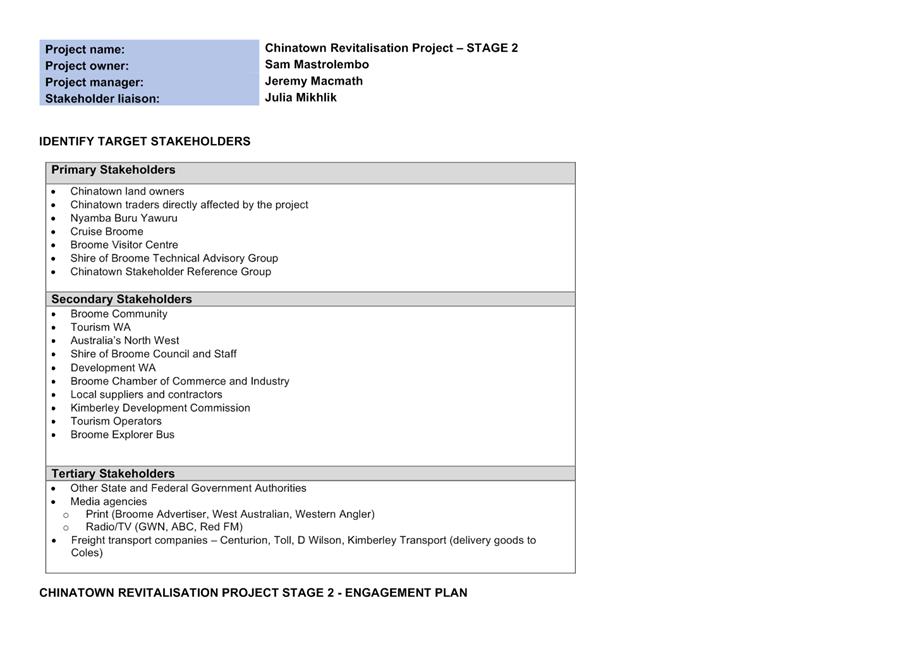
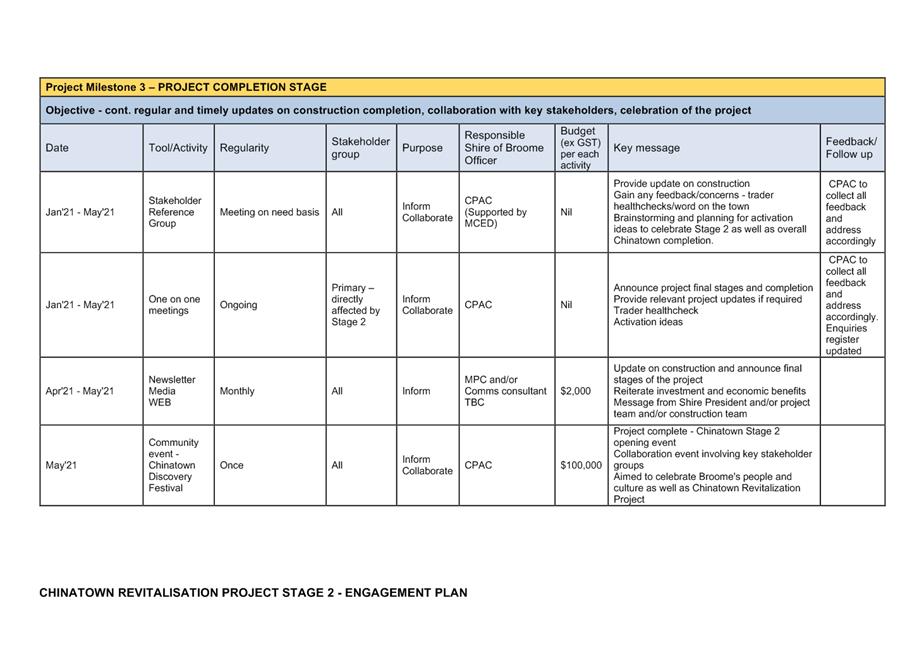
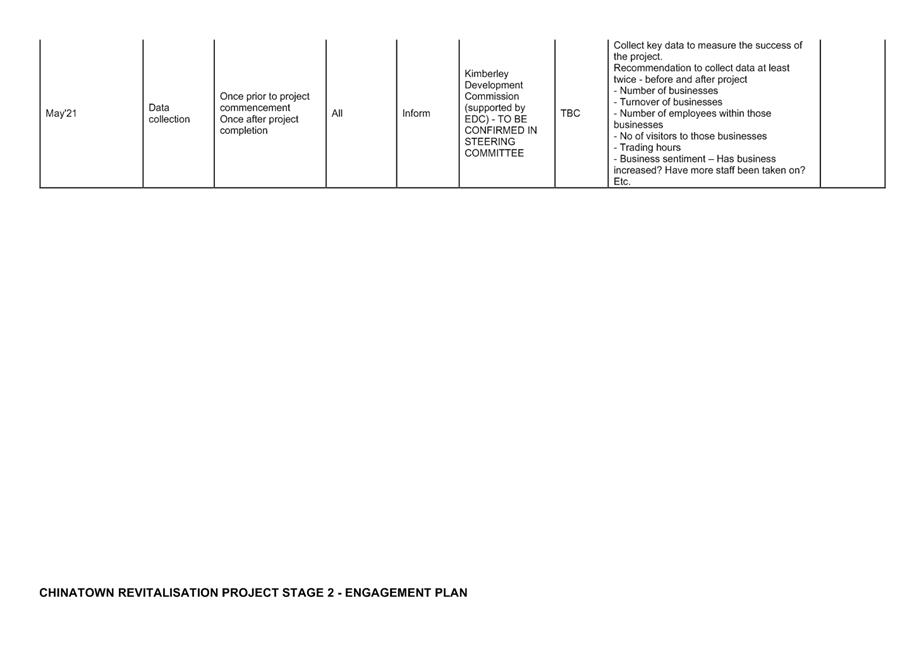
9.1.1 CHINATOWN REVITALISATION PROJECT STAGE 2 - ENGAGEMENT PLAN
9.1.2 ANNUAL ELECTORS MEETING HELD 12 DECEMBER 2019.
9.2.1 PROPOSED SERVICE COMMERCIAL STRUCTURE PLAN - LOT 3082 CABLE BEACH ROAD EAST
9.2.1 PROPOSED SERVICE COMMERCIAL STRUCTURE PLAN - LOT 3082 CABLE BEACH ROAD EAST
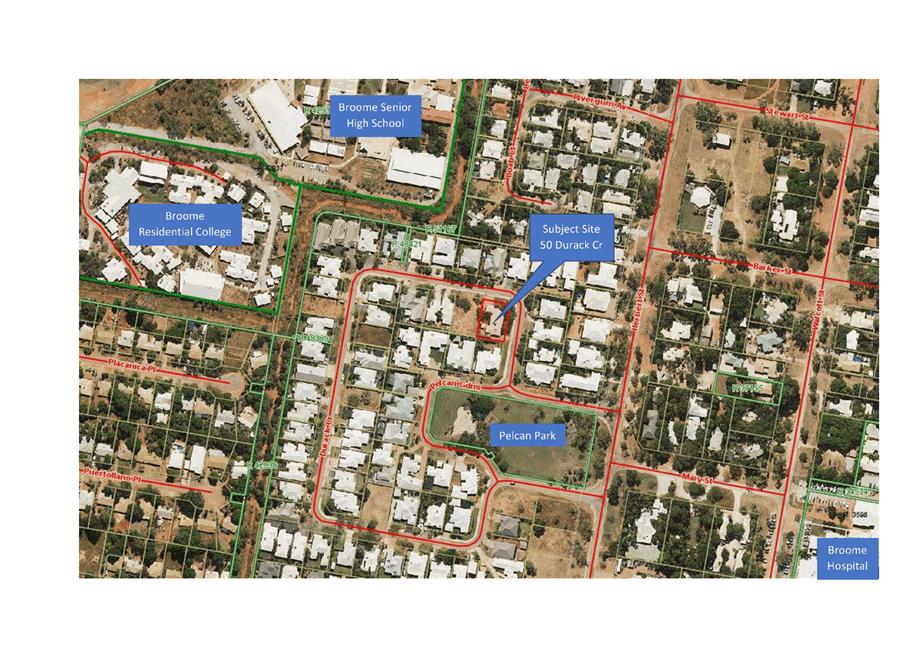
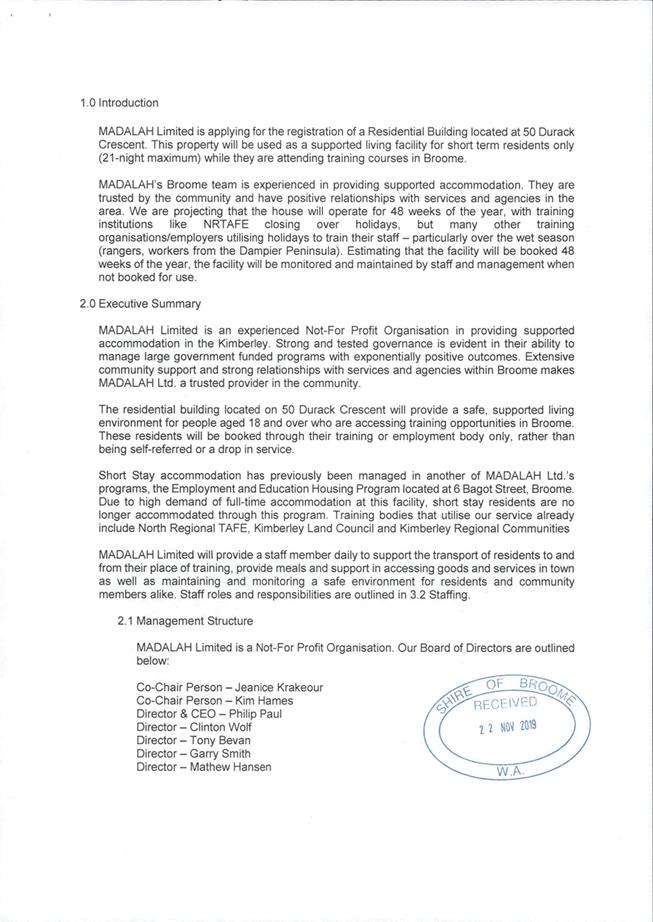
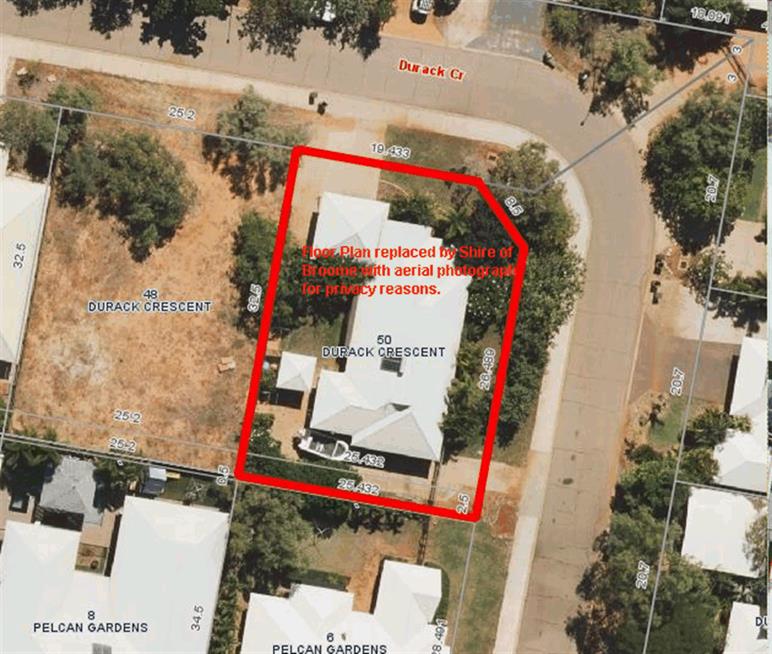
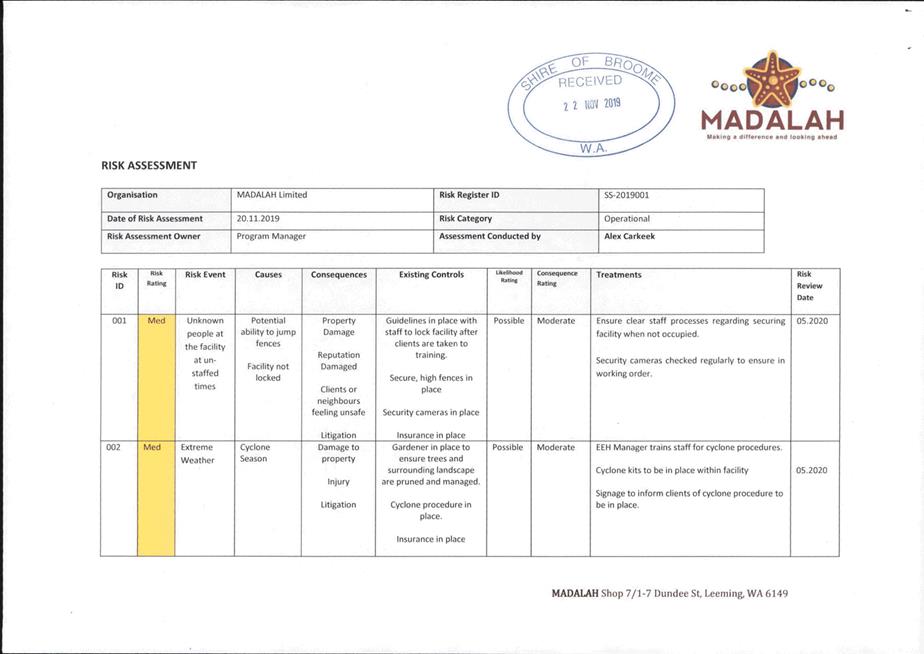
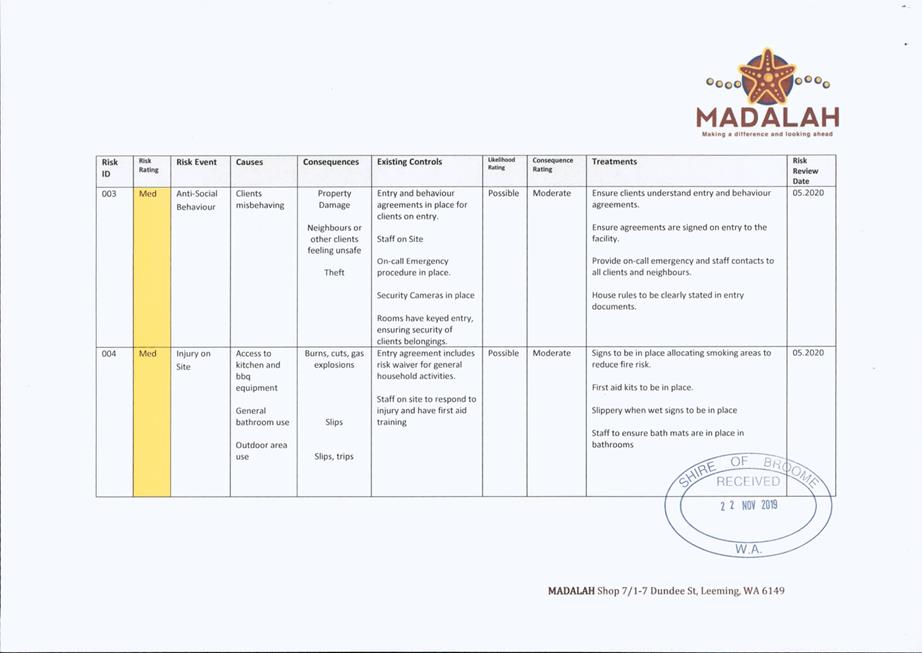
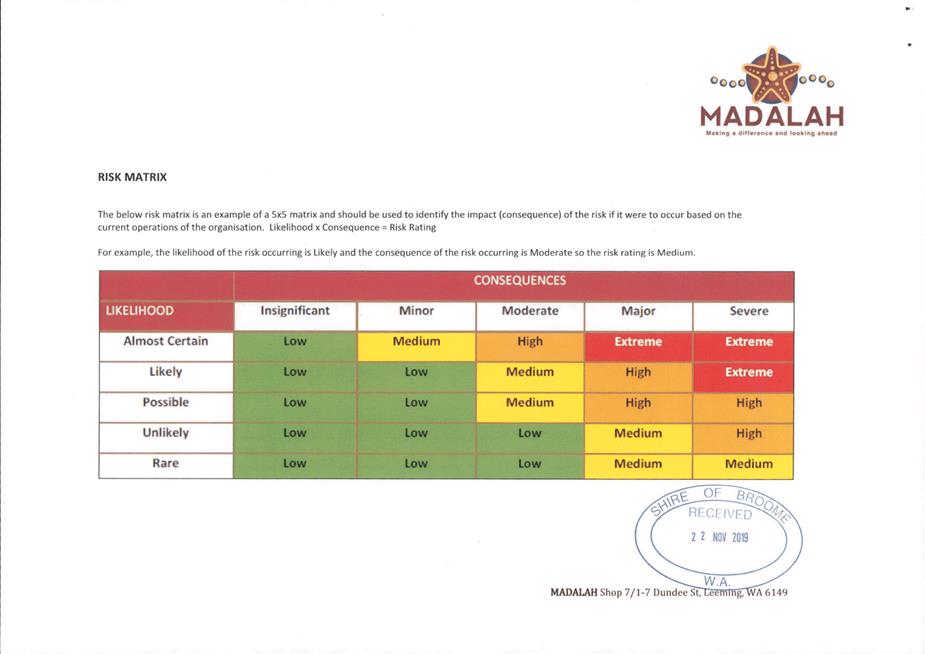
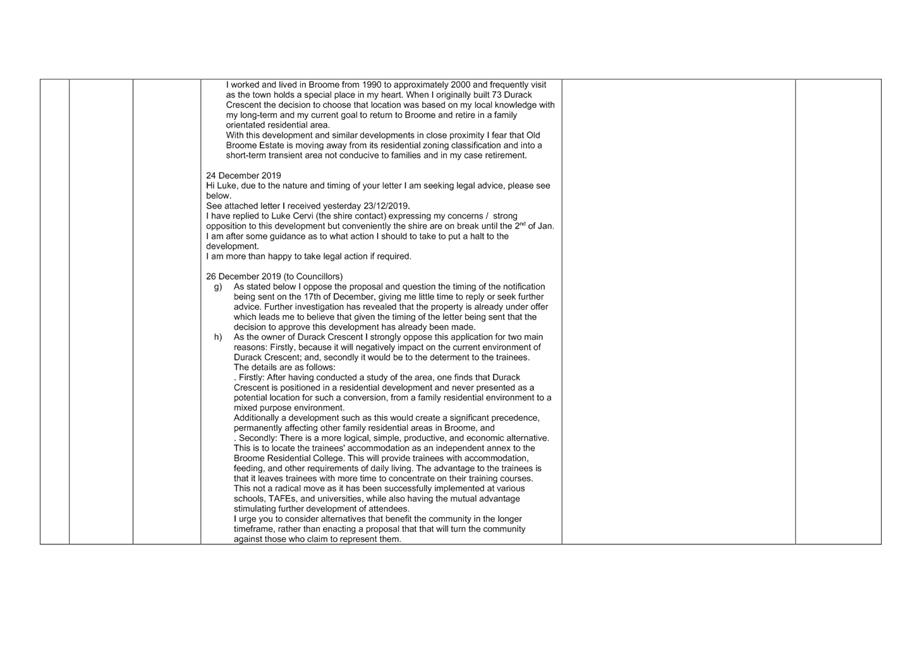
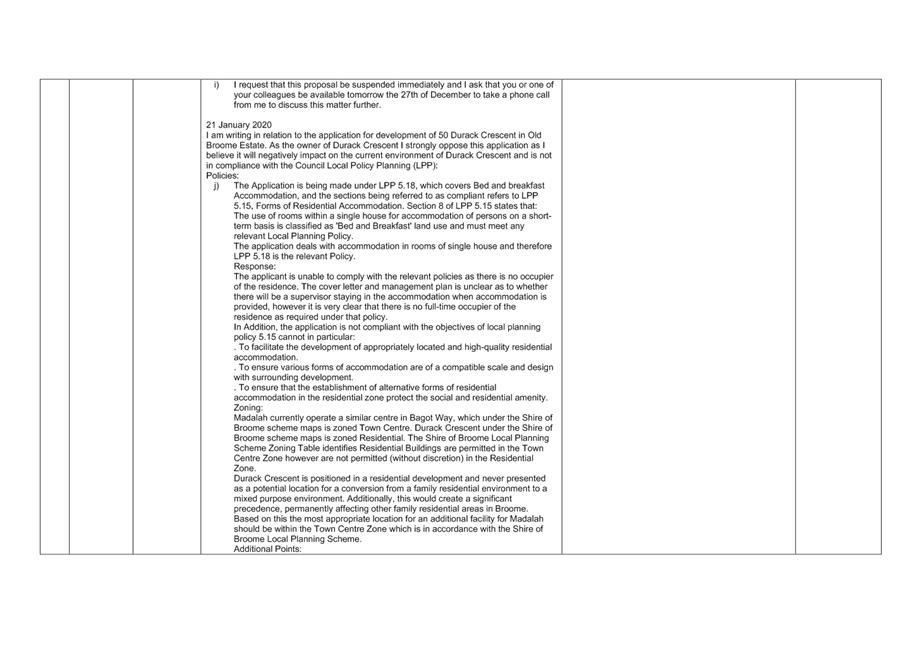
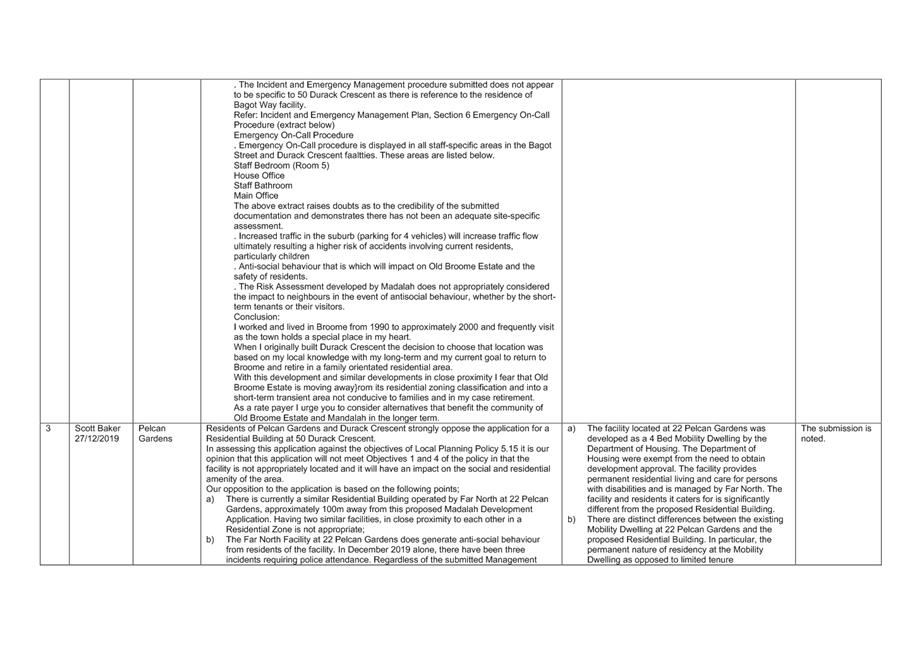
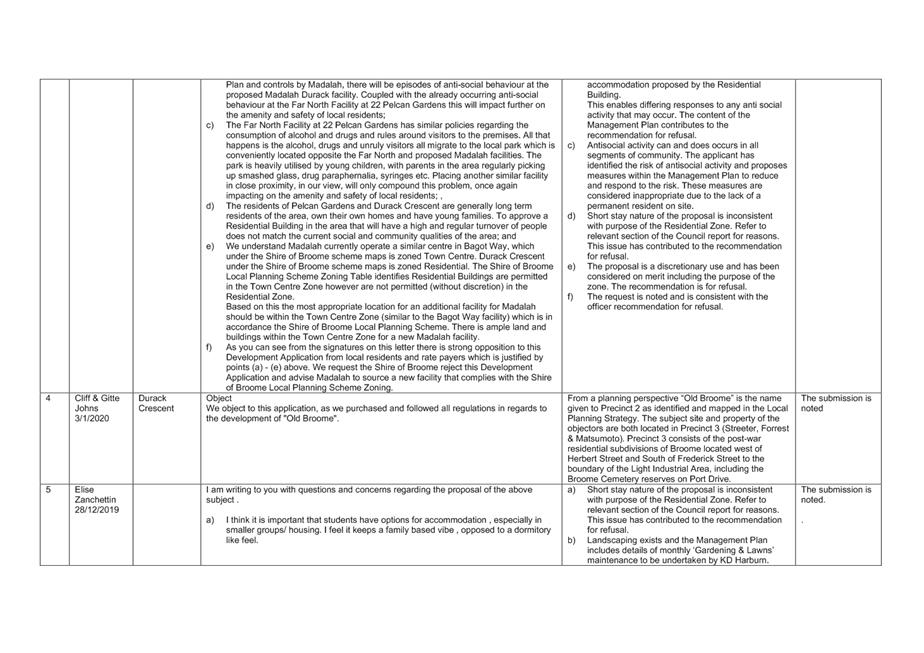
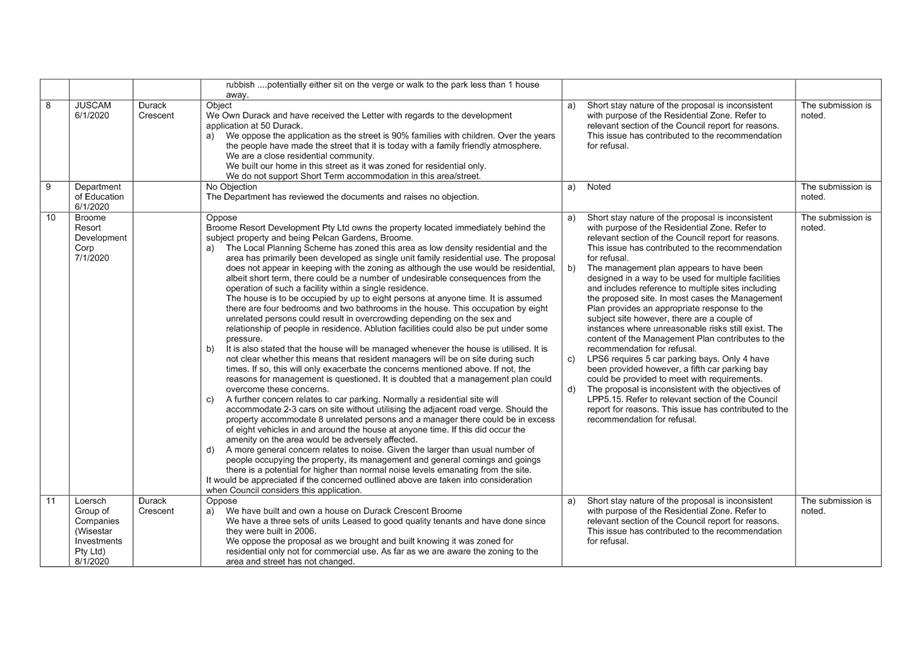
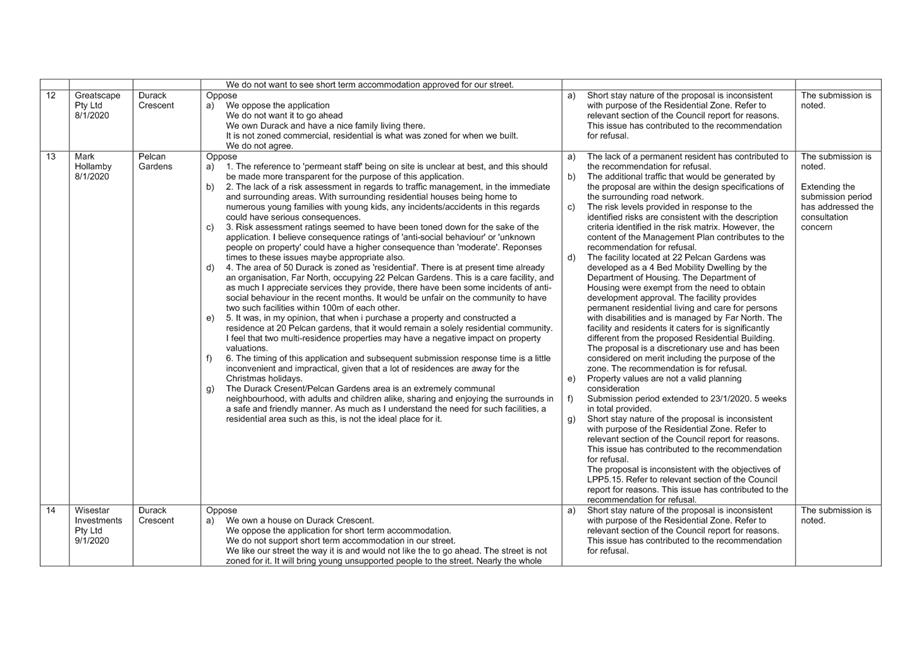
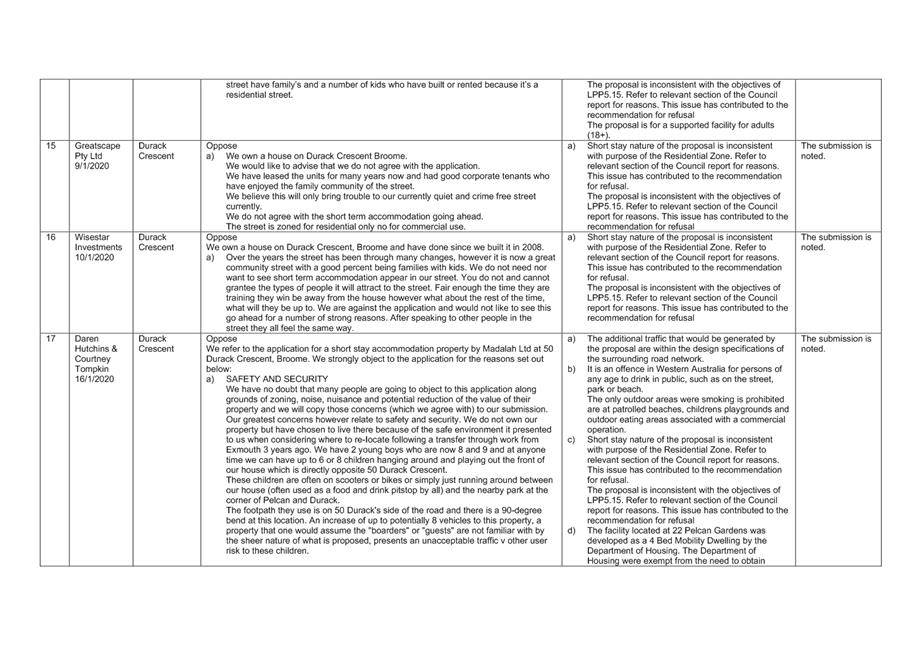
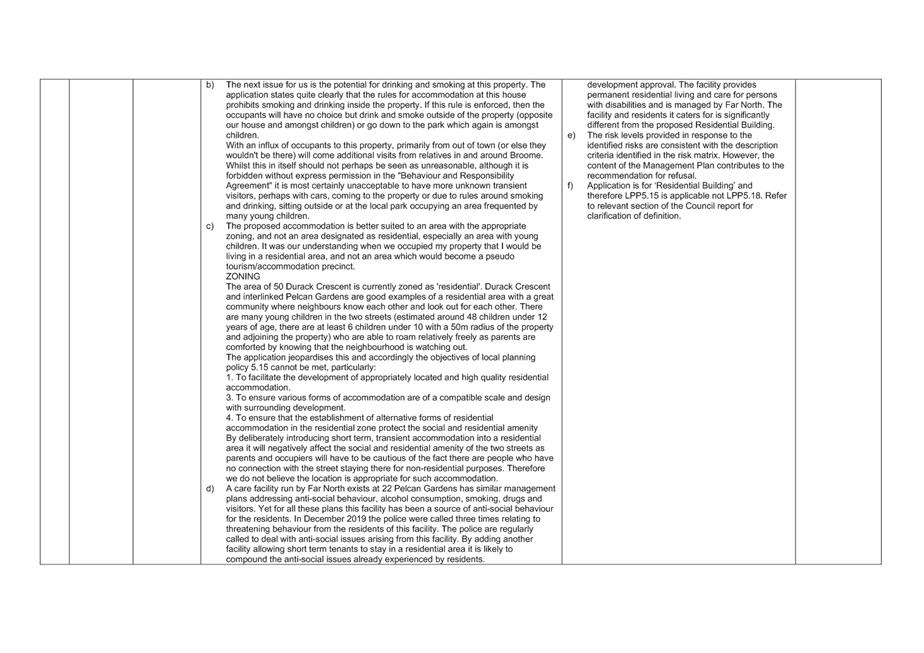
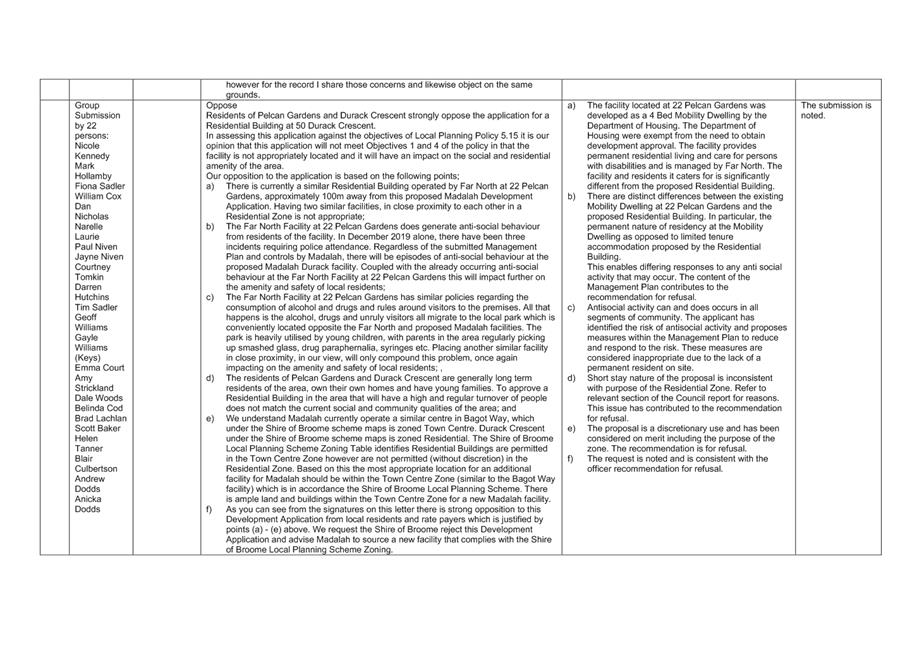
9.2.2 DEVELOPMENT APPLICATION 2019/97 - RESIDENTIAL BUILDING - 50 DURACK CRESCENT, BROOME
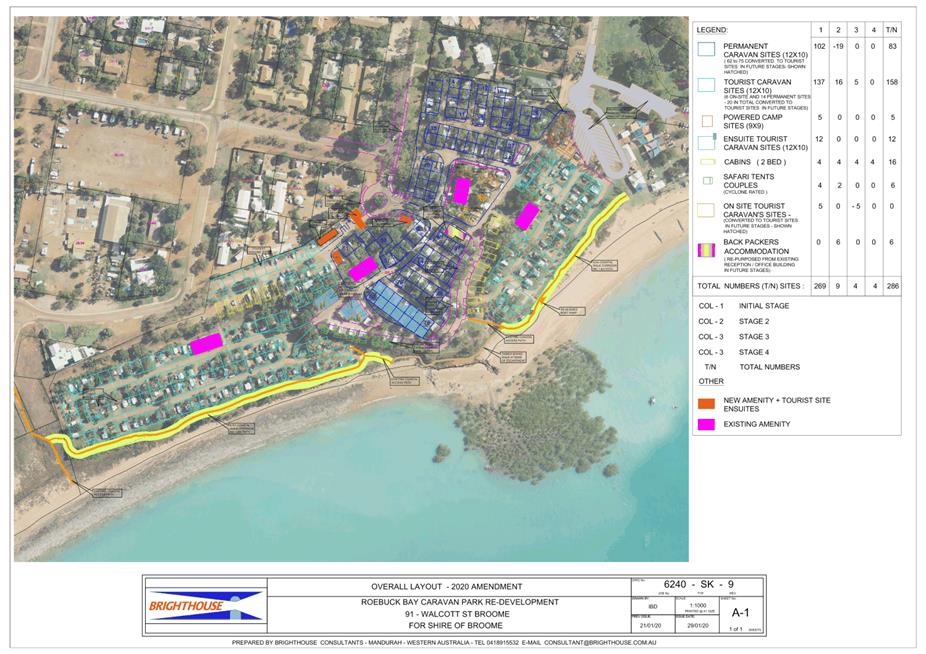
9.2.3 MAJOR LAND TRANSACTION - BUSINESS PLAN (ROEBUCK BAY CARAVAN PARK AND TOWN BEACH CAFE)
9.2.5 REPORT OF REVIEW - SHIRE OF BROOME LOCAL PLANNING STRATEGY AND LOCAL PLANNING SCHEME NO 6
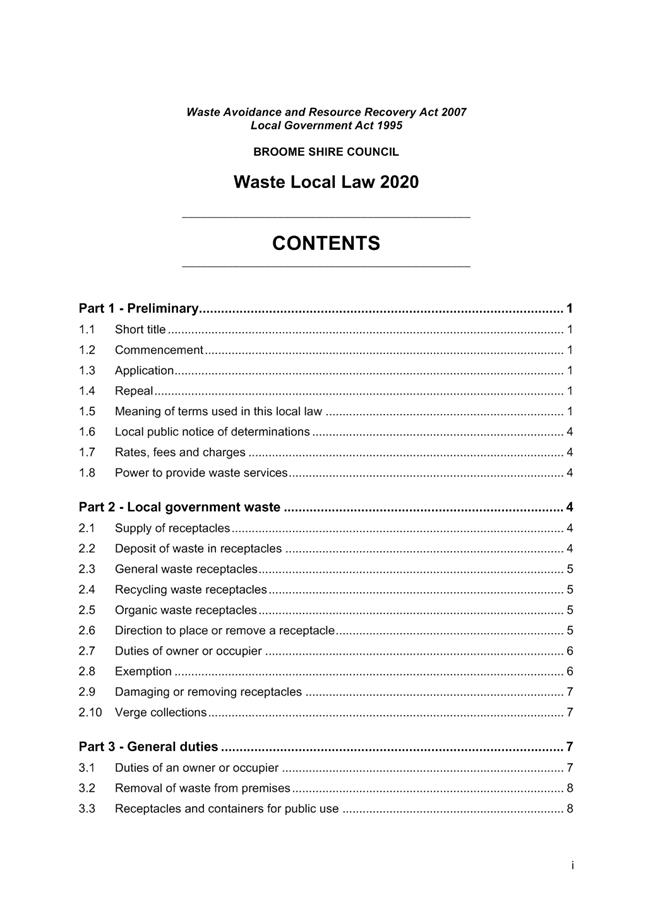
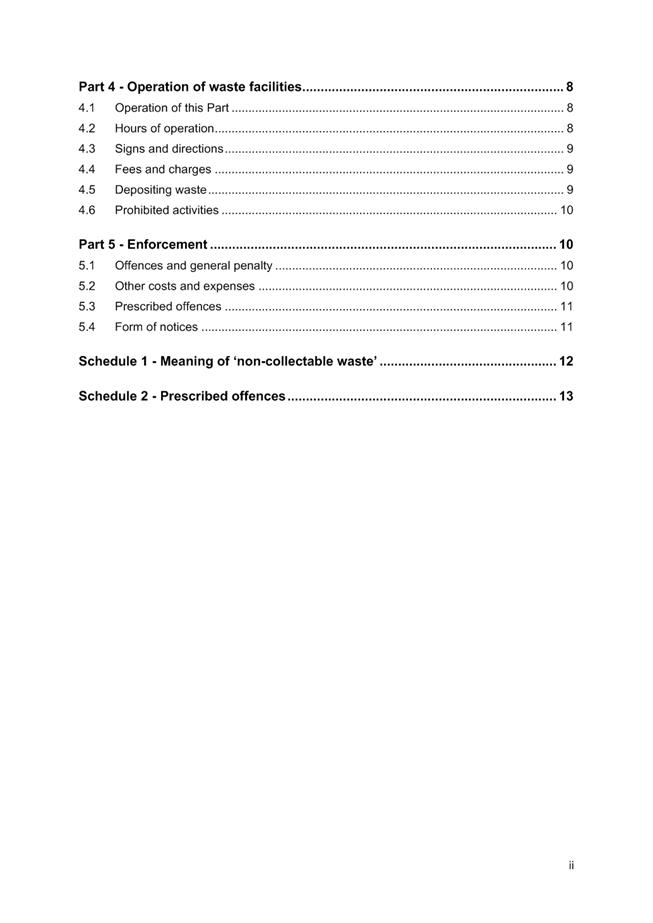
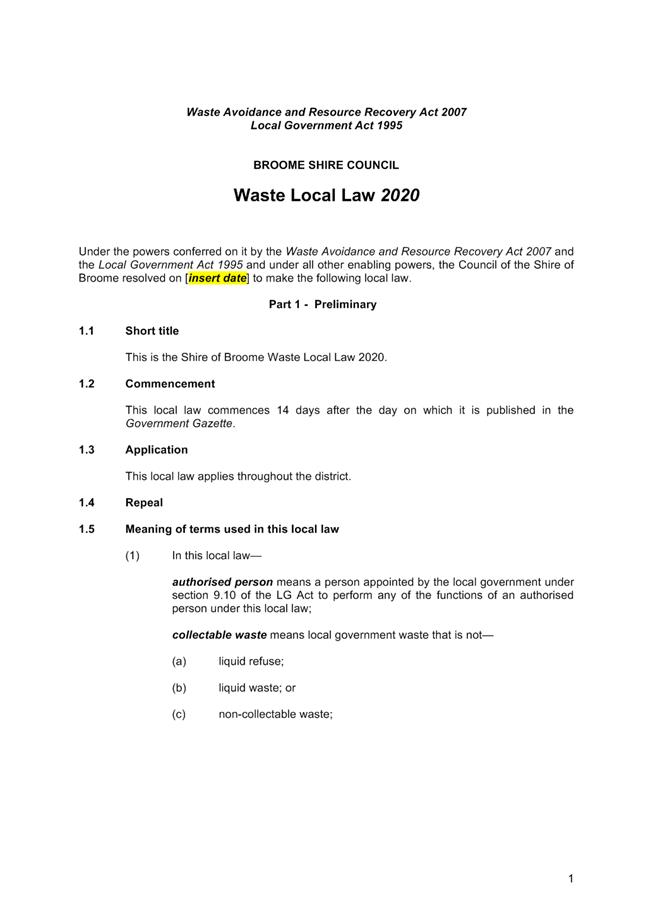
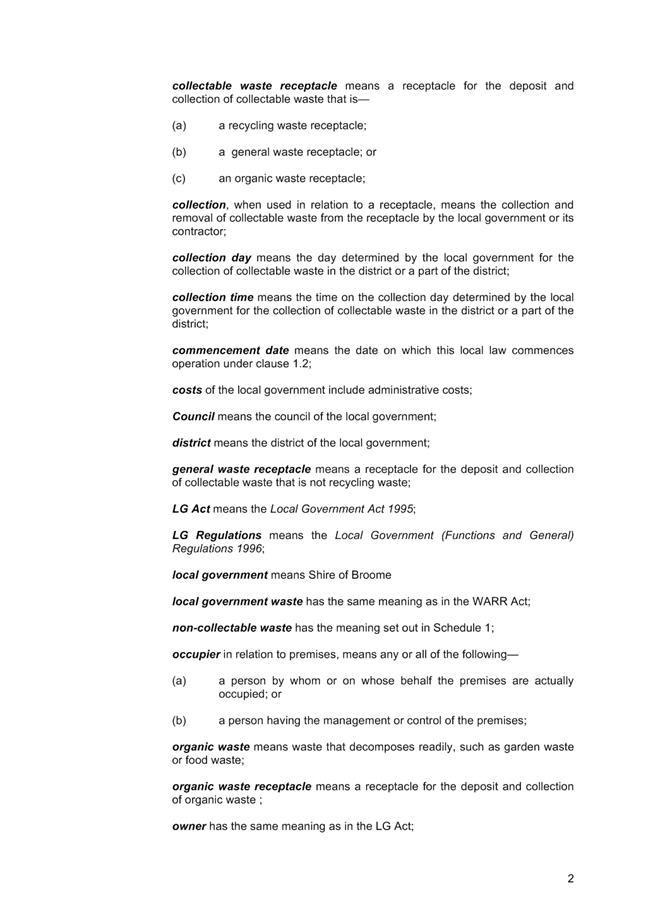
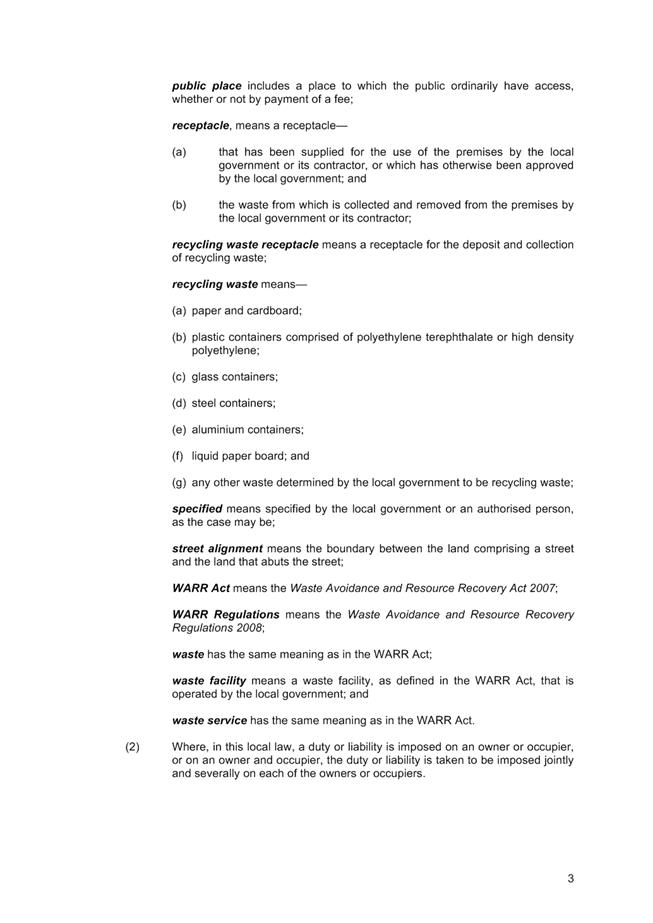
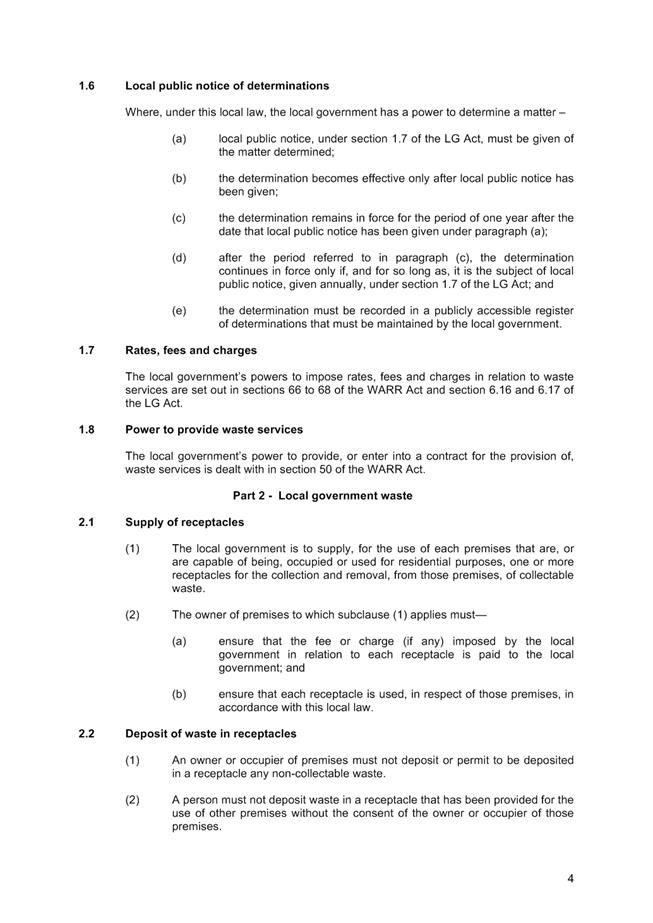
9.2.6 PROPOSED NEW WASTE LOCAL LAW 2020
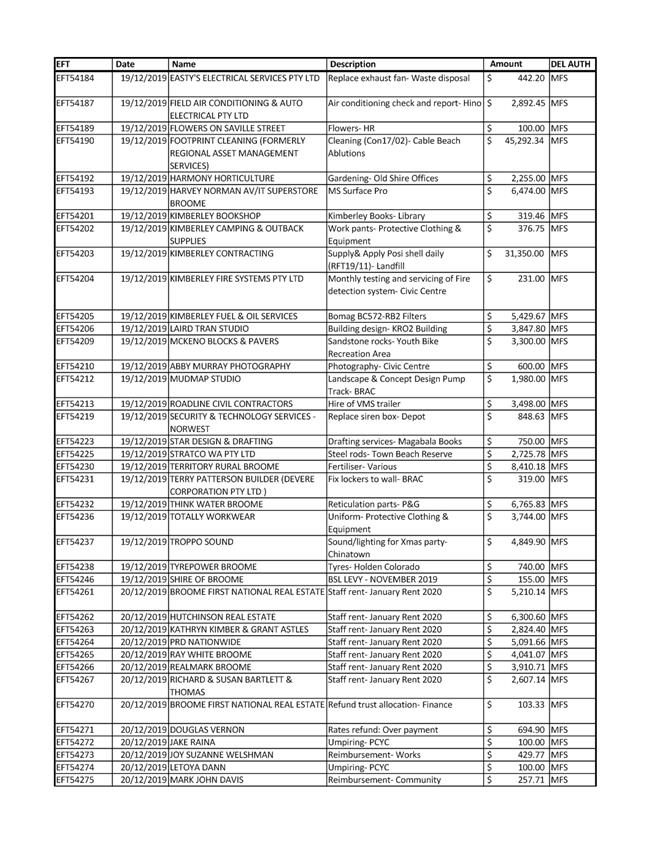
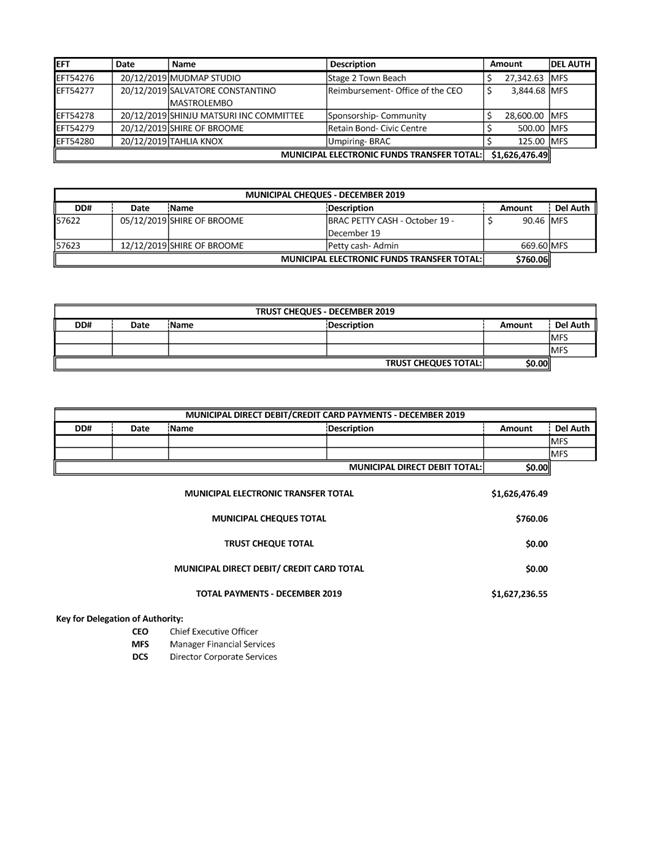
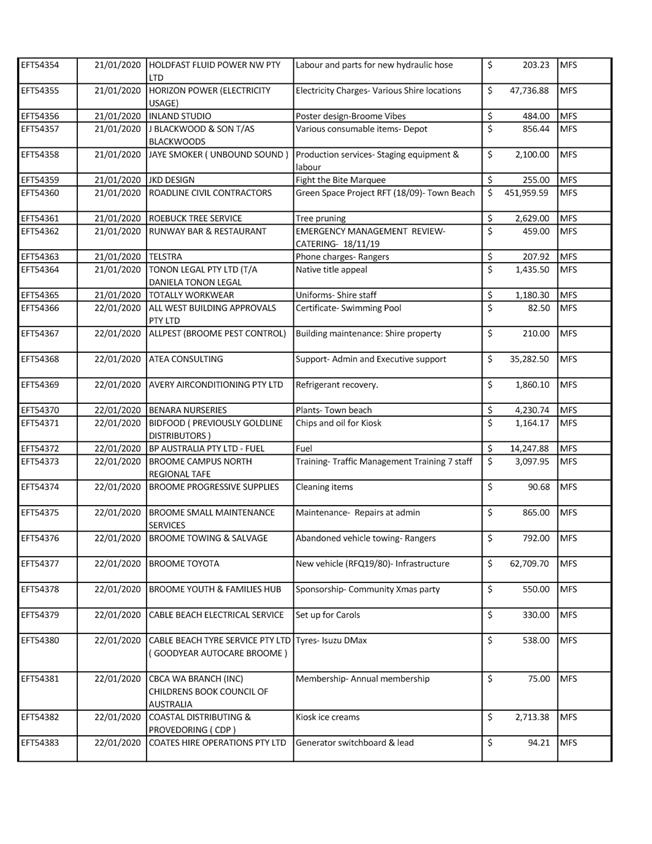
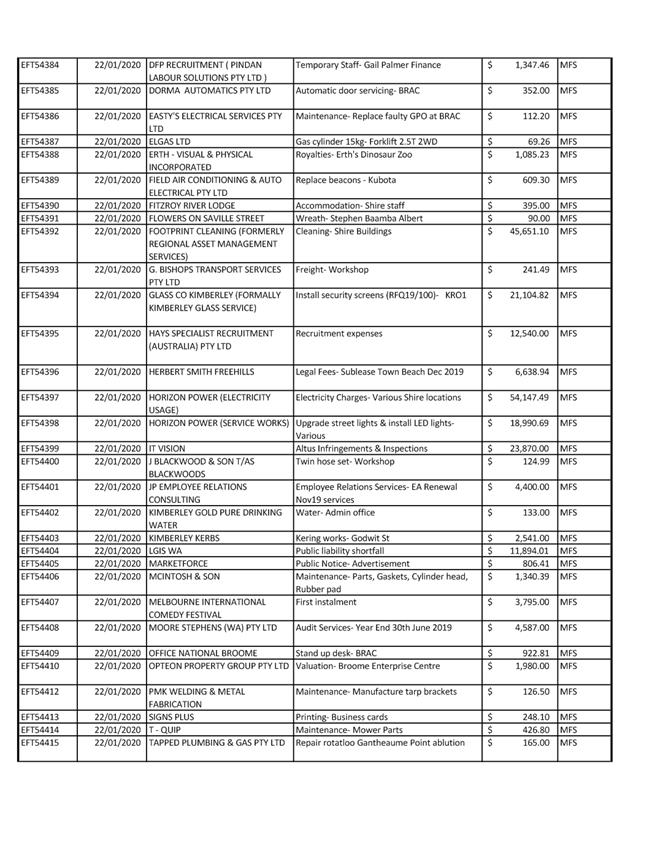
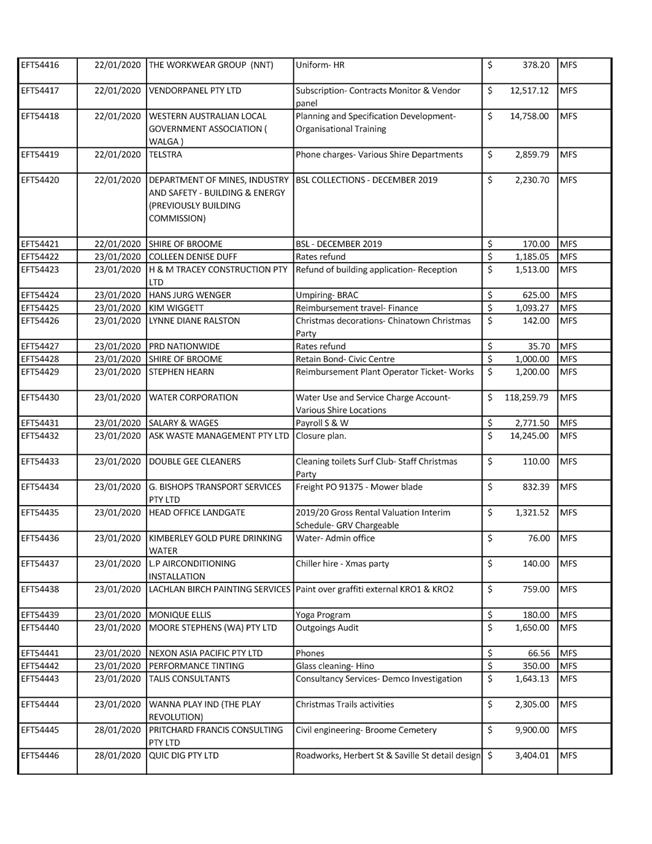
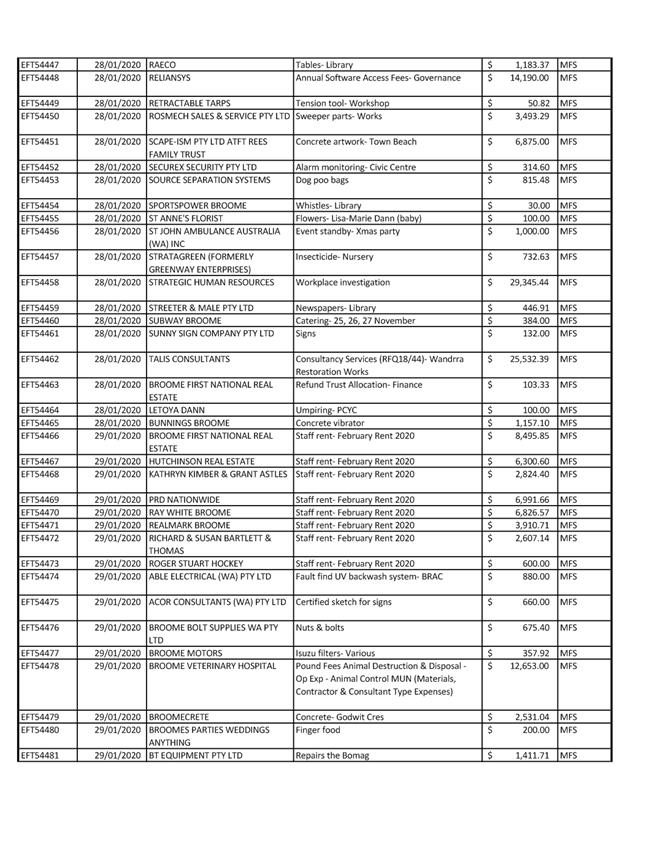
9.4.1 MONTHLY PAYMENT LISTING - DECEMBER 2019
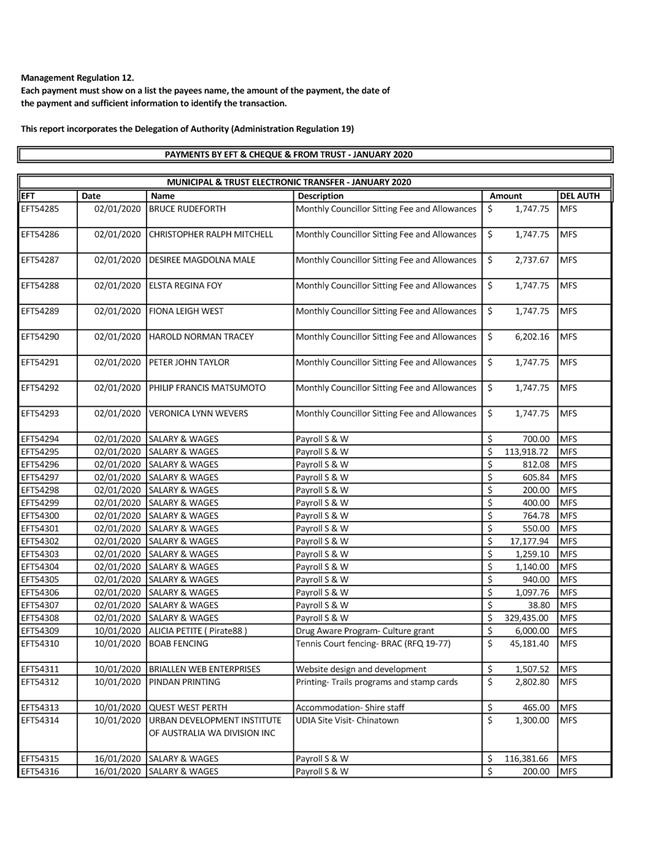
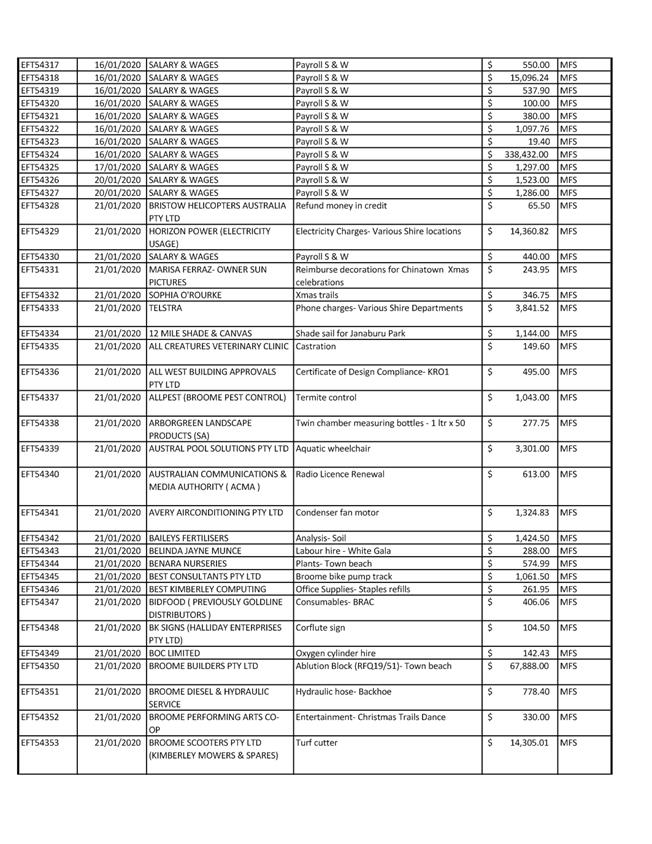
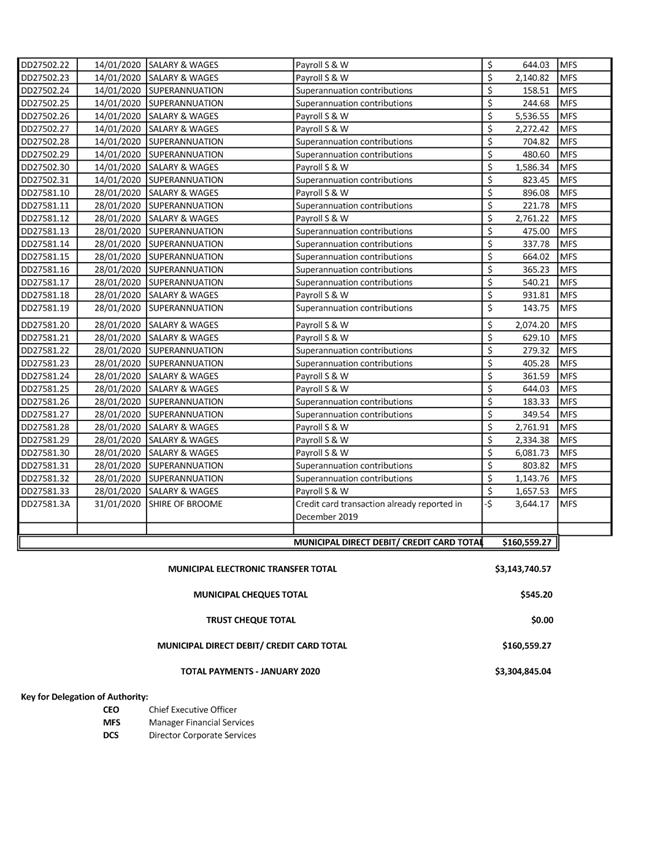
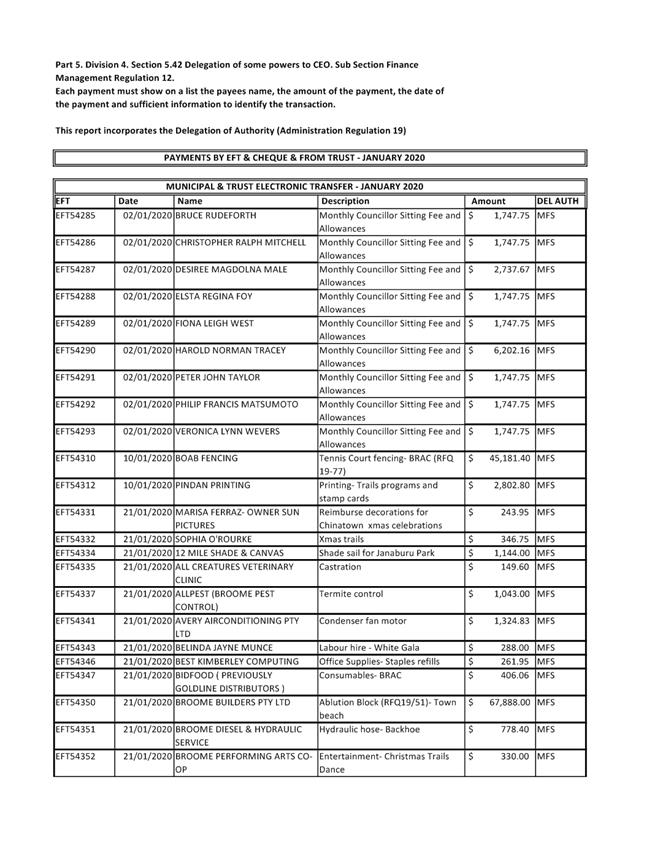
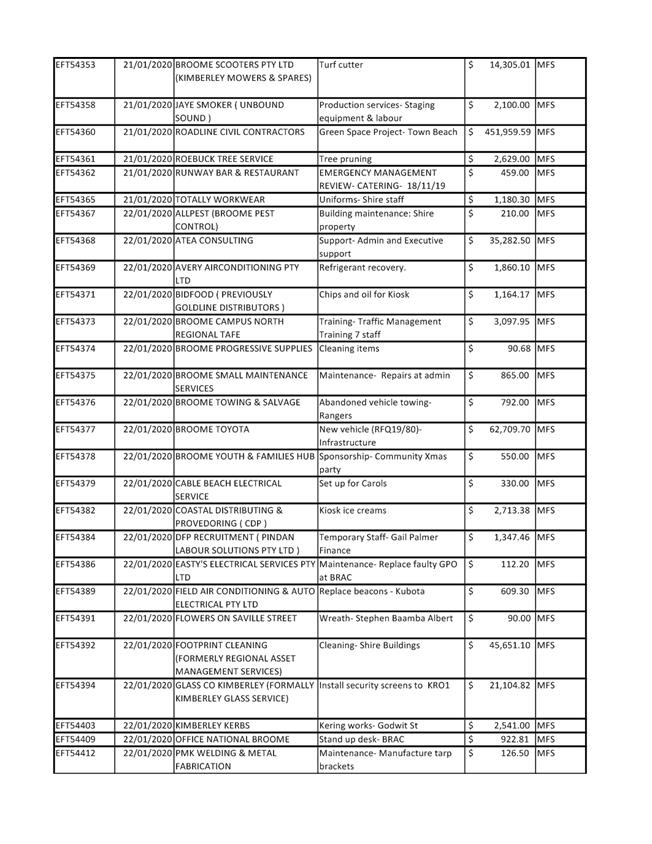
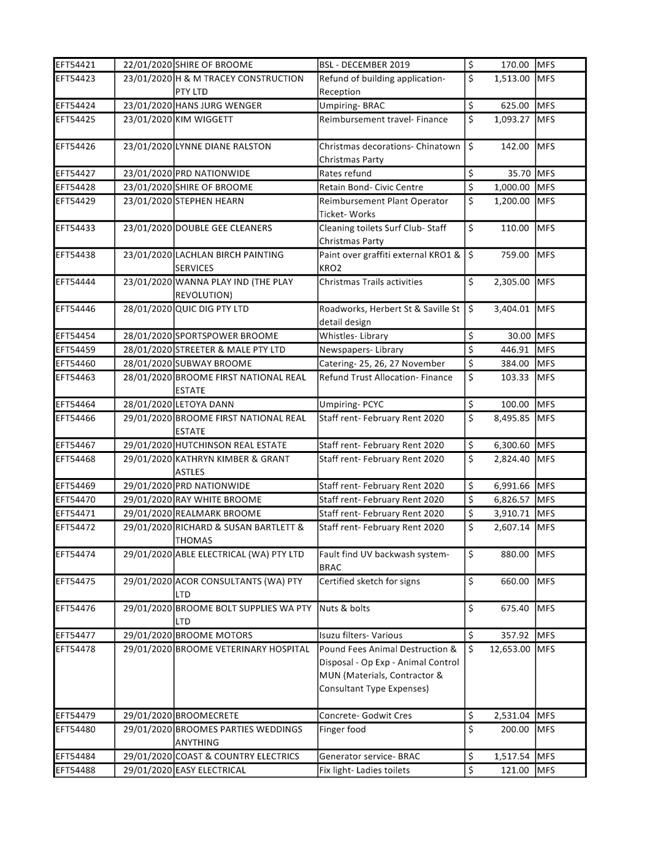
9.4.2 MONTHLY PAYMENT LISTING - JANUARY 2020
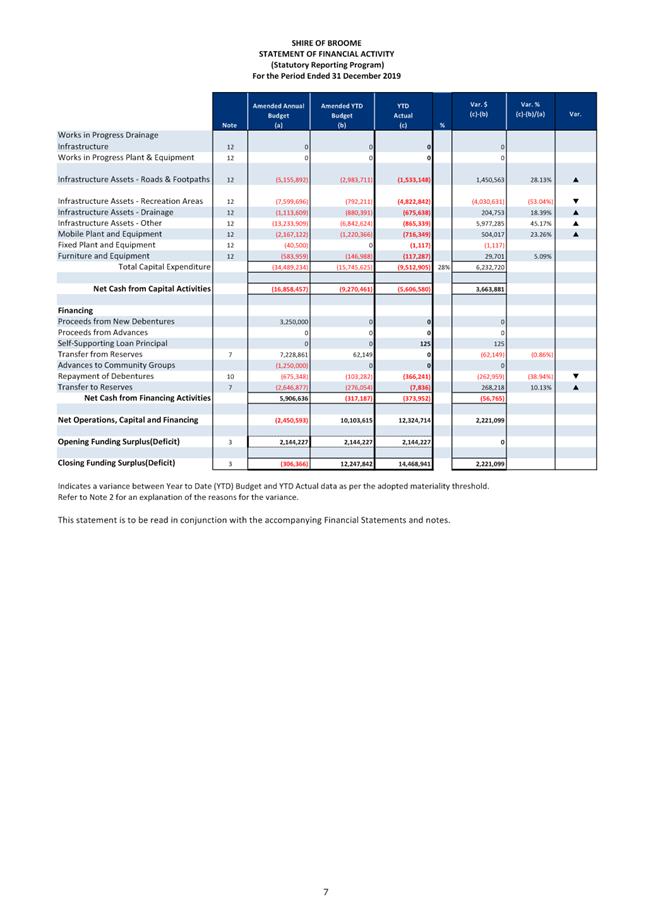
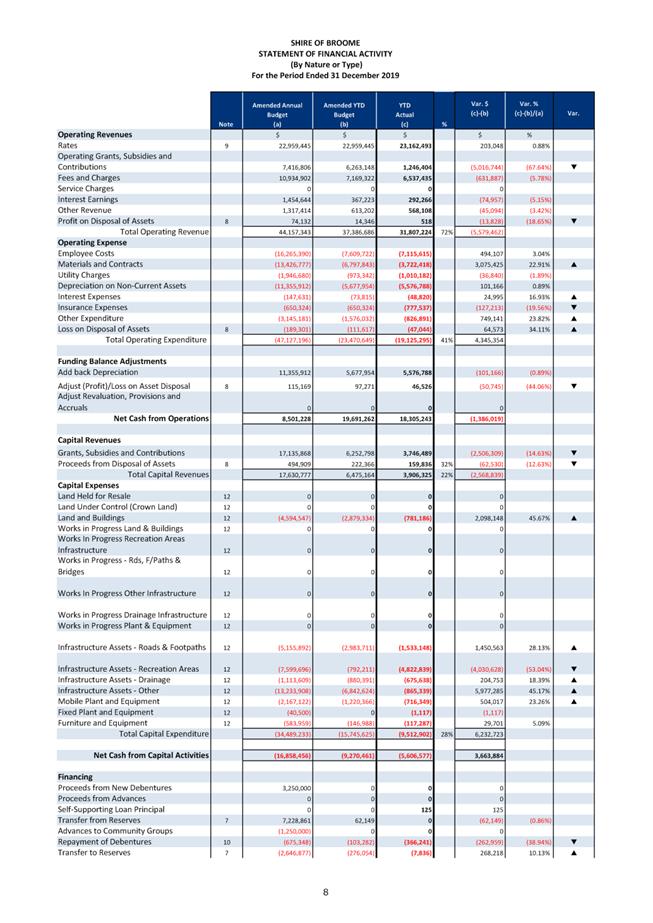
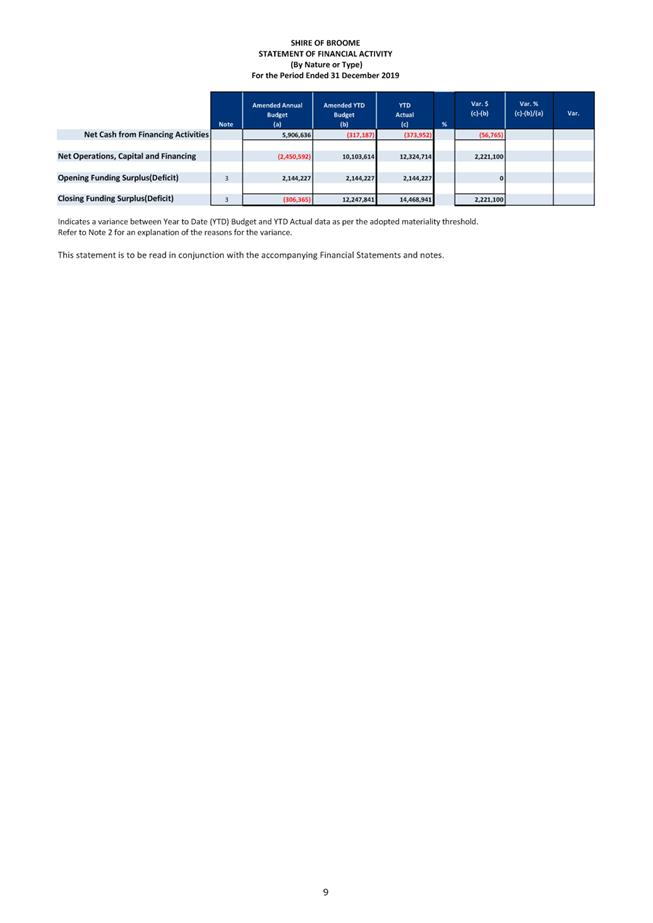
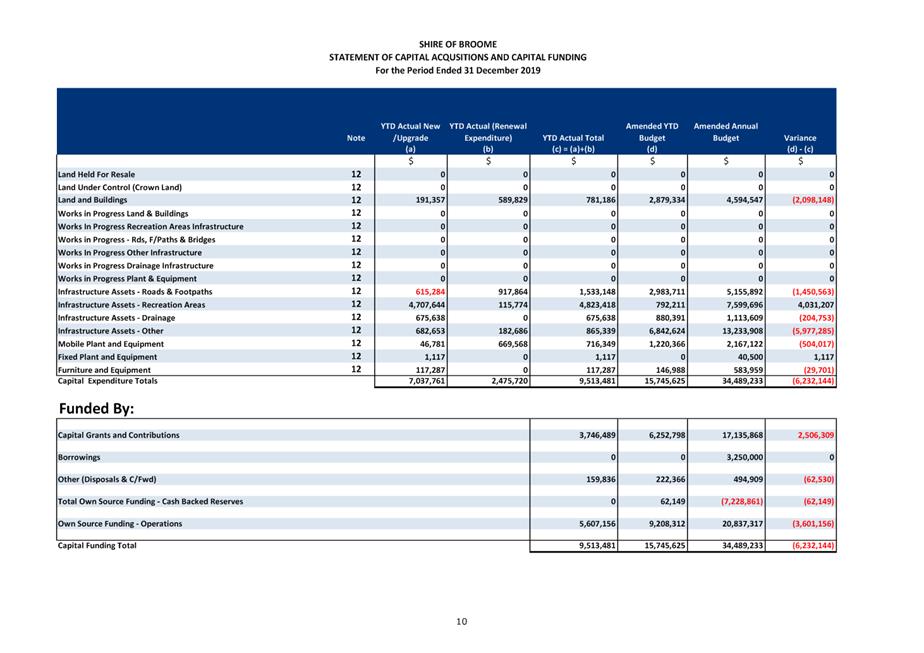
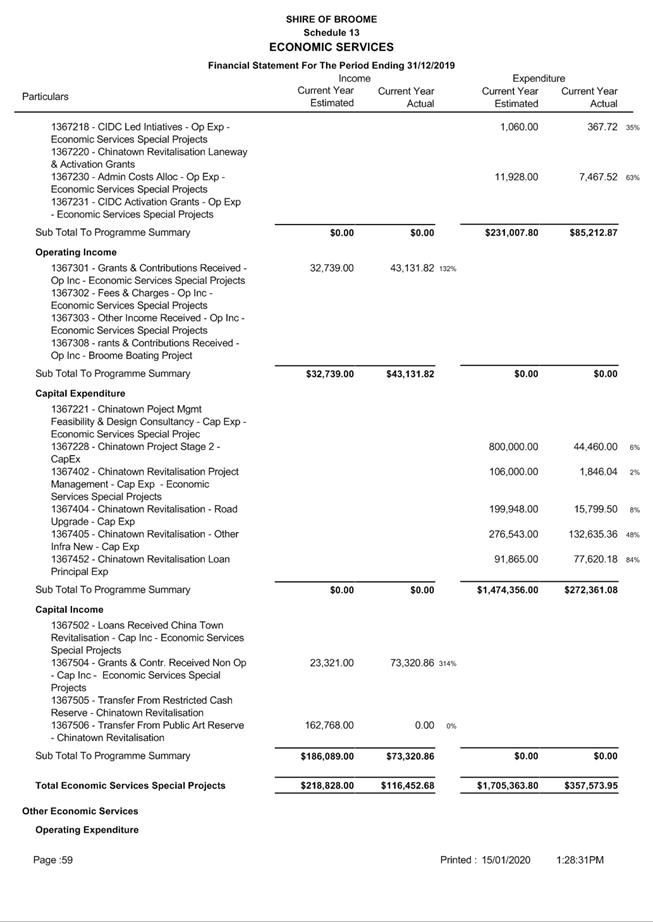
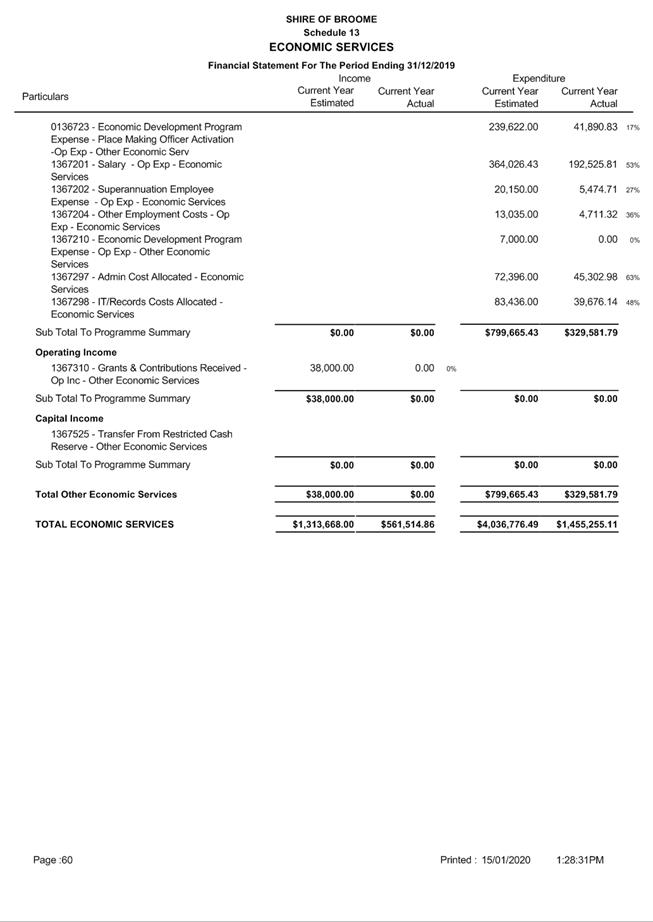
9.4.3 MONTHLY STATEMENT OF FINANCIAL ACTIVITY REPORT DECEMBER 2019
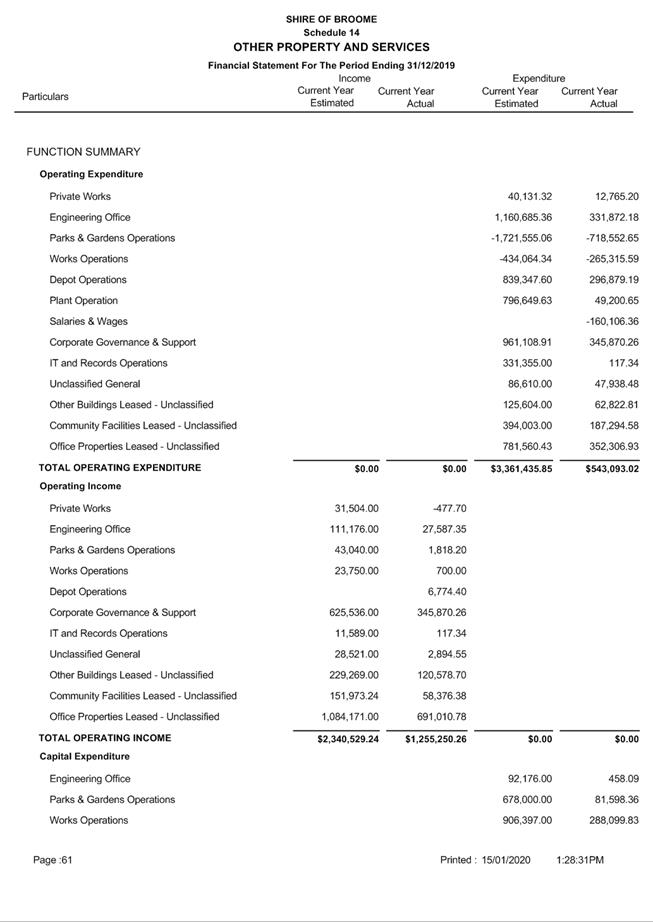
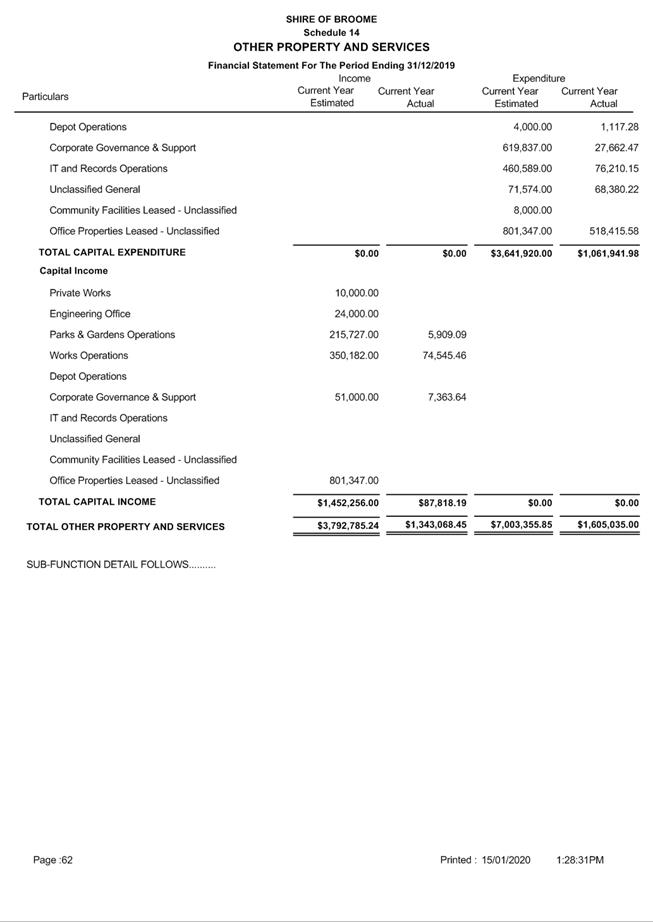
9.4.4 MONTHLY STATEMENT OF FINANCIAL ACTIVITY REPORT JANUARY 2020
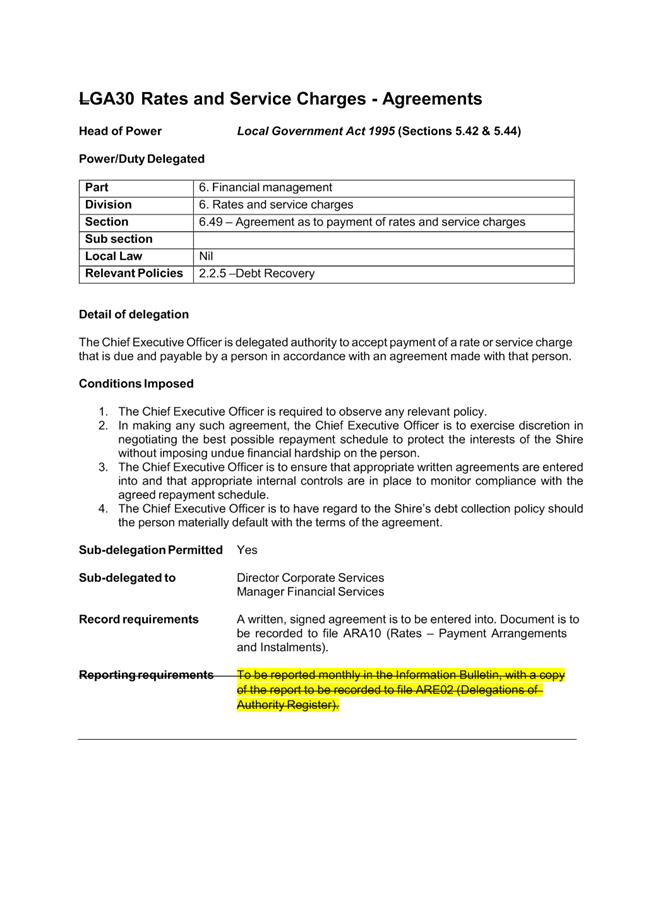
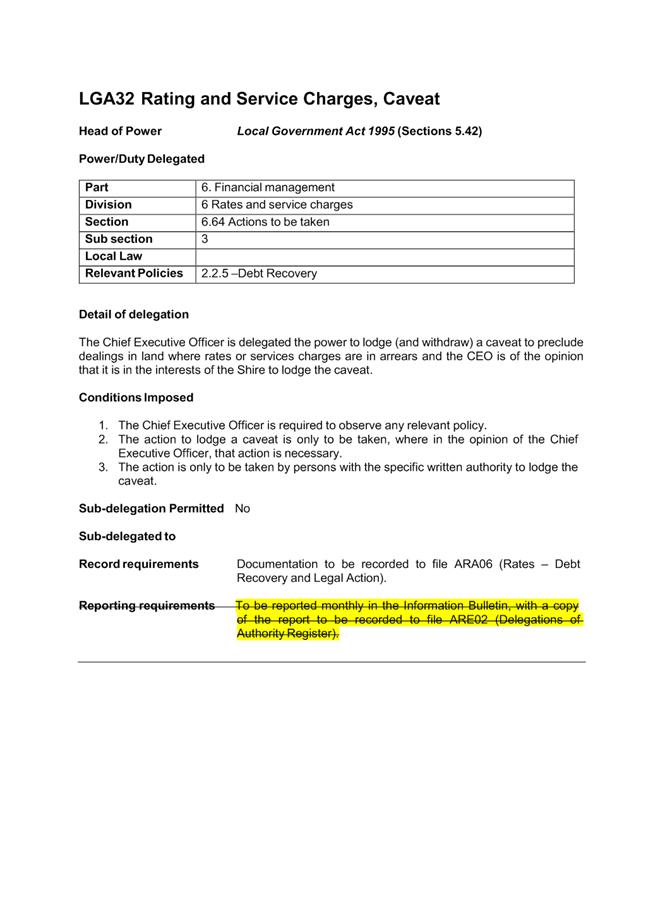
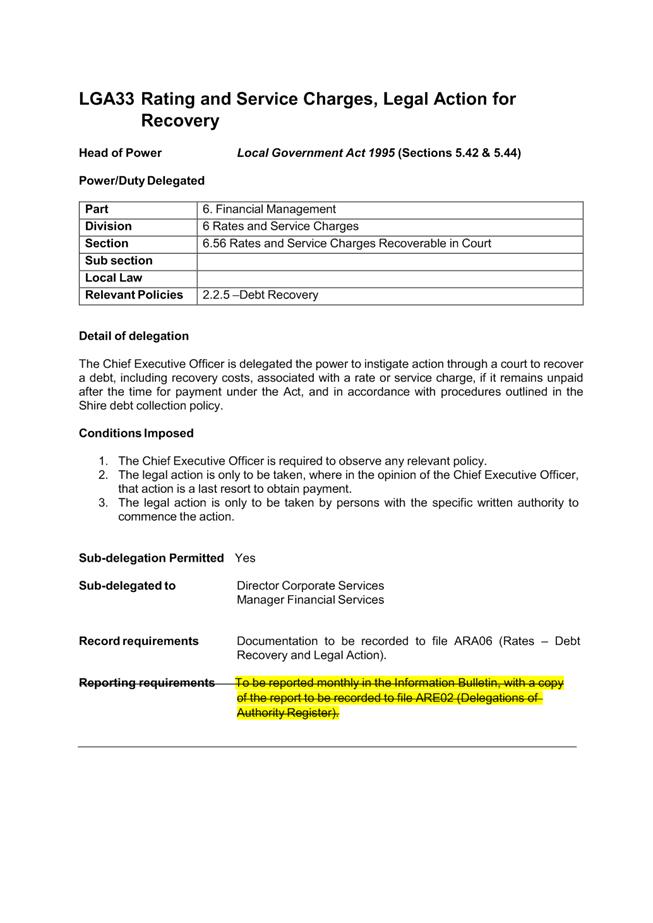
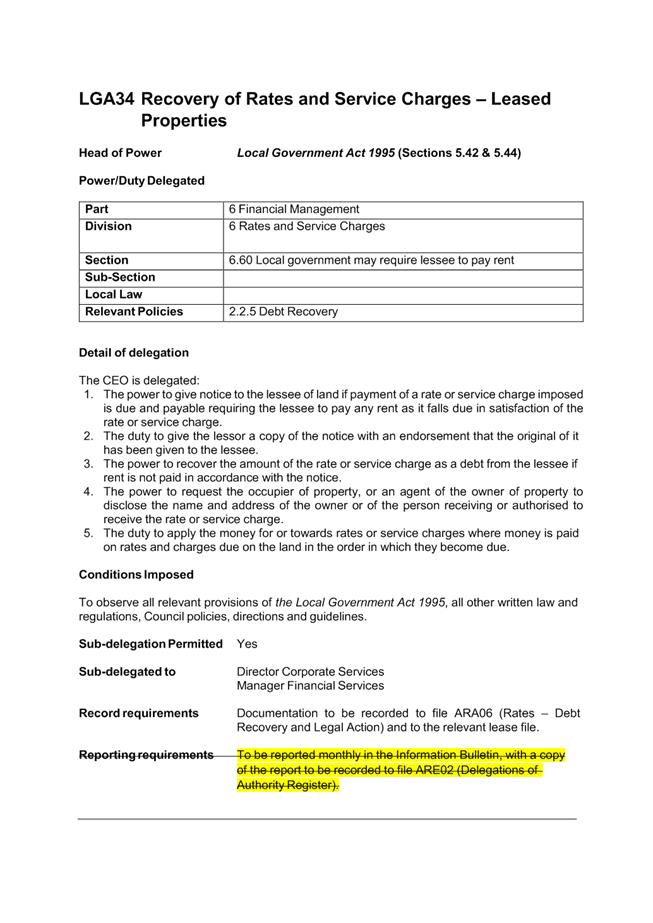
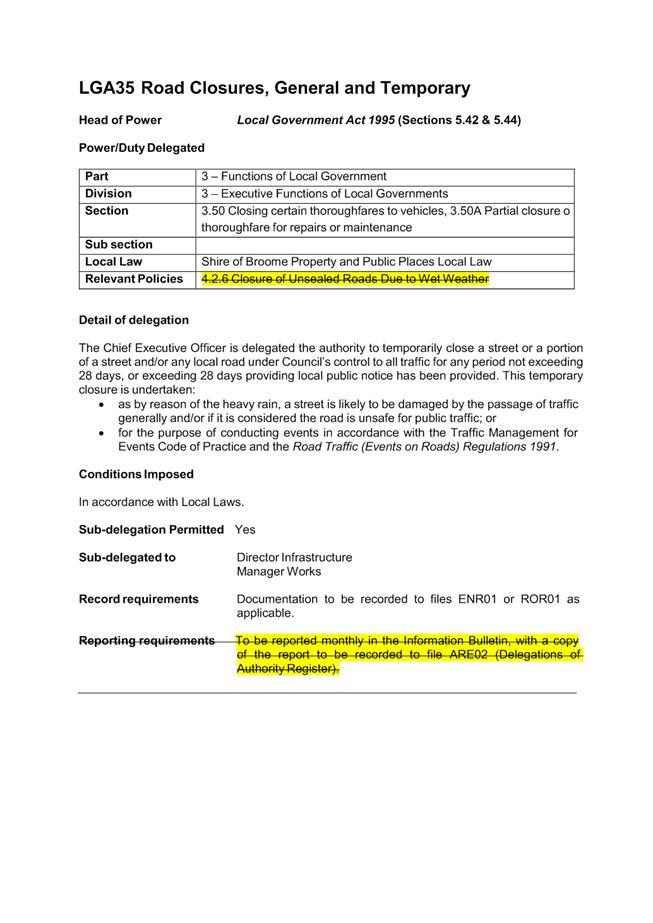
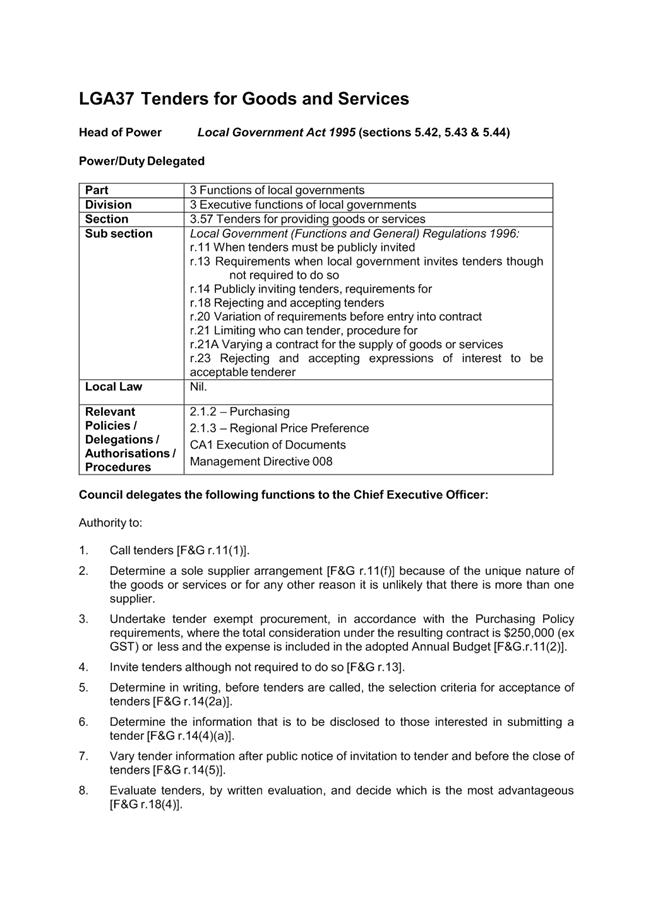
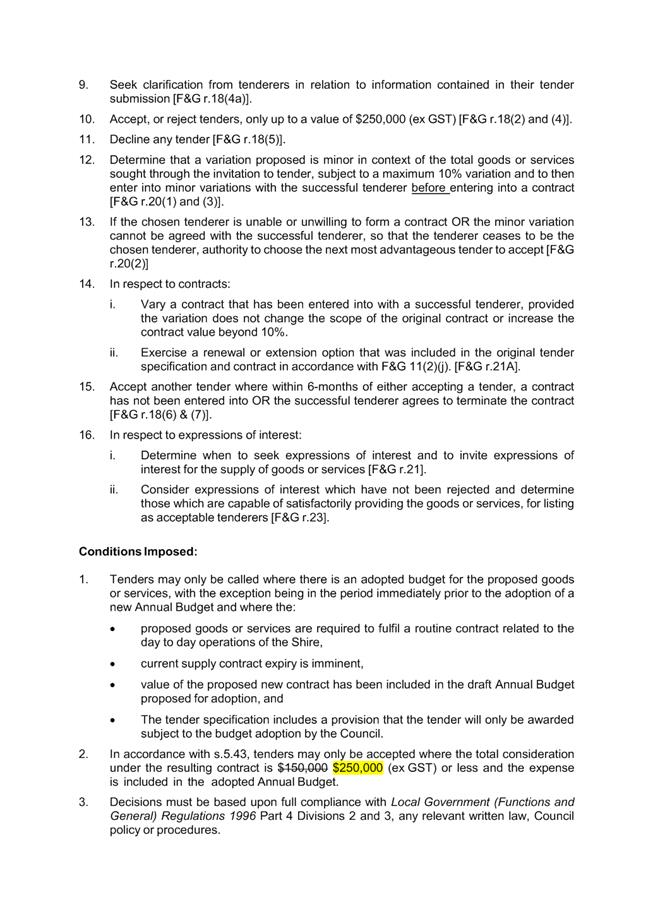
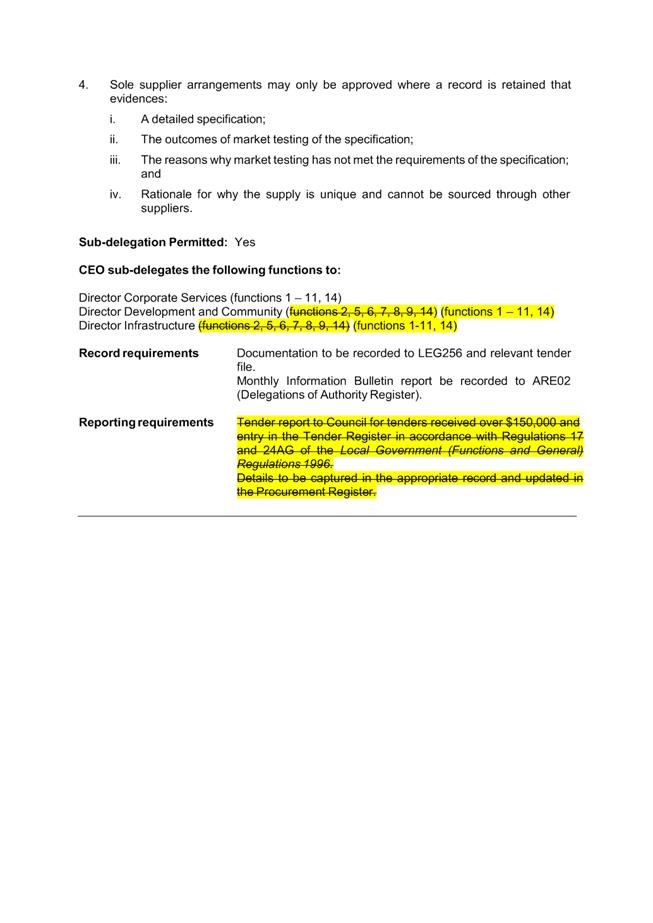
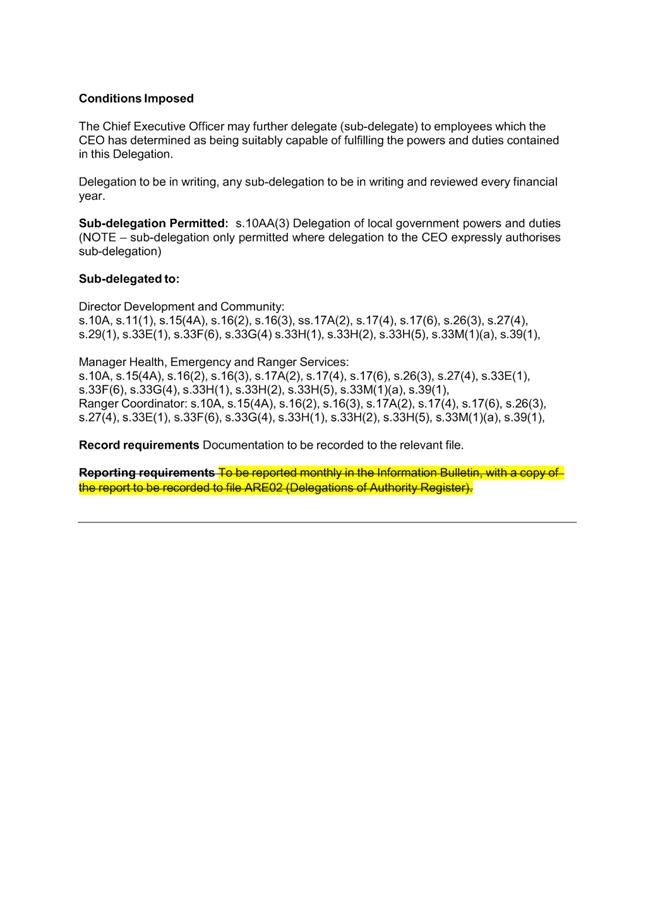
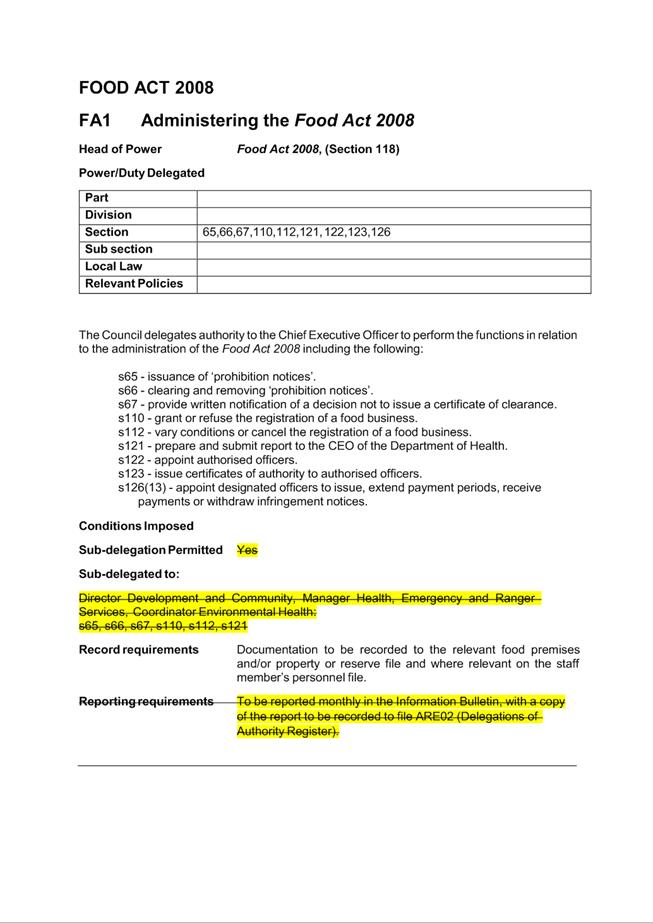
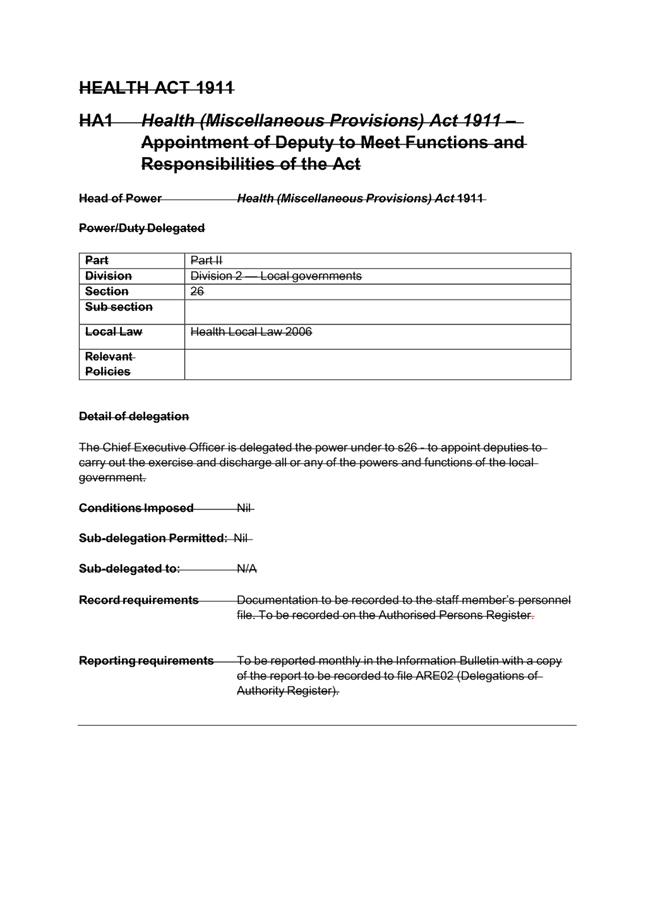
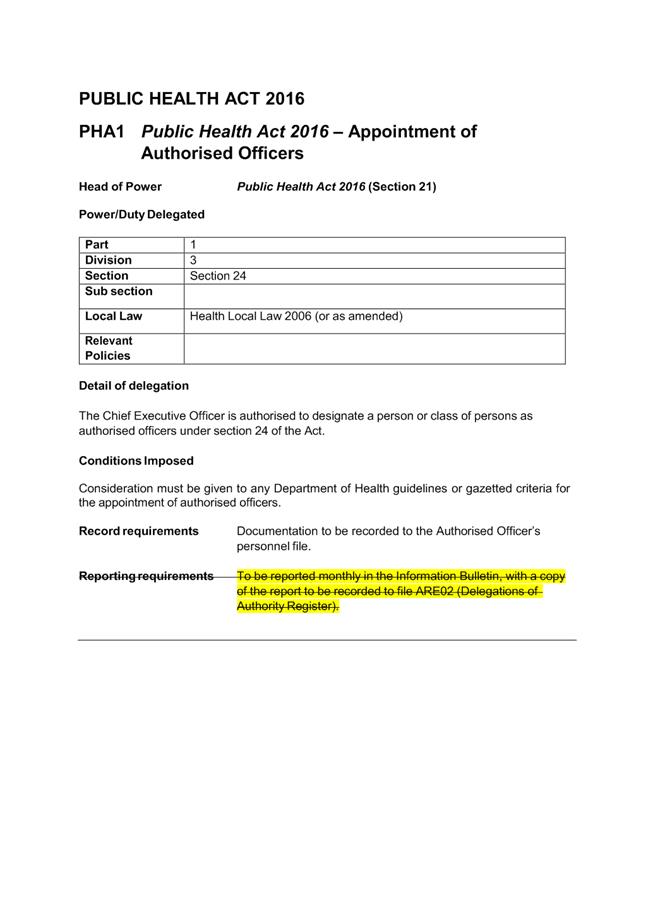
9.4.5 REVIEW OF DELEGATIONS OF AUTHORITY
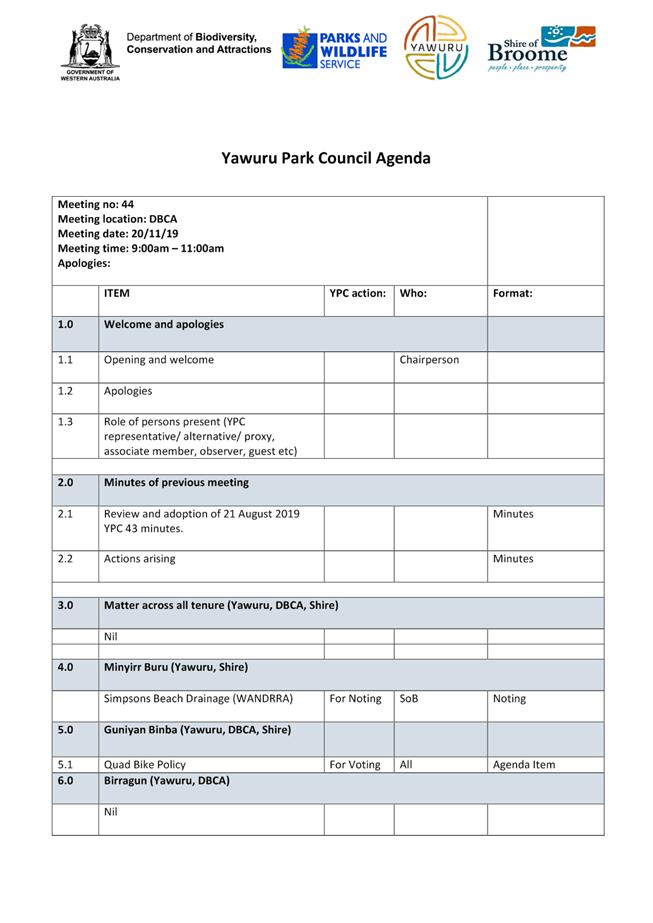
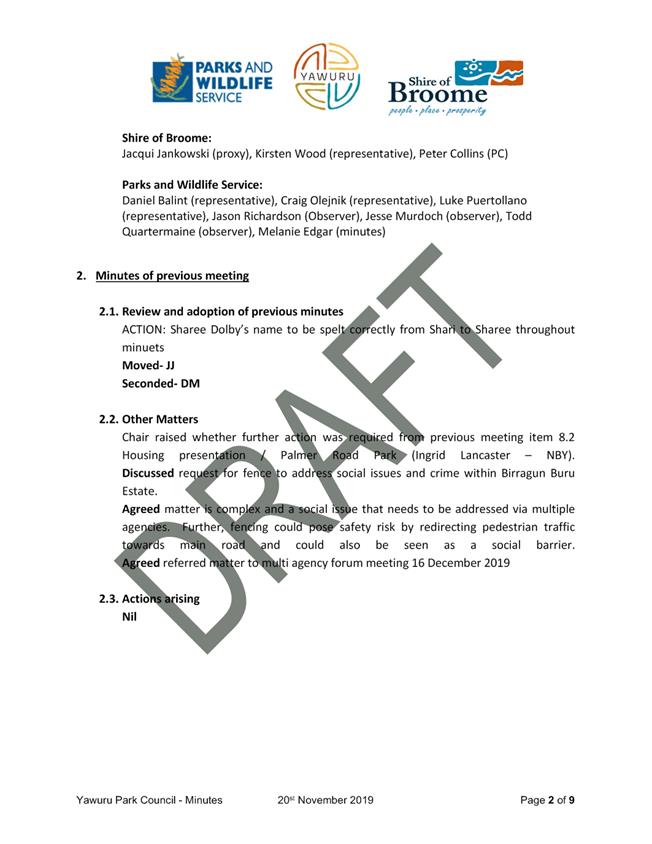
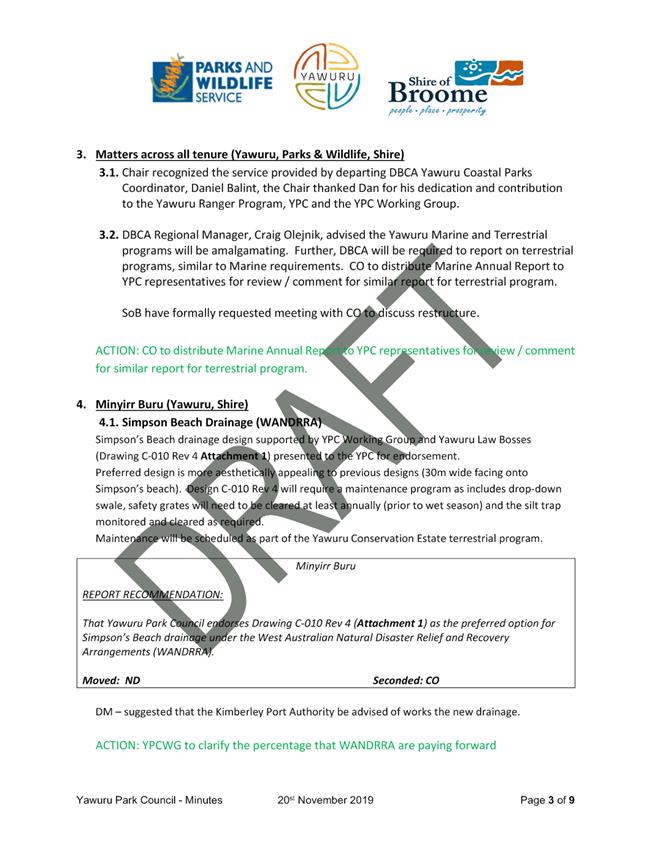
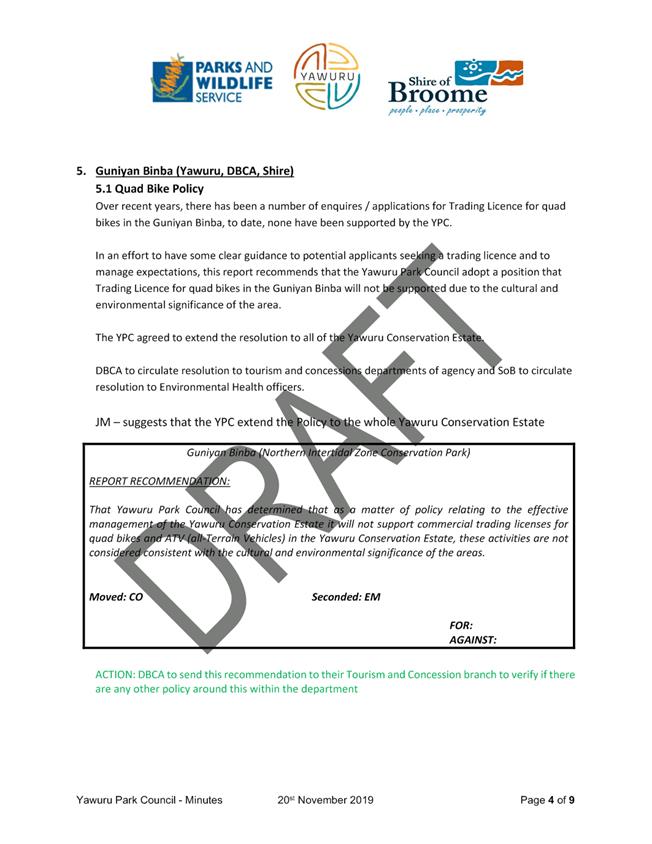
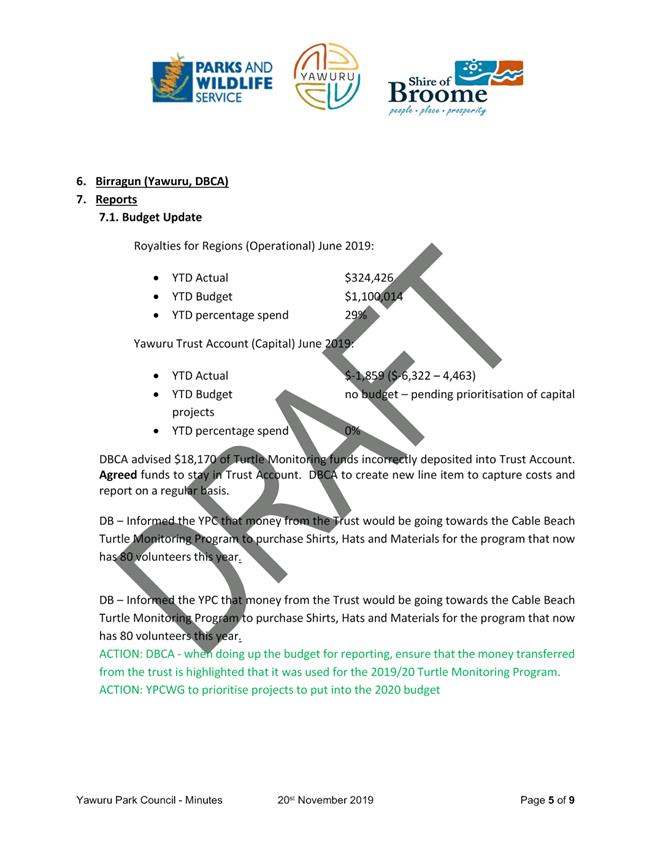
10.1 YAWURU PARK COUNCIL MEETING MINUTES 20 NOVEMBER 2019
10.3 Minutes and Recommendations from Audit and Risk Committee Meeting held on 11 February 2020
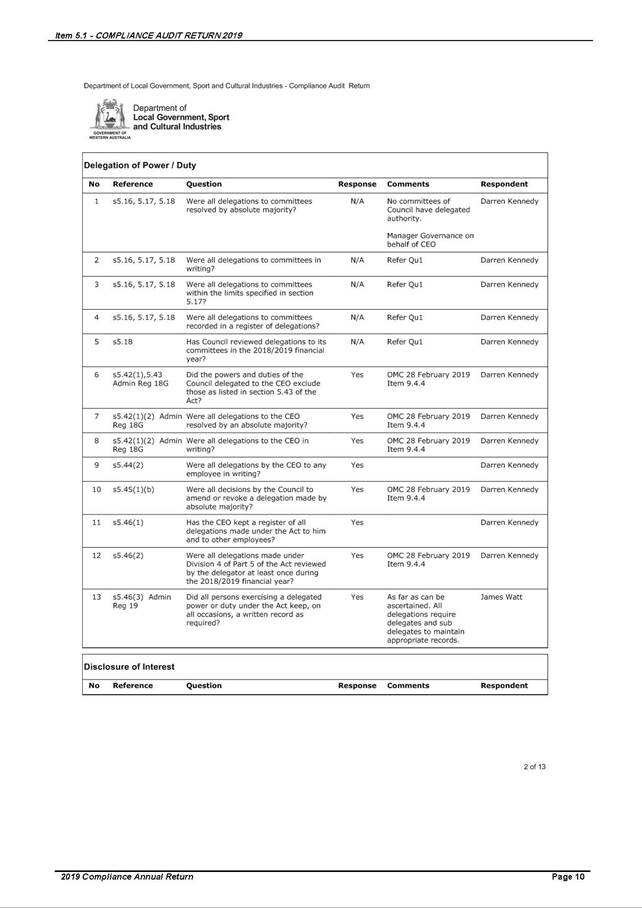
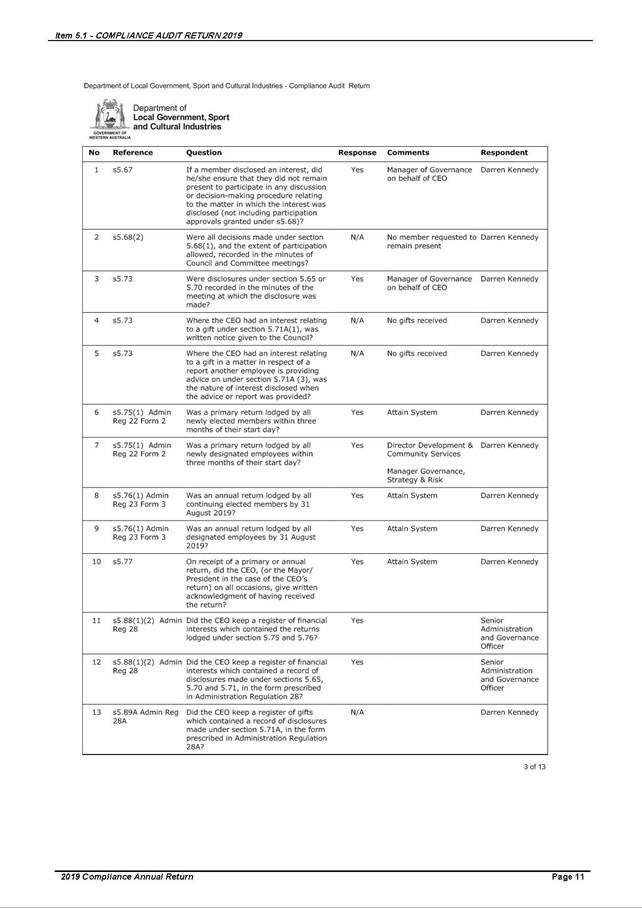
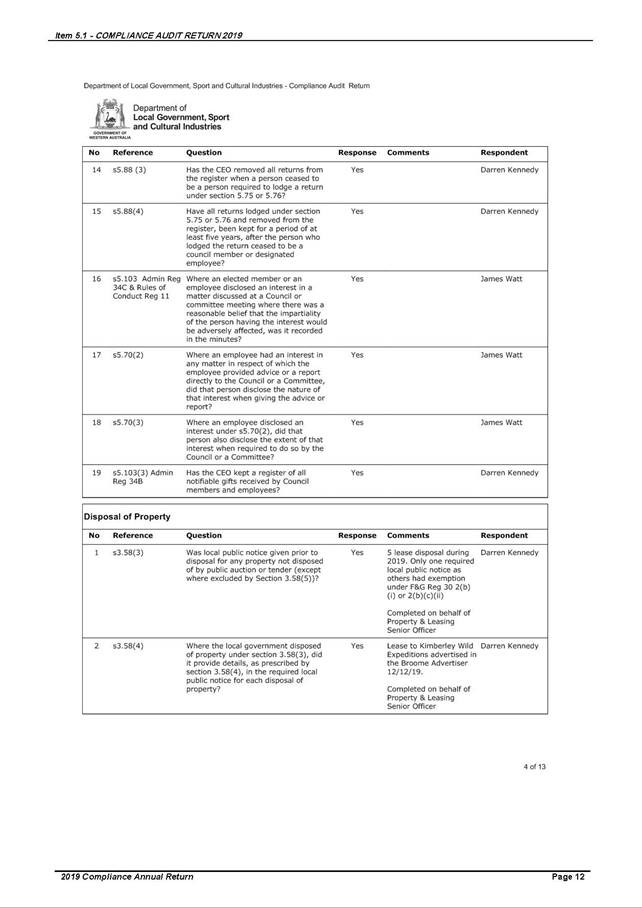
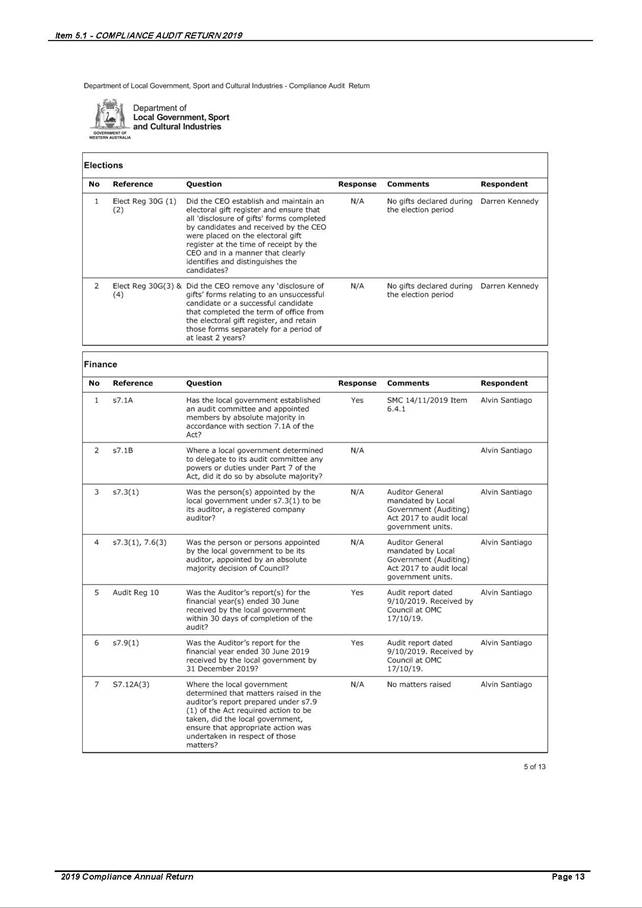
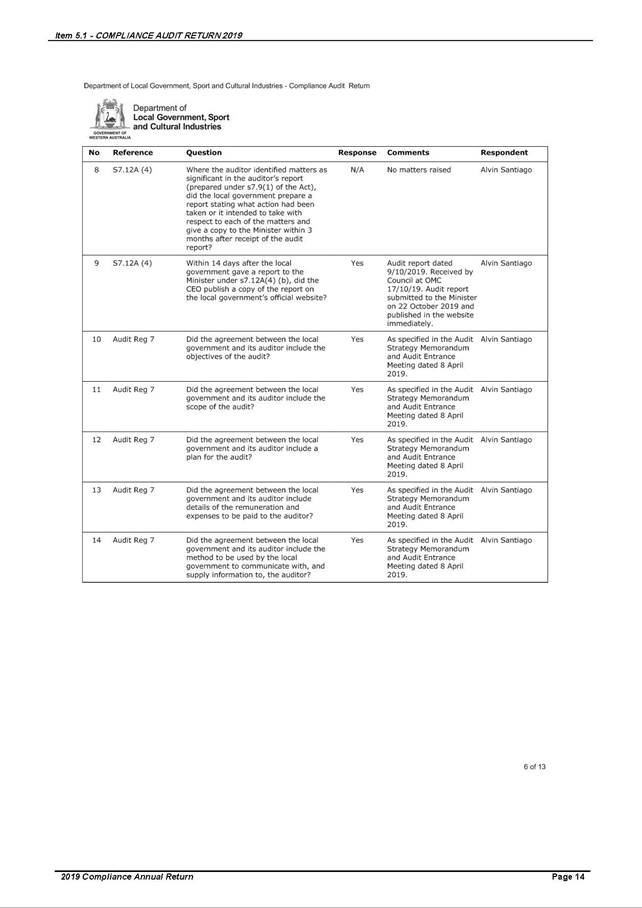
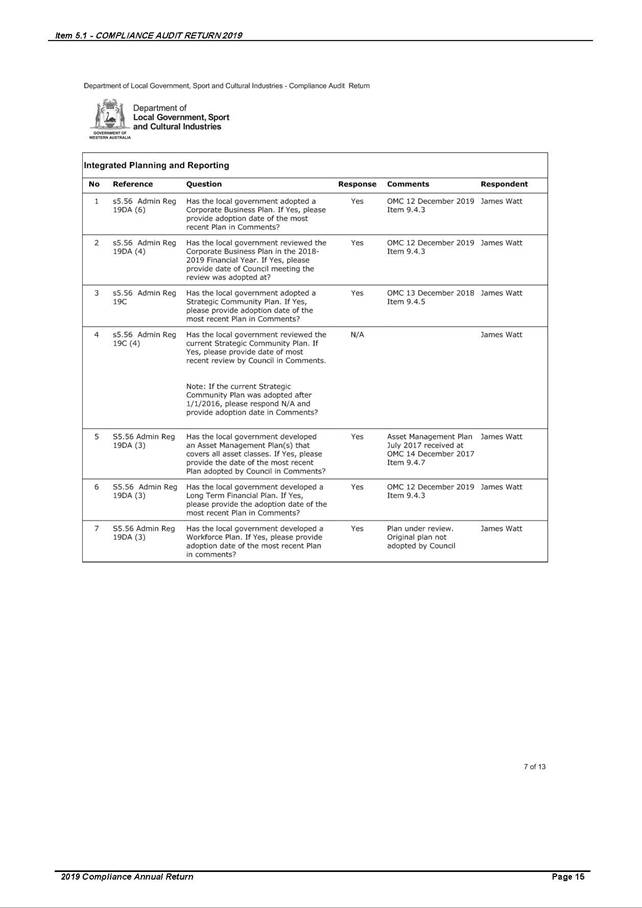
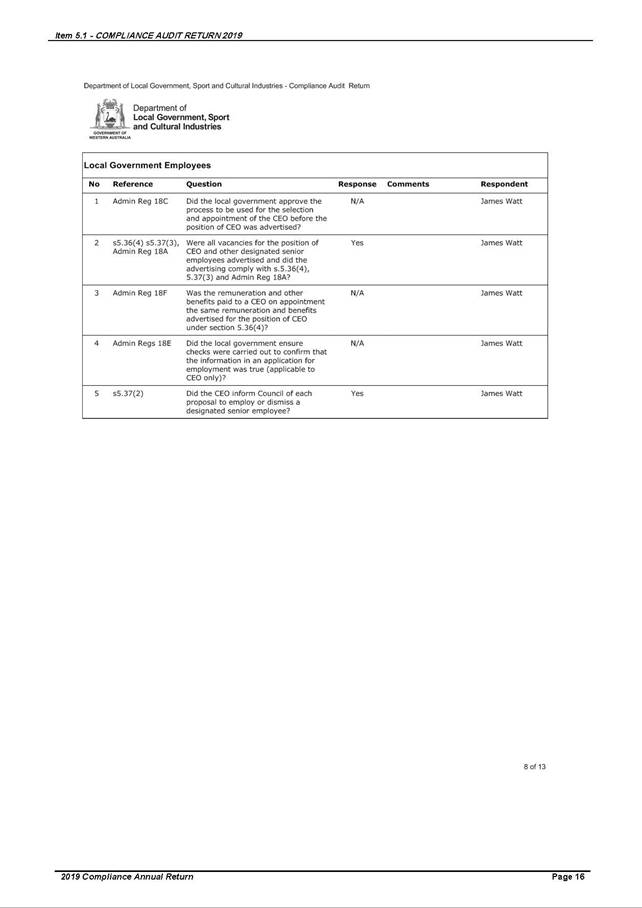
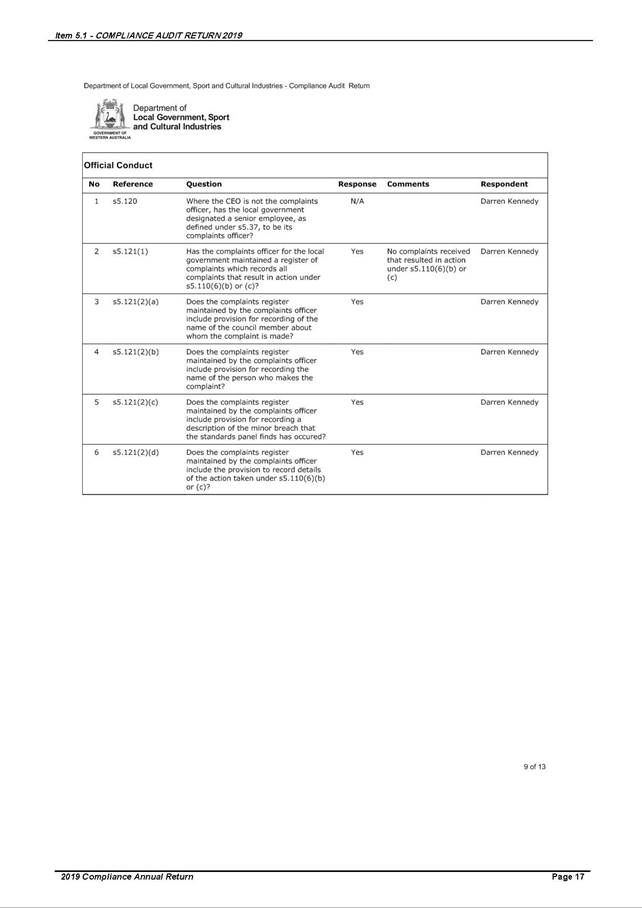
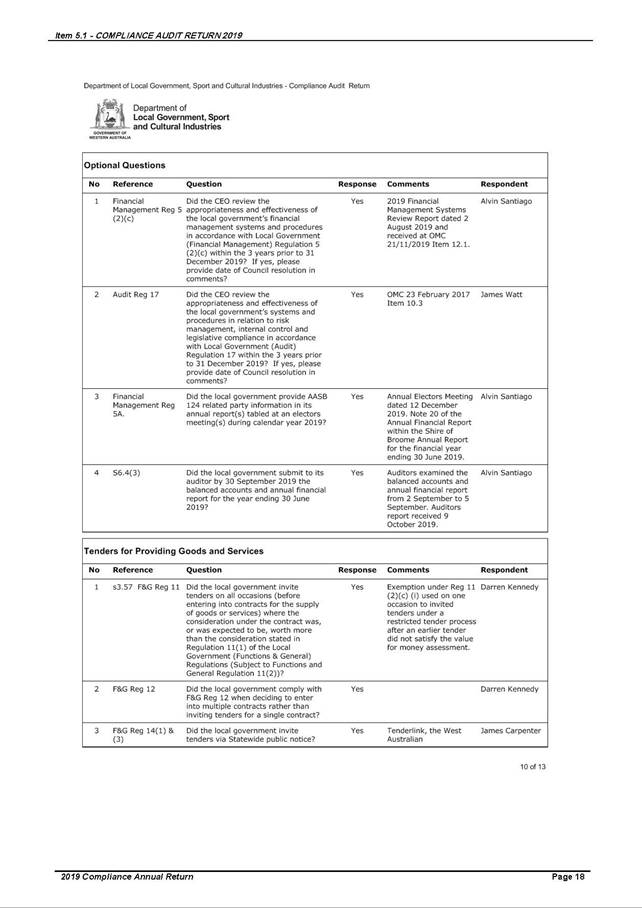
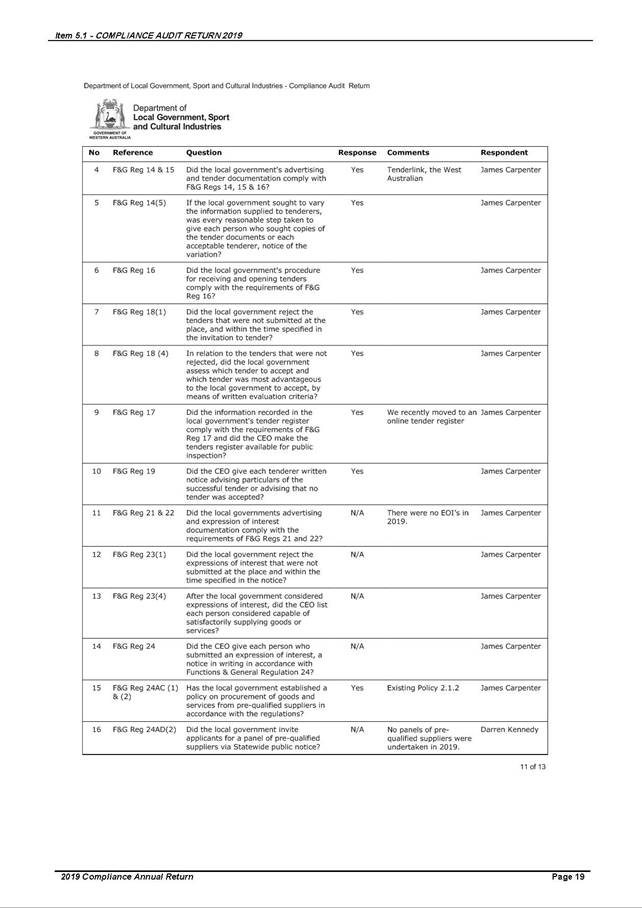
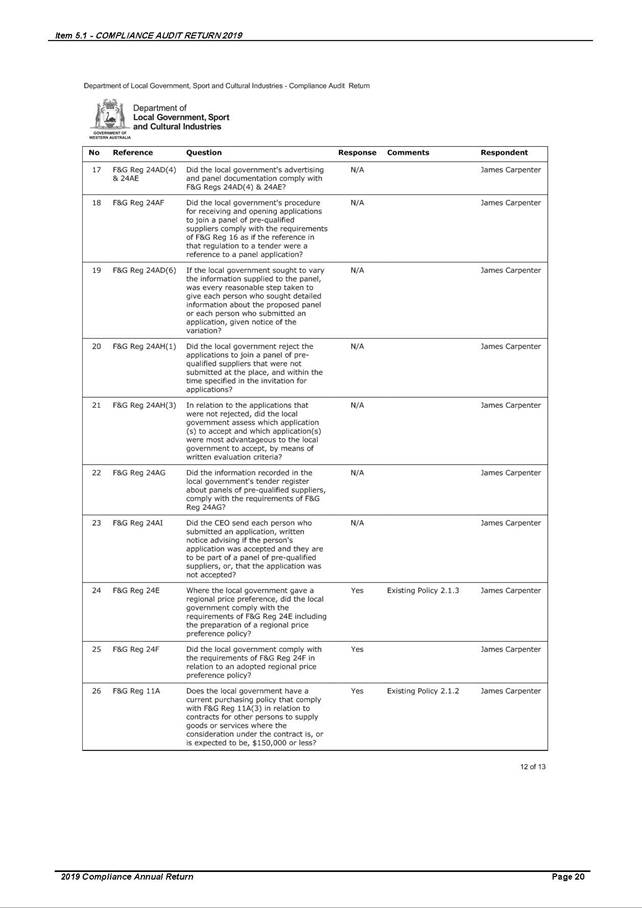
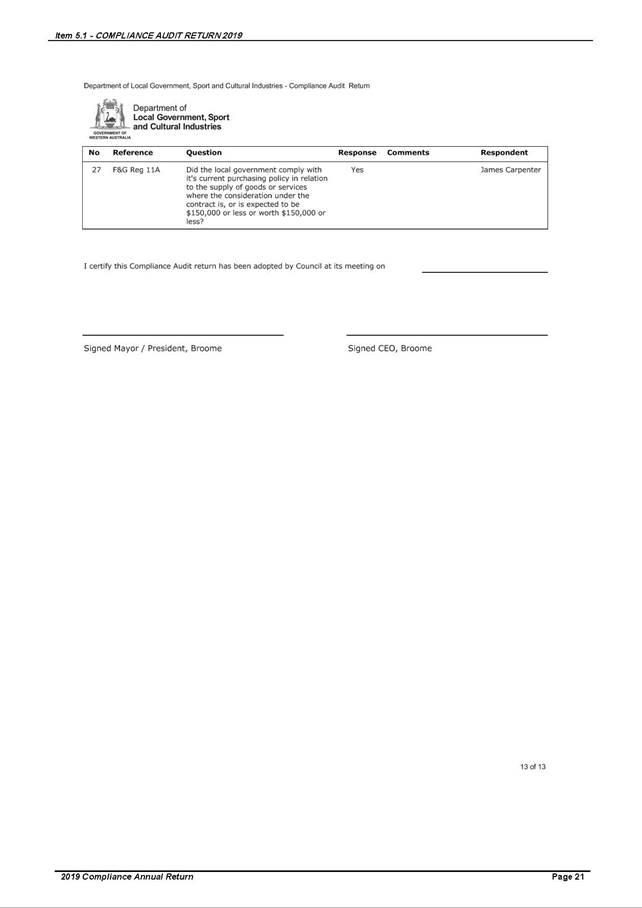
10.3.1 COMPLIANCE AUDIT RETURN 2019 (5.1)
10.3.2 2ND QUARTER FINANCE AND COSTING REVIEW 2019-20 (5.2)
12. Business of an Urgent Nature
13. Questions By Members Of Which Due Notice Has Been Given
14. Matters Behind Closed Doors
HELD IN THE Council Chambers, Corner Weld and Haas Streets, Broome, ON Thursday 27 February 2020, COMMENCING AT 5:00 PM.
The Chair welcomed Councillors, Officers and members of the public and declared the meeting open at 5:07 PM.
The Chair acknowledge the late* Kevin Smith and offered condolences to his family and friends.
The Chair welcomed the new Director Development and Community, Nathan Cain.
*A typographical error was discovered in the minutes and amended administratively after publication. The amendment is underlined in the above text. Refence OMC 27 March 2020.
|
ATTENDANCE |
|
|
|
|
|
|
|
Councillors: |
Cr H Tracey |
Shire President |
|
|
Cr D Male |
Deputy Shire President |
|
|
Cr E Foy |
|
|
|
Cr P Matsumoto |
|
|
|
Cr C Mitchell |
|
|
|
Cr B Rudeforth |
|
|
|
Cr N Wevers |
|
|
|
Cr F West |
(via telephone from 5:25pm) |
|
|
||
|
Apologies: |
|
|
|
|
|
|
|
|
||
|
Leave of Absence: |
Peter Taylor |
|
|
|
|
|
|
|
||
|
Officers: |
Mr S Mastrolembo |
Chief Executive Officer |
|
|
Mr J Watt |
Director Corporate Services |
|
|
Mr N Cain |
Director Development and Community |
|
|
Mr A Graffen |
Director Infrastructure |
|
|
Mr D Kennedy |
Manager of Governance, Strategy and Risk. |
|
|
Ms K Wood |
Manager of Planning and Building Services |
|
|
Mr G McKnight |
Media and Promotions Coordinator |
|
|
Ms L Levi |
Senior Administration and Governance Officer |
|
|
||
|
Public Gallery: |
Gayle Williams |
|
|
|
Geoff Williams |
Sheffield |
|
|
Lyn Yu-Mackay |
Nagula Jarndu |
|
|
Barbara Peek |
Nagula Jarndu |
|
|
Michelle Teoh |
|
|
|
Jan Lewis |
|
|
|
Jason Simmons |
|
|
|
Louise Mullin |
|
|
|
Alex Carkeek |
Madalah Ltd |
|
|
Jakeb Waddell |
Seven West Media |
|
|
Paul McSweeney |
Broome International Airport |
|
|
Denis Ryan |
Broome Future Alliance |
|
|
Tony Byrne |
Broome Future Alliance |
|
|
Harriet Parkes |
Shire of Broome |
|
|
Julia Mikhlik |
Shire of Broome |
|
|
Janine Hatch |
Shire of Brooome |
|
|
Andrew Chambers |
|
|
|
Wade Freeman |
|
|
|
Shaun Clark |
|
|
|
Daryl Dean |
|
|
|
Fiona Dean |
|
|
|
Martine Gijsbrechts |
|
|
|
Inga Petrov |
|
|
|
Wade Reid |
|
|
|
Paul Hope |
Nyamba Buru Yawuru |
|
|
Peter Yu |
Nyamba Buru Yawuru |
|
|
Bruce Rudeforth |
|
|
|
Kevin Puertollano |
Nyamba Buru Yawuru |
|
|
Stuart Martin |
Shire of Broome |
|
|
Mark Davis |
Shire of Broome |
|
|
Maxine Nixon |
|
|
|
Marie Manado |
|
|
FINANCIAL INTEREST |
|||
|
Councillor |
Item No |
Item |
Nature of Interest |
|
Cr H Tracey |
9.2.1 |
Proposed Service Commercial Structure Plan – Lot 3082 Cable Beach |
“I am a Director of a Company, and 50% Shareholder with the Proponant.” |
|
INDIRECT FINANCIAL INTEREST |
|||
|
Councillor |
Item No |
Item |
Nature of Interest |
|
Cr F West |
9.2.1 |
Proposed Service Commercial Structure Plan – Lot 3082 Cable Beach |
“A closely associated person to me is in a financial relationship with the proponent/applicant.” |
|
Cr B Rudeforth |
9.2.1 |
Proposed Service Commercial Structure Plan – Lot 3082 Cable Beach |
“A closely associated person to me is in a financial relationship with the proponent/applicant” |
|
Cr P Matsumoto |
9.2.1 |
Proposed Service Commercial Structure Plan – Lot 3082 Cable Beach |
“Member and Director of PBC” |
|
Cr P Matsumoto |
10.1 |
Yawuru Park Council Meeting Minutes 20 November 2019 |
“PBC Director and Native Title Holder”
|
|
IMPARTIALITY |
|||
|
Councillor |
Item No |
Item |
Nature of Interest |
|
Cr D Male |
9.1.1 |
Chinatown Revitalisation Project Stage 2 – Engagement Plan |
“I am a beneficiary of a trust that owns property and operates a business in the precinct”. |
|
Cr D Male |
9.2.1 |
Proposed Service Commercial Structure Plan – Lot 3082 Cable Beach |
“There may be a perception of a conflict as my family run a small business that could be seen as in competition”. |
|
Cr F West |
9.1.2 |
Annual Electors Meeting Held 12 December 2019 – Elector Motion 1 |
“I’m vice-chair of the Roebuck Bay Working Group. I’m a member of the Kimberley Port Authority Community Consultation Committee”. |
|
Cr C Mitchell |
9.2.4 |
Development Application 2019/104 Extension to Showroom Including Off-site Car Parking at Lot 1036 (5) Haynes Street, Broome |
“Close Personal Friend”. |
|
Cr E Foy |
9.2.1 |
Proposed Service Commercial Structure Plan – Lot 3082 Cable Beach |
“Traditional Owner/Elder and Member”. |
The Chair noted that due to the number of financial and indirect financial interest declarations a quorum could not be reached and that Item 9.2.1 would need to be deferred to a later date.
The following questions were submitted by Jan Lewis prior to the meeting:
Question 1
Is the Shire of Broome intending to become a Refund Point for the new Containers for Change Scheme that will commence in June 2020?
Response Provided by Director Infrastructure:
The Shire of Broome has been informed by WA Return Recycle Renew Ltd that we were not successful in being granted approval to deliver Refund Point services.
Question 2
If no; do you have any information on which organisation in Broome will take on the role?
Response Provided by Director Infrastructure:
The scheme has appointed Nirrumbuk Environmental Services as the collection agent in Broome. We have not been contacted by them at this time.
The following questions were submitted by Brendan Renkin prior to the meeting:
Question 1:
At the Audit and Risk Committee meeting in November 2019 it was noted that there is a forecasted deficit for the financial year of almost $190,000. $106,000 of that deficit is attributed to “additional Chinatown project management costs.
What percentage of the overall expenditure by the Shire (not including State government grants) on the Chinatown project is $106,000? Why has the overspend occurred? What steps has the Shire taken to ensure that such overspends do not occur on future projects?
Response Provided by Director Infrastructure:
$106,000 equates to 0.7% of the total Chinatown Revitilisation Stage 1 project budget or 3% of the Shire of Broome contribution. The date for Practical completion was 15 May 2019 whilst the date of practical completion was certified on the 21 June 2019. Project completion however does not occur at practical completion as defects are resolved, variations finalised and master document registers compiled and delivered. These activities take time and resources to achieve and were not budgeted in 2019/20 as the date for practical completion would have allowed for expenses to be accrued in the 2018/19 financial year. The superintendents engagement was extended to include the defect liability period due to the complexity of the project and their corporate knowledge through the construction period. These are known expenses however due to the delayed project completion were carried forward into the 2019/20 financial year.
The Shire of Broome undertakes a lesson learned exercise as part of project completion which captures review of the concept, design and delivery processes. The Shire of Broome also implements Team Based Risk Assessments at the critical project control points procurement, contract award and construction to identify all project risks and ensure sufficient controls are in place.
Question 2
At the Shire meeting in September 2019 in response to my question the Shire confirmed that it does not have an Indigenous employment strategy or targets despite the abysmally low rate of Indigenous employment at the Shire. In the answer to my question the Shire indicated it is “currently investigating options to progress a Reconciliation Framework or the like”.
I note that the newly approved 2020 Shire Corporate Business Plan does not include any strategies or actions for either a Reconciliation Framework or Indigenous employment strategy or targets, other than the Shire encouraging business and industry to adopt Indigenous employment targets.
Can the Shire explain:
· What action it has taken since September on this matter?
· Why a Reconciliation plan or Indigenous employment strategy and targets were not included in the corporate business plan and does this mean that no action will be taken until after 2024?
· And if not, what is a reasonable time frame for the Shire to develop either a Reconciliation plan or Indigenous employment strategy and targets?
Response provided by the Chief Executive Officer:
The Shire of Broome first expressed its commitment to reconciliation in the mid 1990’s, which resulted in the preparation and formal signing of an Interim Agreement between the Rubibi Working Group and the Shire in May 1996; framed copies of this agreement are displayed in the Shire Administration Building Reception. This interim agreement was far-reaching and committed to working together on a range of matters. Part of this commitment was to develop consultative processes which were inclusive of the views and wishes of all people in Broome.
Since that time, the Shire has made many positive steps towards building stronger relationships with and showing deeper respect for Aboriginal people in its community - through the delivery of projects and processes which span the themes of relationships, opportunities and respect. These projects are largely considered to be ‘business as usual’ and are engrained in the Shire’s operations; therefore providing a sound foundation to progress.
To continue to evolve the Shire’s approach, officers have developed a discussion paper encapsulating different approaches that the organisation may wish to pursue to further reconciliation. This body of work has been completed following investigation into approaches by various local governments and other bodies throughout the State; and will be workshopped in the near future with Council to further explore the Shire’s approach and future direction.
In regards to your statement regarding Aboriginal and Torres Strait employment the Shire been very proactive in this space since September. We have partnered with Nirrumbuk Aboriginal Corporation to provide indigenous employment opportunities and work readiness initiatives. The Shire has had 3 indigenous trainees commence at the Depot within this time, also through the depot we have had 4 work for the dole participants complete programs and the Shire commenced a second round of Work for th Dole programs and already have one person signed up.
Further to this, the China Town Revitalisation Project, also in partnership with Nirrumbuk Aboriginal Corporation, has recently commenced recruitment for a Administration Trainee. This is an exciting opportunity for someone to gain administration qualification and experience whilst working on one of the biggest projects the Shire has undertaken.
Overall the Shires Aboriginal participation rate is approximately 10% and whilst the Shire remains committed to improving this number.
Response provided by the Shire President:
Further to the response provided by the Chief Executive Officer we have recently met with Reconciliation WA and discussed a Reconcilitation Action Plan for the Shire of Broome. The advice they gave us was that we were already doing more than what is prescribed within a typical Reconciliation Action Plan and are more progressed that other Local Governments in this space.
The following questions were received by Claire Mullin at the meeting:
My questions relate to the review of our Local Planning Scheme Number 6 specifically Short Stay Accommodation.
Question 1
Firstly please will you ensure thorough community consultation before finalising your view?
Response provided by the Manager of Planning and Building Services:
The Shire acknowledges that the Scheme Review process will generate a lot of community interest. A community engagement plan will be prepared and presented to Council for adoption to guide the community engagement that will occur during the different stages of the review process.
There will be thorough consultation undertaken.
Question 2
Secondly please will you clearly define short stay accommodation or devise new terminology to adequately deal with the various types of short stay accommodation currently existing in Broome.
Response provided by the Manager of Planning and Building Services:
One of the findings of the recent State Inquiry is that a review of the land use definitions for short stay accommodation types is required.
The State Government has released its position on the recommendations of the State Inquiry this month and in this acknowledge that the land use definitions contained in the Model Provisions of the Planning and Development (Local Planning Schemes) Regulations 2015 requires review. The Shire is required to consider the Model Provisions when it reviews the Scheme so this will be addressed. The State Government has also committed to releasing an interim position statement by mid-2020 that the Shire will consider.
Public Question time closed at 5:21 pm.
Cr F West submitted a request to join the meeting via telephone as per Regulation 14A of the Local Government (Administration) Regulations Cr F West confirmed her address and that there would be no one else present.
|
Minute No. C/0220/001 Moved: Cr C Mitchell Seconded: Cr B Rudeforth That Councll; 1. Approves the request from Cr F West to attend this meeting via telephone; and 2. Note that she has confirmed no one else is present at the approved* address. |
 *Minutes amended administratively, 28 April 2020, due
to privacy concerns expressed by Cr F West the address she was calling from was
removed and the wording approved inserted.
*Minutes amended administratively, 28 April 2020, due
to privacy concerns expressed by Cr F West the address she was calling from was
removed and the wording approved inserted.
Cr F West joined the meeting at 5:25pm and remained on the phone for the duration of the meeting.
|
Minute No. C/0220/002 Moved: Cr C Mitchell Seconded: Cr D MaleThat Cr C Mitchell be granted a leave of absence from Councillor duties, inclusive of 23 March 2020 through to 27 March 2020. |
|
Minute No. C/0220/003 Moved: Cr C Mitchell Seconded: Cr B Rudeforth That Cr D Male be granted a leave of absence from Councillor duties, inclusive of 4 April 2020 through to 19 April 2020. |
|
Minute No. C/0220/004 Moved: Cr C Mitchell Seconded: Cr D Male That Cr E Foy be granted a leave of absence from Councillor duties, inclusive of 28 February 2020 throughto 31 March 2020. |
|
Minute No. C/0220/005 Moved: Cr D Male Seconded: Cr P Matsumoto That the Minutes of the Annual Electors Meeting of Council held on 12 December 2019, as published and circulated, be confirmed as a true and accurate record of that meeting. |
|
Minute No. C/0220/006 Moved: Cr C Mitchell Seconded: Cr D Male That the Minutes of the Ordinary Meeting of Council held on 12 December 2019, as published and circulated, be confirmed as a true and accurate record of that meeting, subject to noting the inclusion of an additional attachment to Item 9.4.2 Stage 2 – Chinatown Revitalisation Project being the Draft Financial Assistance Agreement as circulated to Councillors prior to the meeting. |
|
Minute No. C/0220/007 Moved: Cr C Mitchell Seconded: Cr D Male That the Minutes of the Special Meeting of Council held on 19 December 2019, as published and circulated, be confirmed as a true and accurate record of that meeting. |
Nil.
A Deputation request was received from Nyambu Buru Yawuru in relation to Item 9.2.1 Proposed Service Commercial Structure Plan – Lot 3082 Cable Beach however did not proceed due to a lack of quorum required to consider the item.
Nil.
9.1 Our People
With regard to Item 9.1.1 Chinatown Revitalisation Project Stage 2 – Engagement Plan, Cr D Male declared a Impartiality Interest as “I am a beneficiary of a trust that owns property and operates a business in the precinct”.
|
SUMMARY: This report presents Council with an Engagement Plan (EP) as one of the stages of the Chinatown Revitalisation Project Stage 2 (CRP2). It requests Council endorse the EP and the engagement activities contained therein. |
BACKGROUND
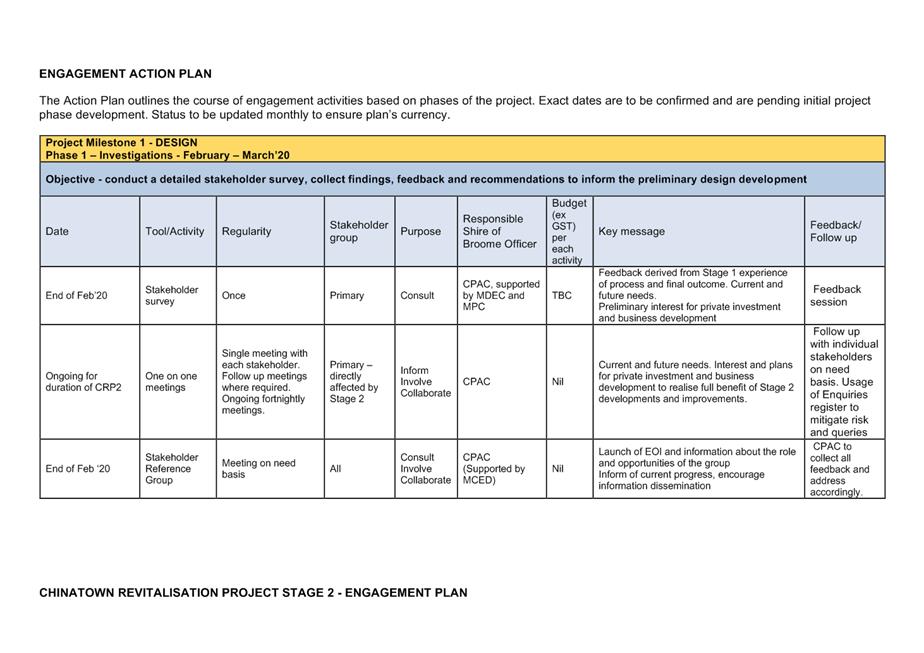
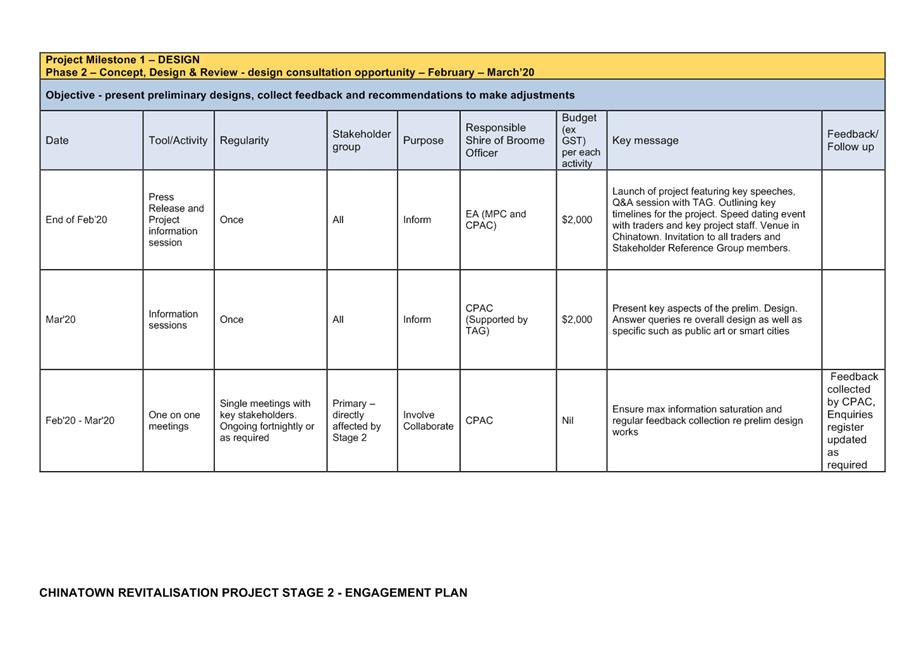
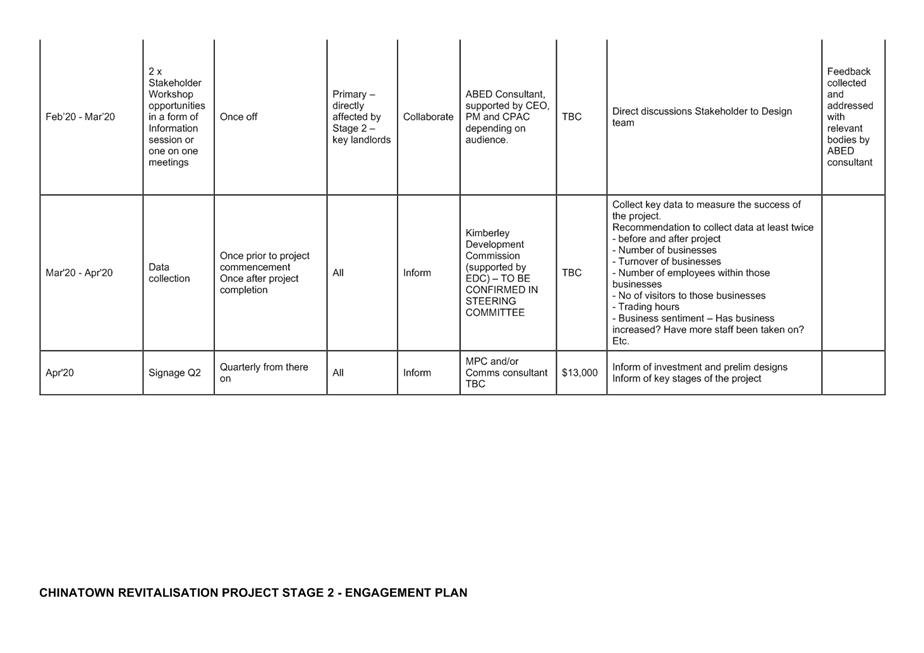
Stakeholder engagement and communications activities were carried out by an external contractor during Chinatown Revitalisation Project Stage 1. With the commencement of CRP2, the administration proposes to internally implement and execute the EP (Attachment 1) - therefore allowing for greater quality control and elimination of potential risks to the Shire.
The proposed EP has been endorsed by the CRP2 Steering Committee on Friday 7 February 2020. It features preferred practice engagement methodologies, which have been developed in line with project key phases and preliminary construction timelines.
COMMENT
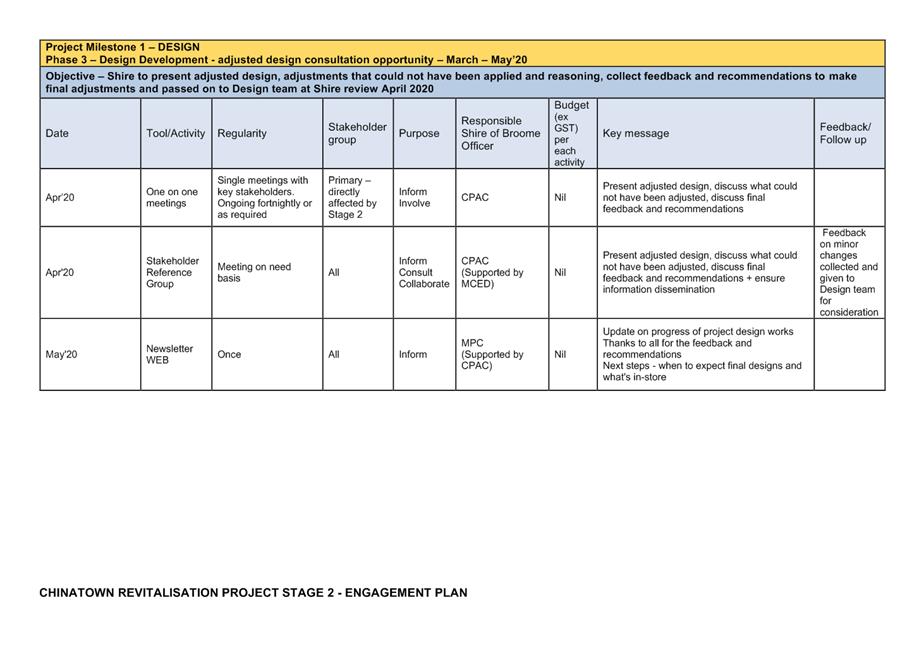
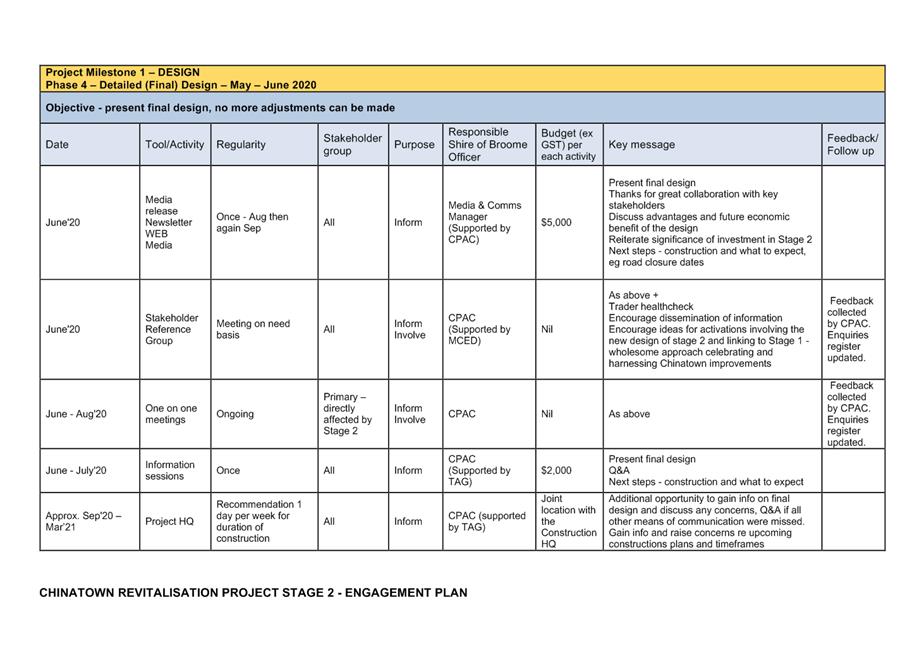
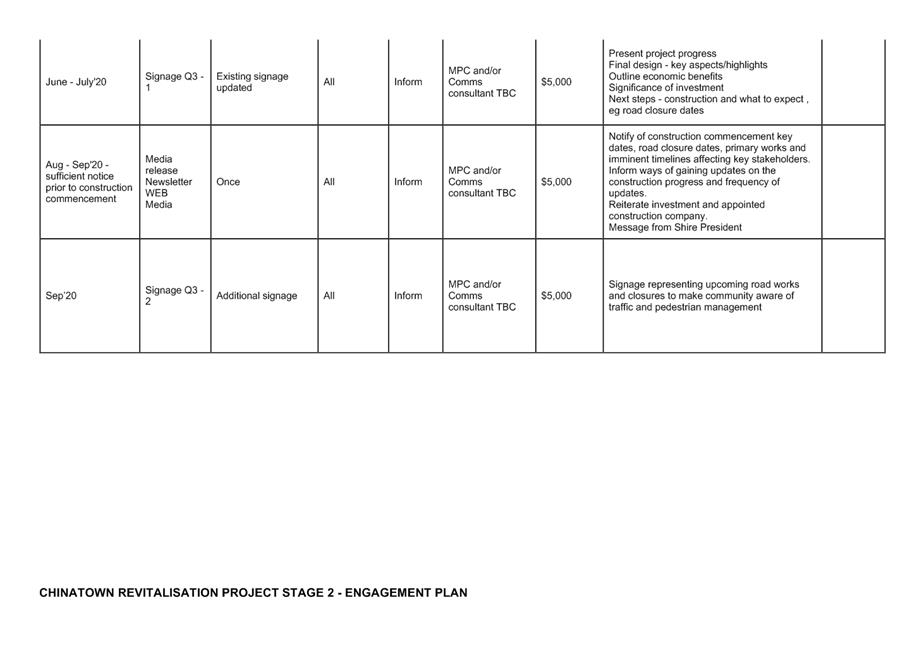
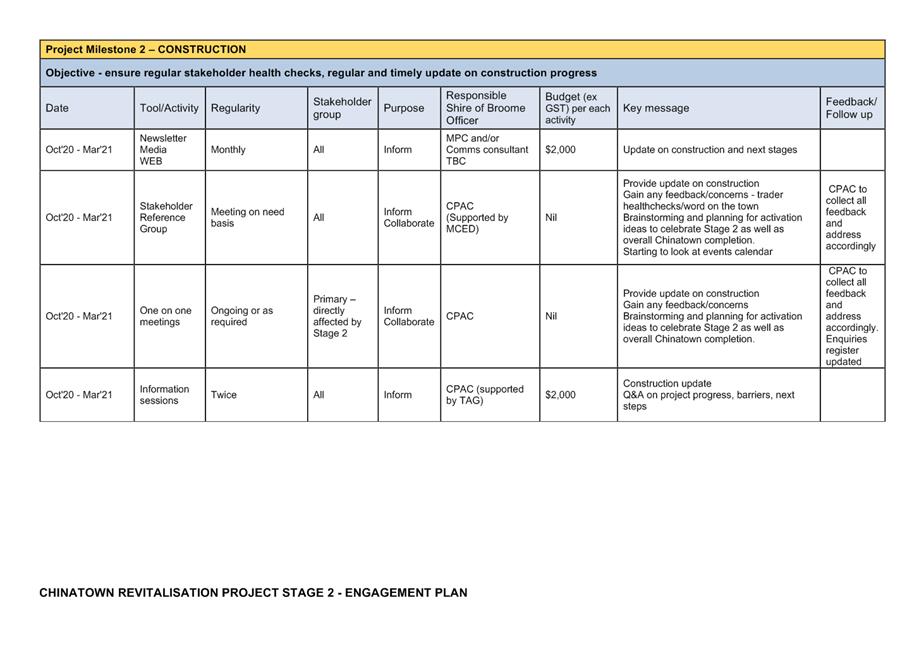
The Chinatown Place Activation Coordinator has prepared the EP for Council’s consideration setting out how the key stakeholder groups will be involved in the CRP2. EP is included in Attachment 1 of this report. It ensures that effective and a suitable level of public participation is offered to appropriate stakeholder groups.
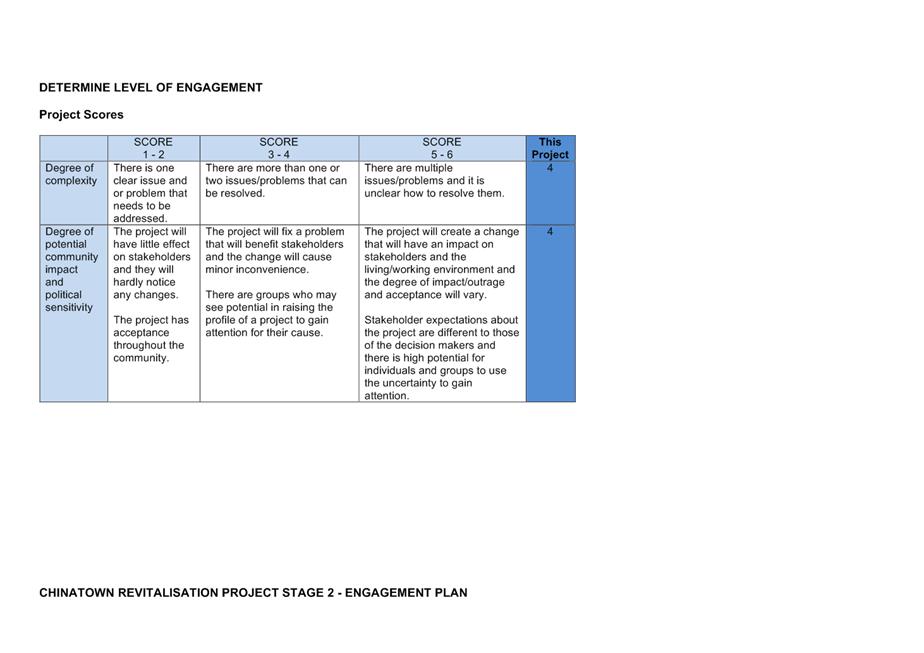
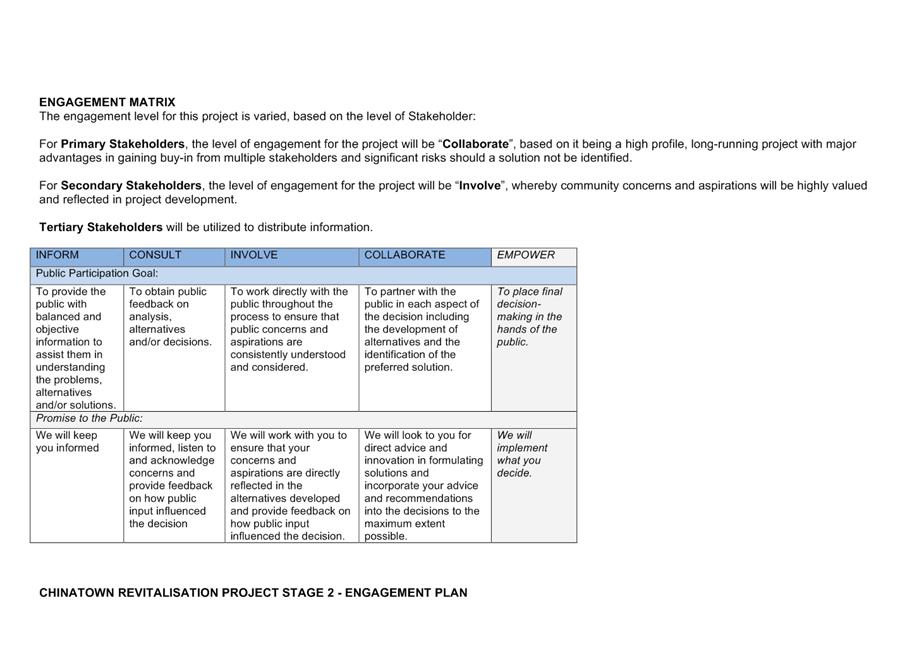
As per Council’s Community Engagement Policy assessment matrix the preferred level of engagement for a project of such high significance is “Collaborate”. Using the policy’s ranking formula, the CRP2 project scores highly in terms of complexity and potential community impact. Therefore, it has been proposed that collaboration with key stakeholder groups is preferred over consulting and is likely to lead to better stakeholder involvement throughout the key milestones and phases of the project.
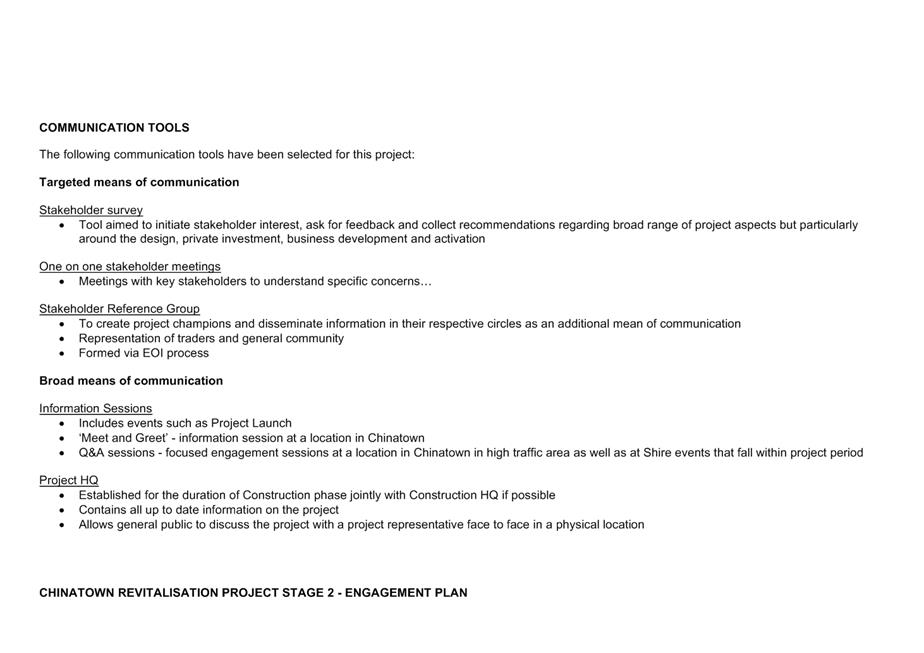
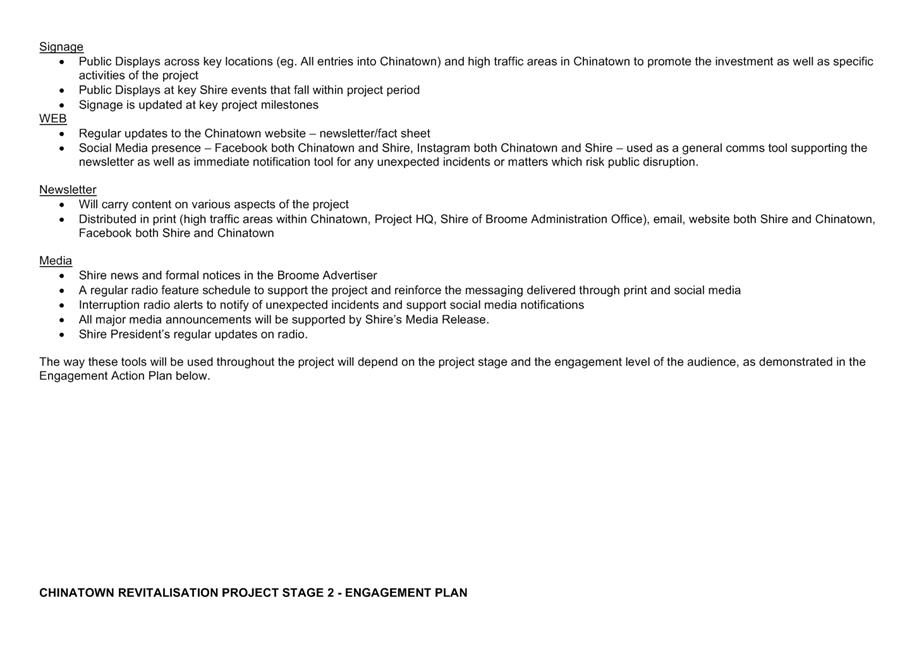
The EP demonstrates a variety of quantitative and qualitative engagement techniques including:
Quantitative (broad):
· Stakeholder survey
· Data collection
Qualitative (targeted):
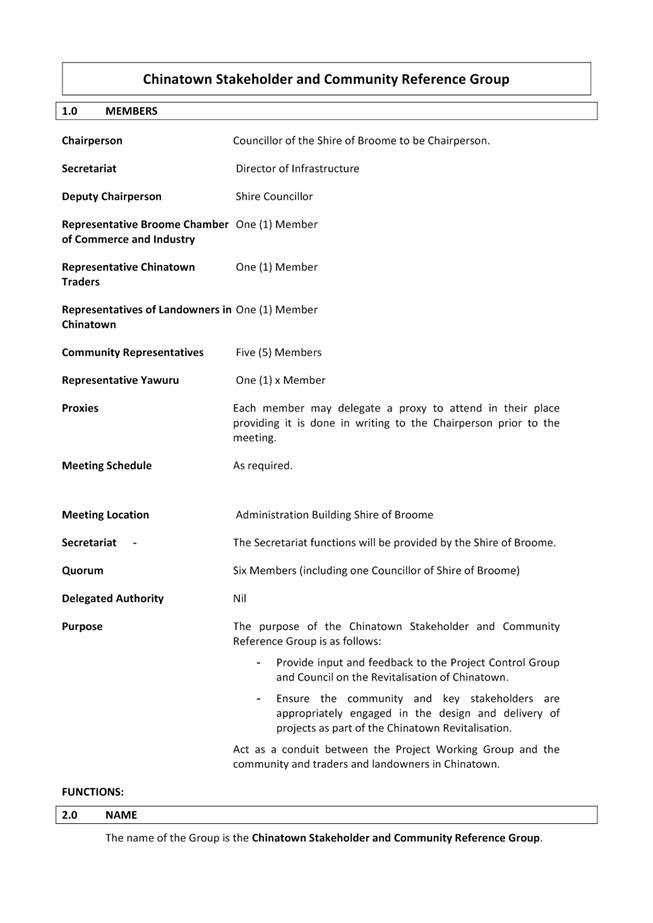
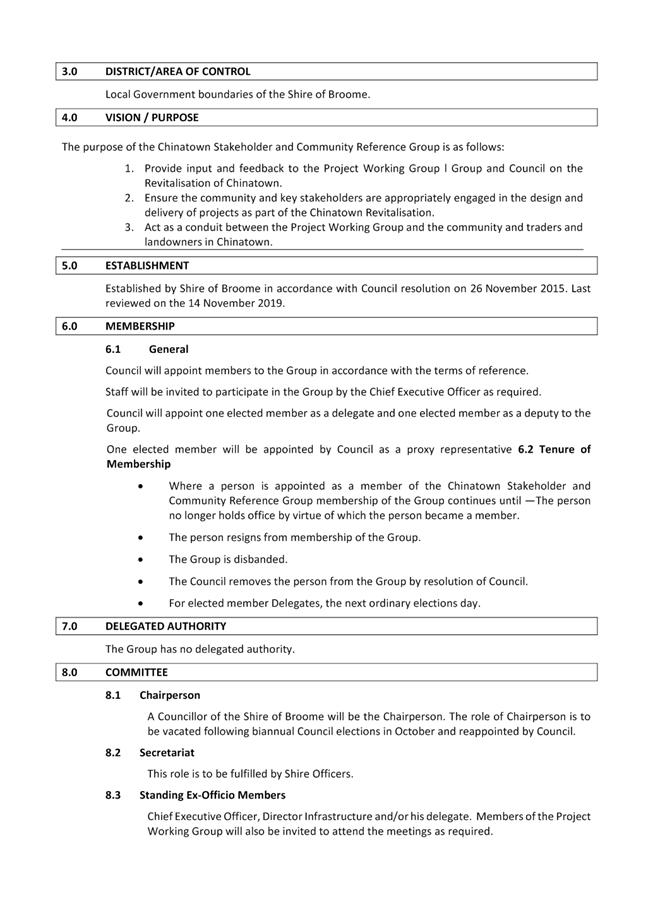
· Chinatown Stakeholder and Community Reference Group (CSCRG)
· One on one meetings / town walks
· Information sessions
The immediate action of the EP, pending Council’s endorsement, is the EOI process for the CSCRG, which will be carried out in line with the attached Terms of Reference (Attachment 2) adopted at SMC on 14 November 2019.
The EOI process will take place over 14 days in late February 2020 to early March 2020. The proposed CSCRG membership will then be presented for endorsement in March 2020 OMC.
CONSULTATION
The Shire has initiated a Technical Advisory Group (TAG) as part of the approach to the project management of CRP2. This group includes officers from various departments with the purpose of monitoring and providing feedback on key elements of the project.
The CRP2 EP has been created in consultation with CRP2 TAG team as well as those officers involved in CRP1. Additionally, the EP is based on key design phases according to the design schedule provided to CRP2 TAG, as well as indicative construction timelines.
STATUTORY ENVIRONMENT
Not applicable
POLICY IMPLICATIONS
Policy 3.4.6 – Community Engagement
FINANCIAL IMPLICATIONS
The CRP2 is fully funded by the State Government as outlined in the Project Financial Assistance Agreement (FAA). The cost to develop and implement the EP has been estimated at $39,000 (excl GST). Any costs incurred in the development and implementation of the EP will be covered by the CRP2 project funding.
RISK
|
Risk |
Type |
Rank |
Mitigation |
|
Negative public perception of the project overall and the elements of the design |
Reputational |
High |
The endorsed EP has been developed with thorough consideration given to stakeholder groups and various engagement methodologies that are applied throughout the key phases of the project planning stages, as well as into construction stages. |
|
Perception of insufficient engagement |
Reputational |
High |
The endorsed EP covers all key stakeholder groups and applies different engagement techniques to ensure all stakeholders are covered in a consistent manner at all key phases of the project. Additional engagement opportunities have been included in the EP to enhance the stakeholder involvement and will be facilitated by Shire. Any feedback of significance will be addressed with design team at final stages of design planning. |
STRATEGIC IMPLICATIONS
Our Organisation Goal – Continually enhance the Shire’s organisational capacity to service the needs of a growing community:
Effective community engagement
VOTING REQUIREMENTS
Simple Majority
|
Minute No. C/0220/008 Moved: Cr C Mitchell Seconded: Cr D Male That Council: 1. Endorses the Engagement Plan for the Chinatown Revitalisation Project Stage 2 as set out in Attachment 1; 2. Authorises the Chief Executive Officer to make minor changes to the plan as required; and 3. Authorises the Chief Executive Officer to commence the Expression of Interest process for the Chinatown Revitalisation Project Stage 2 Stakeholder and Community Reference Group. |
|
CRP2 - Stakeholder Engagement Plan |
|
|
Chinatown Stakeholder and Community Reference Group Terms of Reference |
Minutes – Ordinary Meeting of Council 27 February 2020 Page 1 of 2
With regard to Item 9.1.2 Annual Electors Meeting Held 12 December 2019 Cr F West declared a Impartiality Interest as “I’m vice-chair of the Roebuck Bay Working Group. I’m a member of the KPA Community Consultation Committee.”
|
SUMMARY: The purpose of this report is to present to Council the Minutes of the Annual Electors Meeting held 12 December 2019 and to seek Council consideration of all motions made at this meeting. |
BACKGROUND
Previous Considerations
Nil
COMMENT
Pursuant to section 5.27 of the Local Government Act 1995, the Annual Electors Meeting was held on Thursday 12 December 2019 at 5.00pm. In excess of 200 electors were present.
The Shire President’s Report and Annual Report for the financial year 1 July 2018 to 30 June 2019 were received. During general business a number of motions were raised. A comment on each of the carried motions is provided below with an officer’s recommendation of response for Council consideration.
|
ELECTOR MOTION 1: Moved: John Davidson Seconded: David Galwey That the Shire of Broome Council: 1. Reaffirms its continued support and strategy for the Port of Broome to become a more significant and effective logistics hub and marine support base for the Kimberley, the North West and the State; and 2. Request the Shire President write to the Premier of Western Australia and the Minister for Ports to reiterate Council’s support for the development of the Port of Broome. MOTION CARRIED |
Comment – Manager Community & Economic Development
This motion seeks Council’s support for the growth of Broome as a logistics hub, which aligns with the Shire of Broome Strategic Community Plan 2019 – 2029 and the Broome Growth Plan as per below:
Shire of Broome Strategic Community Plan 2019 – 2029
Economic Objective
Outcome 3.3 - Key economic development strategies for the Shire which are aligned to regional outcomes working through recognised planning and development groups/ committee.
Action 3.3.4 – Continue to promote and facilitate Broome as supply base servicing the regions resource, agriculture, pastoral and other industries.
Broome Growth Plan
Objective: Activating the Traded Economy – Minerals and Energy
Pathway 4: Infrastructure
Short Term: Bulk commodity export – Port study
Mid Term: Extend Port facilities; Investment in building air and sea trade links to growing markets.
Long Term: Competent logistics to enable exploration, project development and project operations.
As these plans have previously been endorsed by Council, communicating with the State Government regarding the continued growth of the Port of Broome is supported and recommended to Council.
|
OFFICERS RECOMMENDATION:
That Council; 1. Reaffirms its continued support and strategy for the Port of Broome to become a more significant and effective logistics hub and marine support base for the Kimberley, the North West and the State as outlined in the following Strategic Documents: (a) Shire of Broome Strategic Community Plan 2019 -2029: promote and facilitate Broome as a supply base servicing the region’s resource, agriculture, pastoral and other industries (b) Broome Growth Plan: objective of Activating the Traded Economy (Minerals and Energy) which references the extension of Port facilities. 2. Requests the Chief Executive Officer prepare a letter for the Shire President to sign reiterating to the Premier and Minister of Ports, Councils support for the development of Broome in accordance with points 1 above. |
|
Moved: Sue Fullerton Seconded: Cr H Tracey That the Shire of Broome request these Ministers: o Minister for Police o Minister for Health and Mental Health o Minister for Corrective Services o The Attorney General o MLA Josie Farrer o Minister for Aboriginal Affairs o Minister for Youth o Minister for Child Protection & Domestic Violence Minister for Community Services
be collectively invited to Broome to attend a Community Forum, to hear from residents about the gravity and escalation of the situation, and to discuss with residents what the State Government is planning to do to help our children, before the situation deteriorates any further. MOTION CARRIED |
Chief Executive Officer Response to Notice of Motion
It is acknowledged that there is a heightened level of concern throughout the community regarding crime and community safety. To this end, the Shire has continued to pursue projects which have the potential of delivering improved outcomes for Broome.
Significant progress has been made by the Shire in the following areas:
· spearheading the implementation of liquor restrictions in Broome to address alcohol related harm and anti-social behaviour;
· support and advocate for the ongoing delivery of Kullarri Patrol services through the Broome townsite;
· work with local service providers to identify and promote diversionary activities during periods where criminal activity peaks, including after hours and during school holidays;
· sourcing of grant funding to supplement Shire funds to deliver better outcomes for the community (e.g. $500,000 in funding for infrastructure such as CCTV and lighting improvements).
· Advocating and engaging with the State Government on issues including juvenile justice, alcohol management and homelessness – key issues highlighted by ongoing engagement with the community and stakeholders
In recent months the Chief Executive Officer, Shire President and Deputy Shire President have met with the Broome’s Officer in Charge, the Commissioner of Police, Kimberley District Superintendent and Director General to the Premier’s Office outlining many of these issues.
The Electors motion aims to provide the broader community with the opportunity to table concerns directly with the key State Government Ministers and our Local Member. The motion is supported, and it is recommended the Shire of Broome host and coordinate the community forum.
|
REVISED RECOMMENDATION:
That Council requests the Chief Executive Officer to:
1. Organise a community forum to enable community concerns to be voiced in regard to crime and anti-social behaviour in Broome and request a State Government planned response; through invitation to the following panel members: a) Minister for Police b) Minister for Health and Mental Health c) Minister for Corrective Services d) The Attorney General e) MLA Josie Farrer f) Minister for Aboriginal Affairs g) Minister for Youth h) Minister for Child Protection & Domestic Violence Minister for Community Services. 2. Invite the Federal Member for Durack, the Hon Melissa Price, to attend the community forum.* |
|
Moved: David Galwey Seconded: Cr B Rudeforth That Council supports the Federal Governments practical steps to achieve Australia’s Paris Agreement commitments. MOTION CARRIED |
Comment – Manager Governance, Strategy & Risk.
The aim of the Paris Agreement is to strengthen the global response to climate change by creating an international network of government bodies, all dedicated to lowering emissions.
The Western Australian Local Government Association (WALGA) have issued a Climate Change Policy Statement which is centred on the Paris Agreement and a Climate Change Declaration which local governments are being encouraged to adopt and become signatories to.
Both the Climate Change Policy Statement and the Climate Change Declaration were forwarded to Councillors by the Chief Executive Officer prior to Christmas for their consideration.
Council is scheduled to workshop this matter in the coming months, and it is proposed to be considered further post this session.
|
OFFICERS RECOMMENDATION: That Council: 1. Acknowledges the elector motion “That Council supports the Federal Governments practical steps to achieve Australia’s Paris commitments”; and
2. Requests the Chief Executive Officer table the Climate Change Declaration and Climate Change Policy Statement at an upcoming Councillor workshop. |
|
ELECTOR MOTION 4: Moved: David Galwey Seconded: Stuart Gallus
That Council notes the Shire’s effort to improve efficiency and reduce its power usage in a fiscally responsible manner by upgrading lighting to Shire assets to LED’s, generating power through solar infrastructure at the Civic Centre and working with Horizon Power to increase solar capacity in the Broome grid. MOTION CARRIED |
Comment - Director of Infrastructure Services:
The Shire has worked closely with Horizon Power whilst they have trialled several LED luminaries. Horizon Power are now renewing all luminaires as they reach the end of useful life with LED alternatives within the Shire. The Shire has recently received the LED tariff’s and are encouraged by the savings realised by the release of the LED tariffs. Crime prevention through environmental design has been a strong focus of this project.
The Council has continued to show a strong commitment to lighting improvements with an annual budget allocation. Recent upgrades have been completed at Walcott Street, Robinson Street and 52 LED luminaries at the Short Street Roundabout. Works are being prioritised based on a recently completed lighting audit of the Shire’s 140km urban road network.
Shire buildings are being progressively converted to LED’s with upgrades occurring at the Administration Building, Kimberley Regional Office & Library. Solar infrastructure at the Broome Civic Centre is providing a daily saving of ~$400.
The Shire’s Environmental Management Plan identifies further actions, and these continue to be progressed as resources allow.
|
OFFICERS RECOMMENDATION:
That Council: 1. continue to engage with Horizon Power and advocate for increased solar capacity for residents and business within the Broome grid; and 2.continue to progress actions with the Shire of Broome Environmental Management Plan. |
|
ELECTOR MOTION 5: Moved: David Galwey Seconded: Stuart Gallus That Council request the Broome Shire Chief Executive Officer to write to:
a. The Prime Minister, the Hon. Scott Morrison b. The Treasurer, the Hon Josh Frydenberg c. The Assistant Minister for Treasury and Finance; and d. The Federal Member for Durack, the Hon. Melissa Price,
the following letter to request the Federal government regulate charities engaging in activism:
Dear________________________
REGULATION NEEDED FOR CHARITABLE ACTIVISTS
Please regulate charities so that they are as transparent and accountable as the individuals and industries they negatively effect. This will protect the livelihoods of our hard working, taxpaying and rate paying residents from the divisive and destructive behaviours of activists masquerading as environmental charities.
Charity or Free Ride?
Traditionally charities had limited funding opportunities to carry out genuine charitable activities and it would be counter-productive imposing taxation on them. This is not the case anymore with many charities having access to generous donors and government grants, and they are engaging in political activism rather than any recognisable traditional form of charity.
The general principle for the justification of charitable (and deductible gift recipient) status is that there is a public benefit, basically for the relief of the poor, aged or impotent; the advancement of education; the advancement of religion; and other purposes beneficial to the community. It is the “other purposes” that activist groups are able to be granted charitable status (usually under the pretence of being an environmental organisation) and receive deductible gift recipient status.
We don’t understand what the public benefit is of these activist groups retaining their charitable status when their activities have the effect of: · destroying legitimate industries that are the lifeblood of regional towns, causing unemployment and less tax and rates to be paid; · preventing activities to occur that would pay royalties to state governments; · giving significant tax deductions (through DGR status) to wealthy donors who do not live in the areas affected by the activists’ activities, which also means less tax is paid by activists‘ donors; · frustrating regulatory processes causing delay or deterring legal agricultural or resource projects; · preventing the creation of employment, employment opportunities, and tax and rate paying activities; and · creating division within our communities.
At a minimum, charitable activity should be cost neutral on the taxpayer. These activists are causing tax collection to decrease by destroying existing industries and preventing new tax paying industries from being created. Not to mention the personal cost to individuals and communities as a result of having their livelihoods destroyed.
These charitable activists are not poor or unsophisticated. Often their annual revenue is $1m or more and it is common for them to receive large grants from State and Federal governments. They also receive large donations from wealthy urban-based individuals who are not affected by the challenges of living in rural Australia, but who enjoy the conveniences and opportunities of living in a well serviced urban metropolis.
These groups are funded by faceless, unaccountable billionaires and millionaires many of whom don’t even live in Australia, such as the Pew Foundation and Tides Foundation. Those whose livelihoods the activists destroy or disadvantage have no means to see who pulls the strings in the background, despite the charity engaging in political conduct that has an effect on our region.
Furthermore, even after affecting the livelihoods of those that live in our regions, the donors to these charities receive a tax deduction for donating to the charity that engages in political activity to the detriment of our residents. So the wealthy international and eastern states urbanites funding these charitable activists receive a financial benefit while our residents suffer from lack of job opportunities and services that would otherwise occur with responsible development.
These activist groups should be held to the highest standard as they are being subsidised by the Australian taxpayer. However this is not the case and they are able to engage in unethical conduct because there is very little regulation holding them to account. Should a public company or pastoralist act in the same manner and spread false information to the public there would be considerable financial penalties and reputational damage. Not so for these charitable groups unfortunately.
Current Enforcement
Currently there are few avenues to pursue these activist charities for deliberately engaging in misleading and deceptive conduct or unethical behaviour.
Officially, the Australian Charities and Not for Profits Commission (the regulator of the charities sector) will only consider acting on concerns where: (a) there is a serious risk to public trust and confidence in the sector, AND (b) a complaint relates to a charity's compliance with requirements of the ACNC Act.
Outside of compliance matters, the charities regulator can only act in very specific circumstances where the actions of the charity poses a serious risk to public trust and confidence in the sector. This is very vague and allows activist organisations to get away with behaviour that others in our community could not get away with. The reality is that the charities regulator has few powers to investigate and prosecute charities engaging in unacceptable behaviour.
So provided that the charity submits its financial compliance obligations (which comprises of the submission of a basic set of financial statements) there is little to make these charities transparent to the public to show which anonymous wealthy donors are funding the activities of activist charities so that we can hold the donors or the charity accountable for the damage that they are doing to our regional community.
Consequence and Regulation Needed
We believe that there needs to be transparency and accountability requirements for activist charities to ensure that trust can be restored to the charity sector.
We request that the Federal Government amend the Australian Charities and Not-for-profits Commission Act 2012 (Cth), Charities Act 2013 (Cth) and related legislation and regulations so that: · charities and or deductible gift recipient status entities that engage in unethical or misleading and deceptive conduct lose their charitable and/or DGR status; · charities that engage in unethical or misleading & deceptive conduct can be fined; · charities should be required to: o declare their expenditure on administration and political. activities o declare the remuneration and benefits of key management personnel; o declare their top 20 donors; o declare all government grants received; o declare if they are providing any in kind or actual financial support to other organisations involved in political advocacy.
By creating consequences for these activist charities, their divisive actions will be significantly reduced and regional Australians will be able to benefit from job prospects that activists funded by the taxpayer and billionaires enjoy in their comfortable metropolises.
It does not make sense to us that our residents have to work hard to pay the tax that subsidises or provides the grants to activist charities, only to have the activist charity actively engage in conduct that negatively effects the livelihoods of our residents without any accountability or transparency.
Sincerely, MOTION CARRIED |
Comment – Manager Governance, Strategy & Risk
The contents of the letter are noted however forming a view on this matter is not a core function of local government. It is recommended that individuals who share these views be encouraged to forward such a letter in their personal capacity.
|
OFFICERS RECOMMENDATION:
That Council: 1. acknowledges the elector motion; but 2. based on this matter not being a core function of local government not support the Shire of Broome Chief Executive Officer writing the letter as requested.
|
Elector Motion 6, 7 and 8.
The Manager of Health, Emergency and Rangers has provided a comment in regard to motions 6 – 8 followed by one officer recommendation.
|
ELECTOR MOTION: Moved: Jan Lewis Seconded: Brendan Renkin
That the Shire formally recognise/reiterates its responsibility for effectively addressing weed and feral animal management within the Broome township. MOTION CARRIED |
Comment - Manager Health, Emergency and Rangers:
The Shire of Broome Environmental Management Plan, adopted by Council at the 31 March 2016 ordinary meeting, includes strategies and operational responses to minimise the threats to biodiversity from pests, weeds and feral animals on Shire owned or managed land, including Special Control Areas included in Local Planning Scheme No. 6 to identify areas of Landscape Protection (which includes Monsoonal Vine Thicket locations and RAMSAR Wetlands of International Importance sites), flood prone and areas at risk of coastal processes. At development assessment stage, the likely effect a development could have upon the natural environment or water resources is a matter that is considered.
The Shire acknowledges its responsibility for undertaking weed and feral animal management activities on lands under its control within the Broome township area. The Shire undertakes a number of different activities in its current operations to address these important issues.
|
ELECTOR MOTION 7: Moved: Jan Lewis Seconded: Brendan Renkin
That a relevant Shire officer/team be identified to consult with appropriate/relevant Shire staff and community groups about the extent of weed and feral animal management problems and possible/priority management/solutions. MOTION CARRIED |
Comment - Manager Health Emergency and Rangers:
The Shire has staff involved in the various components of managing the weed and feral animal issues in the Broome township. Ranger Services are involved in trapping of stray/wild dogs and feral cats within the Broome township via proactive and reactive trapping activities. The Infrastructure department undertakes weed control activities on Shire controlled lands including parks and reserves, drains, verges, natural reserves and other public areas.
The Shire also works with Nyamba Buru Yawuru and the Department of Biodiversity, Conservation and Attractions (DBCA) on the joint managed conservation estates around the Broome township, including Minyirr Park. The Minyirr Buru Conservation Park Management Plan (MBCPMP) was endorsed by Council on 22 February 2018, the MDCPMP outlines a range of proposed management actions for the next ten years to ensure these important areas are managed sustainably and for the use and benefit of Yawuru people, the broader Broome community and visitors to Broome. Weed management and feral animal control are considered a high priority.
|
ELECTOR MOTION 8: Moved: Jan Lewis Seconded: Brendan Renkin
That a weed and feral animal management plan is developed and fully costed to provide a realistic understanding of funds required to address weed and feral animal management issues – to be presented to Council to support decision making in the next Budget and Corporate Business Plan cycle. MOTION CARRIED |
Comment - Manager Health Emergency and Rangers:
The Strategic Community Plan 2019-2029 is a document that guides the services delivered by the Shire.
Strategy 2.3.1 of the plan states that the Shire will consult with relevant authorities to manage the natural environment for the benefit and enjoyment of current and future generations.
To meet this outcome strategy the Shire has an Environmental Management Plan which contains strategies that deliver the objective that bushland, open spaces and biodiversity are protected and enhanced for future generations. As part of the implementation of the Environmental Management Plan a weed management strategy was developed in 2015 and currently is implemented by the Shire Infrastructure Department as part of routine operations. Ranger Services undertake a range of activities relating to animals other than cats and dogs to mitigate their impact on the natural and built environment.
Proactive (planned) and reactive (complaint based) trapping activities occur as part of normal business to attempt to reduce the numbers of stray and feral animals located around the township. The In-Town Yawuru Conservation Estate is jointly managed by the Shire, Nyamba Buru Yawuru and the Department of Biodiversity, Conservation and Attractions. The Minyirr Buru Conservation Park Management Plan outlines a range of proposed management actions to ensure these important areas are managed sustainably for the future use and benefit of the Broome community.
|
OFFICERS RECOMMENDATION:
That Council reaffirms its continued commitment to effective weed and feral animal management activities on land under its control within the Broome township in line with the adopted Strategic Community Plan 2019 – 2029 and Environmental Management Plan.
|
|
ELECTOR MOTION 9 Moved: Ron Johnston Seconded: Mel Virgo That the electors endorse the Shire of Broome Councillors and staff for the fantastic job they do. MOTION CARRIED |
Comment – Chief Executive Officer
The 2018/19 year featured many highlights for the Shire and record levels of infrastructure investment which has contributed to making our town more liveable for residents and more attractive for visitors.
On behalf of the Council and staff of the Shire of Broome, the Elector motion is acknowledged and the positive feedback is appreciated.
|
OFFICERS RECOMMENDATION:
That Council notes the Motion moved by Ron Johnston and carried by electors at the Annual Electors Meeting held 12 December 2019.
|
STATUTORY ENVIRONMENT
5.32. Minutes of electors’ meetings
The CEO is to —
(a) cause minutes of the proceedings at an electors’ meeting to be kept and preserved; and
(b) ensure that copies of the minutes are made available for inspection by members of the public before the council meeting at which decisions made at the electors’ meeting are first considered.
5.33. Decisions made at electors’ meetings
(1) All decisions made at an electors’ meeting are to be considered at the next ordinary council meeting or, if that is not practicable —
(a) at the first ordinary council meeting after that meeting; or
(b) at a special meeting called for that purpose,
whichever happens first.
(2) If at a meeting of the council a local government makes a decision in response to a decision made at an electors’ meeting, the reasons for the decision are to be recorded in the minutes of the council meeting.
POLICY IMPLICATIONS
Nil
FINANCIAL IMPLICATIONS
Nil. Any financial implications will be the subject of a future report to Council.
STRATEGIC IMPLICATIONS
Our People Goal – Foster a community environment that is accessible, affordable, inclusive, healthy and safe:
Effective communication
Our Organisation Goal – Continually enhance the Shire’s organisational capacity to service the needs of a growing community:
Effective community engagement
VOTING REQUIREMENTS
Simple Majority
Electors Motion 1
|
Minute No. C/0220/009 Moved: Cr C Mitchell Seconded: Cr B Rudeforth
That Council; 1. Reaffirms its continued support and strategy for the Port of Broome to become a more significant and effective logistics hub and marine support base for the Kimberley, the North West and the State as referenced in the following Strategic Documents: (a)Shire of Broome Strategic Community Plan 2019 -2029: promote and facilitate Broome as a supply base servicing the region’s resource, agriculture, pastoral and other industries (b) Broome Growth Plan: objective of Activating the Traded Economy (Minerals and Energy) which references the extension of Port facilities. 2. Requests the Chief Executive Officer prepare a letter for the Shire President to sign reiterating to the Premier and Minister of Ports, Councils support for the development of Broome in accordance with points 1 above. |
ELECTORS MOTION 2
Cr N Wevers proposed an amendment to the Report Recommendation.
Cr N Wevers moved the Amended Motion.
Cr H Tracey seconded the Amended Motion.
|
That Council requests the Chief Executive Officer to: 1. Organise a community forum to enable community concerns to be voiced in regard to crime and anti-social behaviour and the wellbeing of children and young people in Broome and request a State Government planned response; through invitation to the following panel members: a) Minister for Police b) Minister for Health and Mental Health c) Minister for Corrective Services d) The Attorney General e) MLA Josie Farrer f) Minister for Aboriginal Affairs g) Minister for Youth h) Minister for Education i) Minister for Child Protection & Domestic Violence Minister for Community Services. 2. Invite the Federal Member for Durack, the Hon Melissa Price, to attend the community forum. |
Reason: To ensure that the wellbeing of children and young people is addressed at the forum.
|
Minute No. C/0220/010 Moved: Cr N Wevers Seconded: Cr H Tracey
That That Council requests the Chief Executive Officer to: 1. Organise a community forum to enable community concerns to be voiced in regard to crime and anti-social behaviour and the wellbeing of children and young people in Broome and request a State Government planned response; through invitation to the following panel members: a) Minister for Police b) Minister for Health and Mental Health c) Minister for Corrective Services d) The Attorney General e) MLA Josie Farrer f) Minister for Aboriginal Affairs g) Minister for Youth h) Minister for Education i) Minister for Child Protection & Domestic Violence Minister for Community Services. 2. Invite the Federal Member for Durack, the Hon Melissa Price, to attend the community forum. |
ELECTORS MOTION 3
|
Minute No. C/0220/011 Moved: Cr D Male Seconded: Cr C Mitchell That Council: 1. Acknowledges the elector motion “That Council supports the Federal Governments practical steps to achieve Australia’s Paris commitments”; and 2. Requests the Chief Executive Officer table the Climate Change Declaration and Climate Change Policy Statement at an upcoming Councillor workshop. |
Electors Motion 4
|
Minute No. C/0220/012 Moved: Cr C Mitchell Seconded: Cr N Wevers That Council: 1. Continue to engage with Horizon Power and advocate for increased solar capacity for residents and business within the Broome grid; and 2. Continue to progress actions within the Shire of Broome Environmental Management Plan. |
Electors Motion 5
|
OFFICERS RECOMMENDATION 5 – Elector Motion 5: That Council acknowledges the elector motion and requests the Chief Executive Officer to prepare a report for Council consideration no later than May 2020. |
Cr B Rudeforth proposed an amendment to the Report Recommendation.
Cr B Rudeforth moved an Alternative Motion.
Cr H Tracey seconded the Alternative Motion.
|
ALTERNATIVE MOTION That Council: 1. Acknowledges the Elector Motion; and 2. Requests that the Chief Executive Officer send the letter as tabled to the Federal Ministers listed in the Electors Motion. |
Reason: Complying with the Elector Motion provides support for the Kimberley Marine Supply Base and Cold Storage Facility that are included in the Broome Growth Plan and Strategic Community Plan. These projects are threatened by charitable activism as referred to within the letter tabled within the elector motion.
|
Minute No. C/0220/013 Moved: Cr B Rudeforth Seconded: Cr H Tracey That Council: 1. Acknowledges the Elector Motion; and 2. Requests that the Chief Executive Officer send the letter as tabled to the Federal Ministers listed in the Electors Motion. CARRIED 5/4 |
It is noted that the votes were equally divided and the Chair cast a second vote as per section 5.21(3) - Voting.
Cr N Wevers and Cr E Foy asked that a record was made in the minutes that they were against the Motion.
Electors Motion 6
|
Minute No. C/0220/014 Moved: Cr C Mitchell Seconded: Cr D Male That Council reaffirms its continued commitment to effective weed and feral animal management activities on land under its control within the Broome township in line with the adopted Strategic Community Plan 2019 – 2029 and Environmental Management Plan. |
Electors Motion 7
|
Minute No. C/0220/015 Moved: Cr D Male Seconded: Cr C Mitchell That Council notes the Motion moved by Ron Johnston and carried by electors at the Annual Electors Meeting held 12 December 2019. |
|
Annual Electors Meeting Minutes - 12 December 2019 |
9.2.1 PROPOSED SERVICE COMMERCIAL STRUCTURE PLAN - LOT 3082 CABLE BEACH ROAD EAST
This item is located in these Minutes under Section 14, Matters To Be Discussed Behind Closed Doors.
Minutes – Ordinary Meeting of Council 27 February 2020 Page 1 of 2
With regard to Item 9.2.1 Proposed Service Commercial Structure Plan – Lot 3082:
Cr H Tracey declared an Financial Interest as “I am a Director of a Company and 50% Shareholder with the Proponant.”
Cr F West declared an Indirect Financical Interest as “ A closely associated person to me is in a financial relationship with the proponent/applicant.”
Cr B Rudeforth declared an Indirect Financial Interest as “A closely associated person to me is in a financial relationship with the proponent/applicant.”
Cr P Matsumoto declared an Indirect Financial Interest as “Member and Director of PBC Yawuru Native Title Holder.”
Cr D Male declared an Impartiality Interest “There may be a perception of a conflict as my family run a small business that could be seen as in competition.”
Cr E Foy declared an Impartiality Interest “Traditional Owner/Elder and Member.”
The Chair noted that due to financial interest declarations there is not the required quorum to consider Item 9.2.1 and that the item will be deferred to a later date.
|
9.2.1 PROPOSED SERVICE COMMERCIAL STRUCTURE PLAN - LOT 3082 CABLE BEACH ROAD EAST LOCATION/ADDRESS: Lot 3082 (102) Cable Beach Road East APPLICANT: Urbanplan on behalf of NBY FILE: CAB-1/102 AUTHOR: Coordinator Planning Services CONTRIBUTOR/S: Manager Planning and Building Services RESPONSIBLE OFFICER: Director Development and Community Services DISCLOSURE OF INTEREST: Nil DATE OF REPORT: 20 January 2020 |
|
SUMMARY: Lot 3082 Cable Beach Road East Service Commercial Structure Plan (Structure Plan) has been received from Urbanplan on behalf of Nyamba Buru Yawuru Ltd (NBY) to facilitate a proposed Homemakers Centre on part of Lot 3082 (102) Cable Beach Road East. The Structure Plan was advertised for public comment between 19 December 2019 and 16 January 2020. Under the Planning and Development (Local Planning Schemes) Regulations 2015 (the Regulations), the Shire must now prepare a report on the proposed structure plan and provide it to the Western Australian Planning Commission (WAPC) within 60 days of the closing of submissions. The report must include the following — 1. A list of the submissions and any comments by the Shire in respect of those submissions; 2. A schedule of any proposed modifications to address issues raised in the submissions; 3. The Shire’s assessment of the proposal based on appropriate planning principles; 4. A recommendation by the Shire on whether the proposed structure plan should be approved by the WAPC, including a recommendation on any proposed modifications. In accordance with delegation PLA9 Structure Plans, the application is being presented to Council to provide a report, as officers do not have delegation to perform this function in this case as the Structure Plan is inconsistent with the Local Planning Strategy. Whilst noting the aspirations of NBY to achieve financial sustainability and independence, officers, in assessing the proposed Structure Plan, are legislated to consider the planning principles / merit of the proposal against the adopted planning framework and the principles of orderly and proper planning. The planning principles assessment concludes that the subject site is not appropriate for Service Commercial purposes. Furthermore, the assessment concludes that the proposal is inconsistent with long established directions and strategies included within the Local Planning Strategy and Local Commercial Strategy and is inconsistent with design principles in SPP 7.0 – Design of the Built Environment. The report recommends that Council provide a report on the Structure Plan to the WAPC recommending it not be approved. |
BACKGROUND
Previous Considerations
OMC 26 May 2016 Item 9.2.7
OMC 21 November 2019 Item 9.2.1
Background
At the Ordinary Meeting of Council on the 26 May 2016, Council considered a request for in-principle support for a proposed service commercial development at Lot 3082 Cable Beach Road East. At this time advice was also sought on the ‘approval pathway’ for the development concept. At this meeting, Council made the following resolution:
|
COUNCIL RESOLUTION: Moved: Cr W Fryer Seconded: Cr B Rudeforth That Council advise Nyamba Buru Yawuru Ltd that: 1. The Shire supports Nyamba Buru Yawuru Ltd.’s aspirations to develop land granted to the Yawuru Native Title Holders Aboriginal Corporation RNTBC under the ILUA and the development of land for service commercial purposes in Broome. 2. In the event Nyamba Buru Yawuru Ltd wishes to proceed with the lodgement of a formal application, the Shire advises that a Structure Plan would need to be prepared and submitted in accordance with Clause 4.44.1 of Local Planning Scheme No 6 and Clause 15 (a) (ii) of the Planning and Development (Local Planning Schemes) Regulations 2015. FOR: 4 AGAINST: 2 MOTION CARRIED |
Reason – to support the application rather than negate the application.
Cr C Mitchell and Cr D Male wished for their vote to be recorded against the Motion.
Cr R Johnston returned to the Chambers at 6.06pm and assumed the Chair. Cr Tracey advised of the resolution passed.
The Council resolution varied the Officer Recommendation. The difference between the Council Resolution and Officer Recommendation was the omission of advice that the subject site should not be supported for the development for service commercial purposes, for the following reasons:
a) The proposal is inconsistent with the planning framework, which has progressed since the adoption of the Local Commercial Strategy in 2007.
b) The proposal is inconsistent with the objectives and guidelines for Precinct 9 and the recommendations for Future Development Area 3 contained within the Local Planning Strategy.
c) The proposal is inconsistent with the objectives, strategies and actions for retail, commercial and activity centres contained within the Local Planning Strategy.
d) The proposal would result in an over-allocation of land for service commercial purposes, which would lead to an ad-hoc and fragmented distribution of retail and commercial floor space.
e) The site is not considered an appropriate or desirable location for the development of a service commercial precinct.
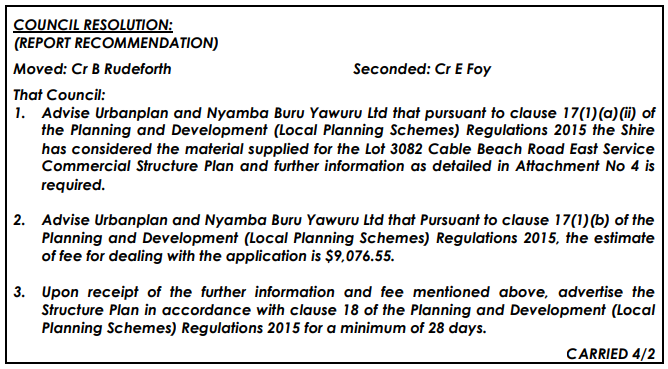
The applicant lodged the Structure Plan with the Shire of Broome on 11 October 2019. The Structure Plan was presented to the Ordinary Meeting of Council on the 21 November 2019, where Council resolved the following:
The further information was received on 10 December 2019 with advertising being undertaken from 19 December 2019 to 16 January 2020.
Site and Surrounds
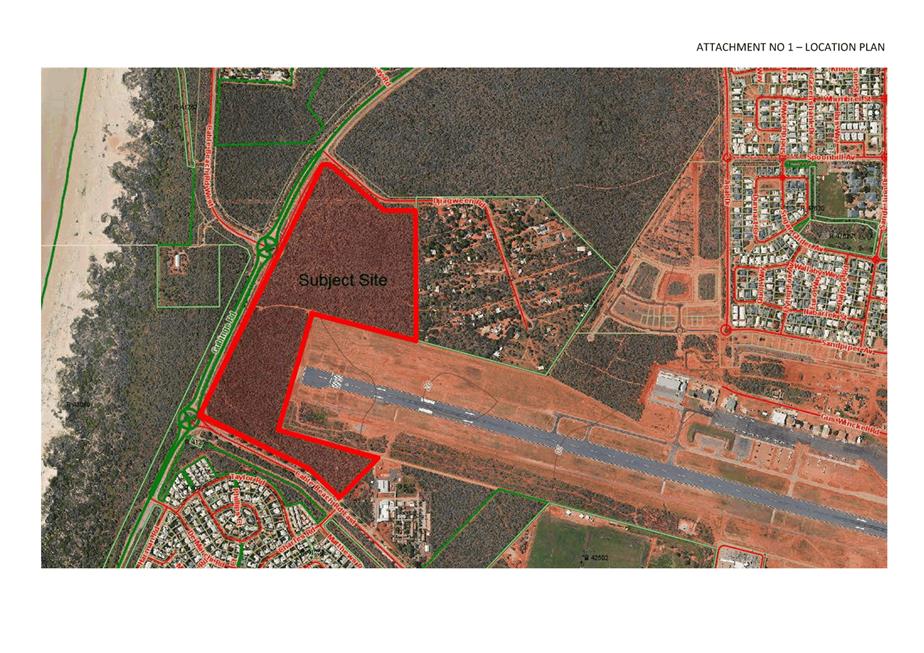
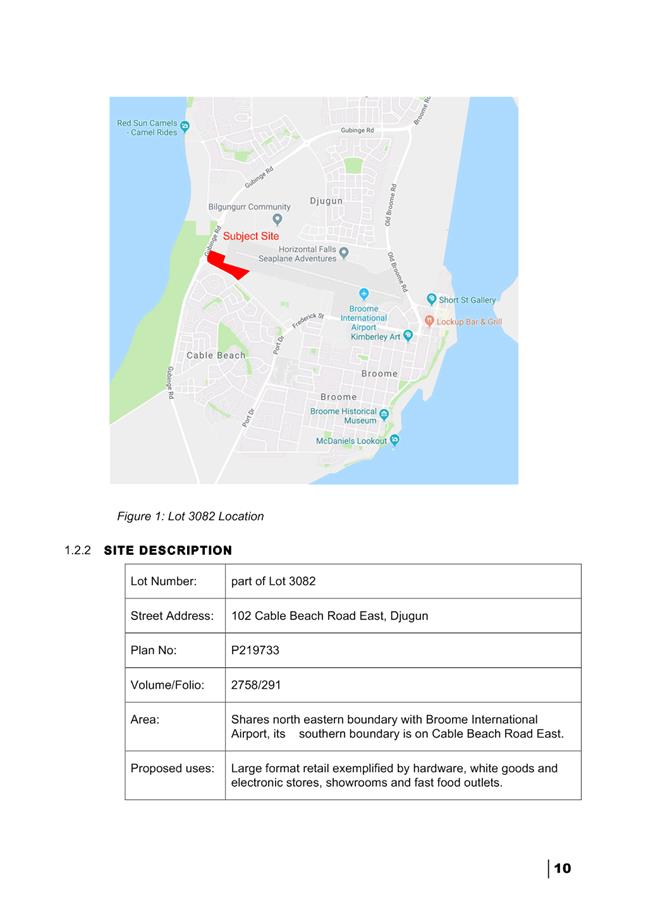
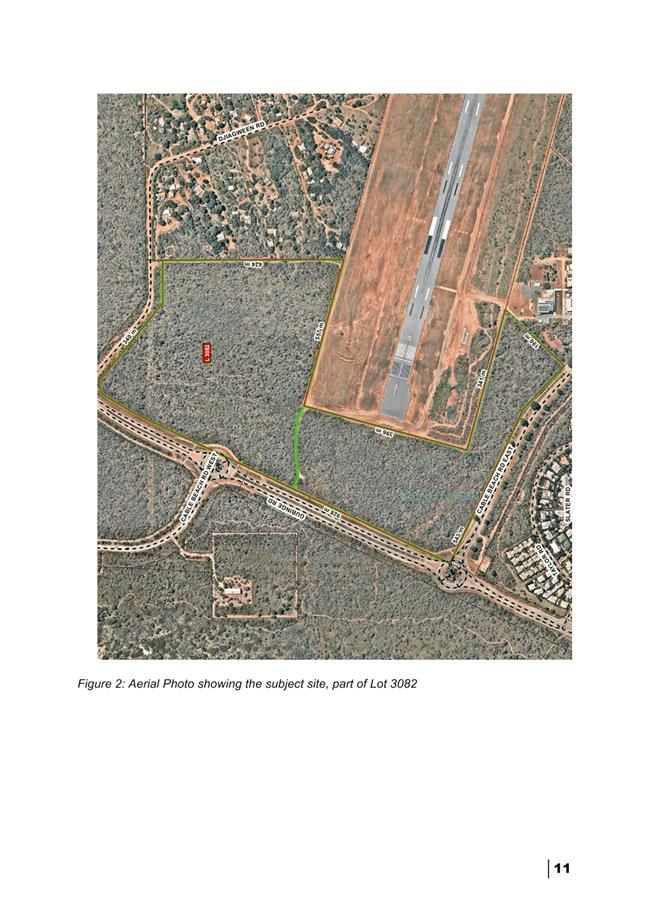
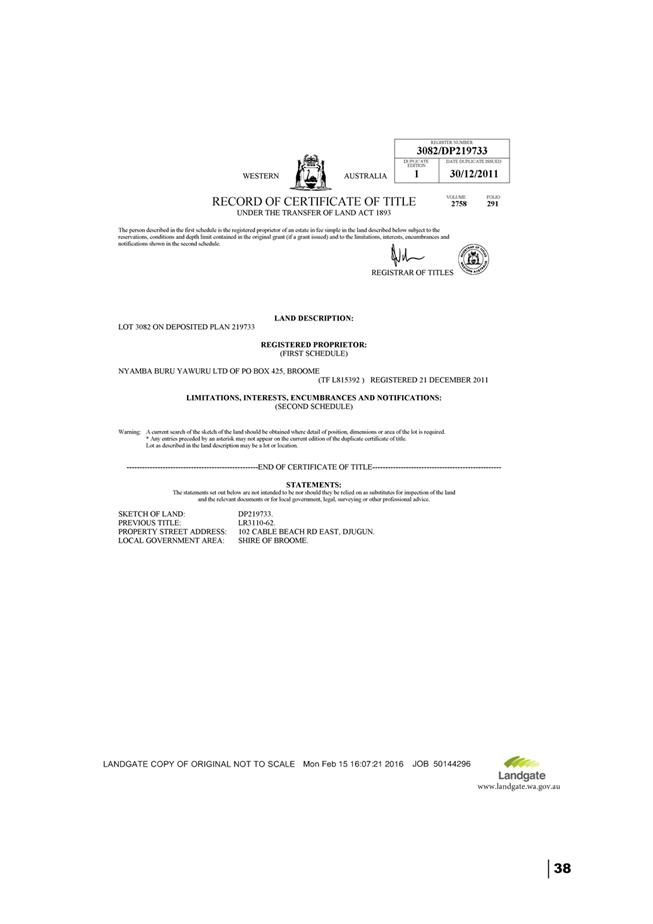
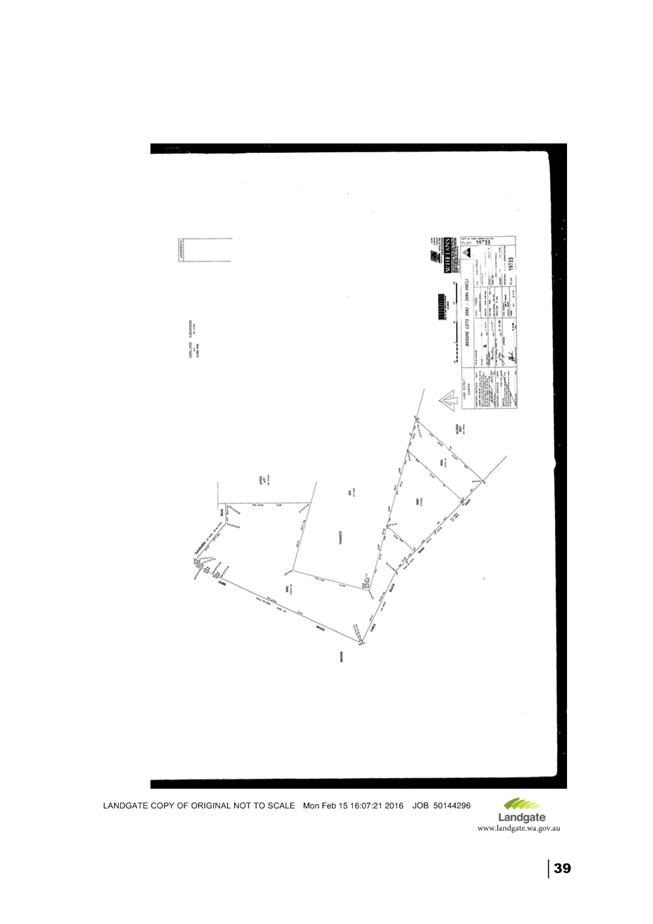
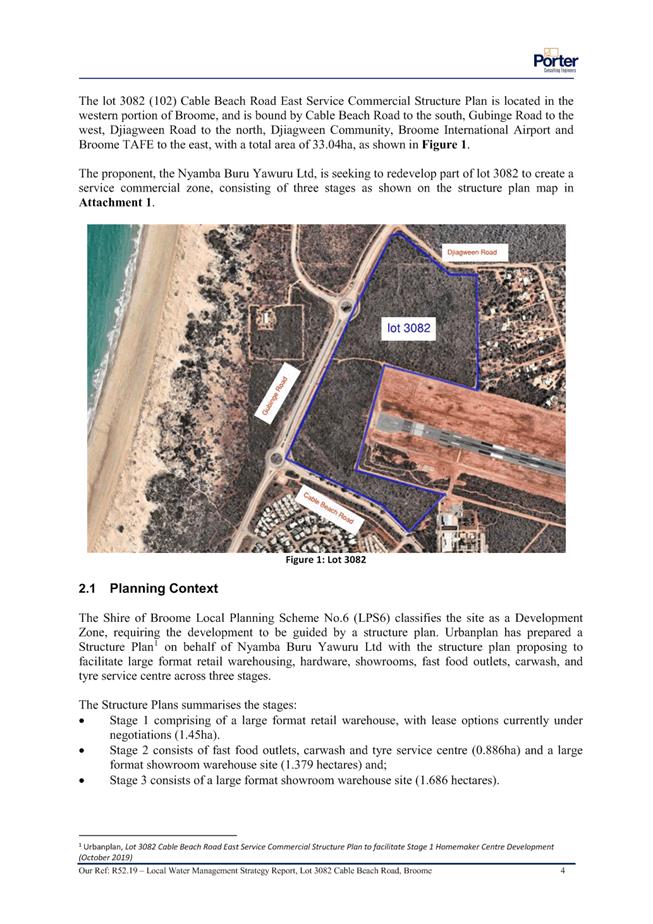
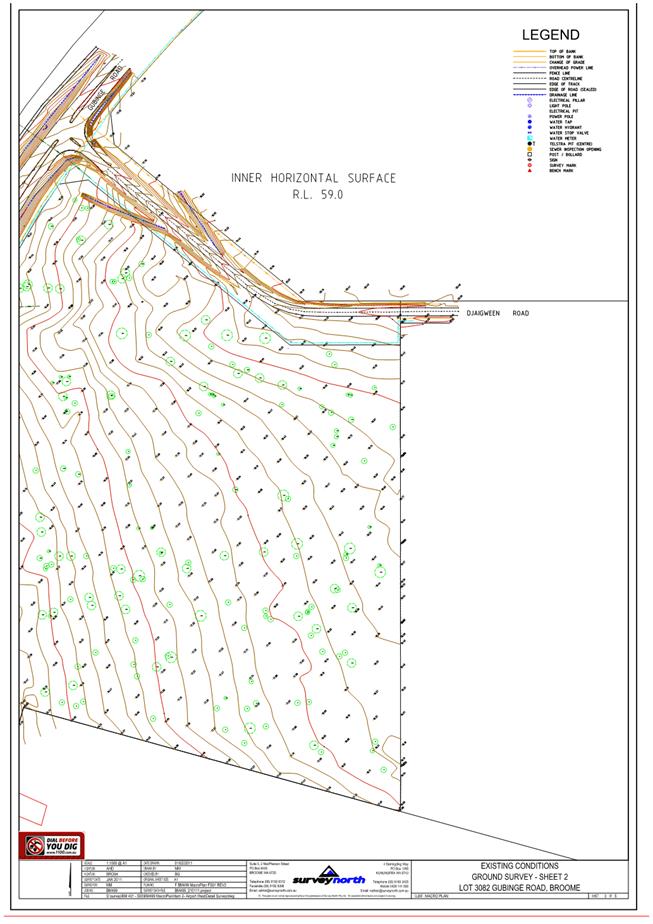
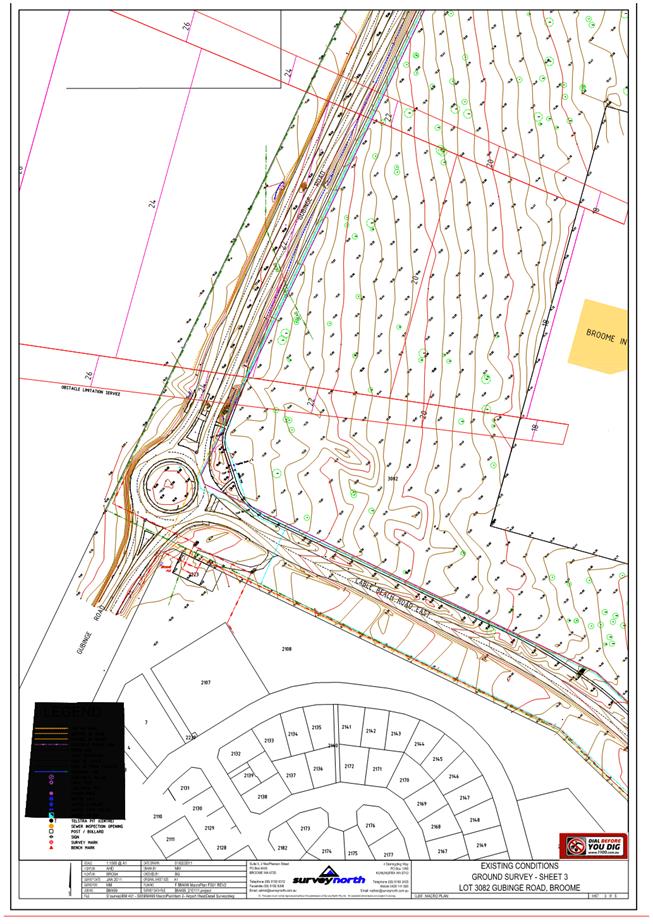
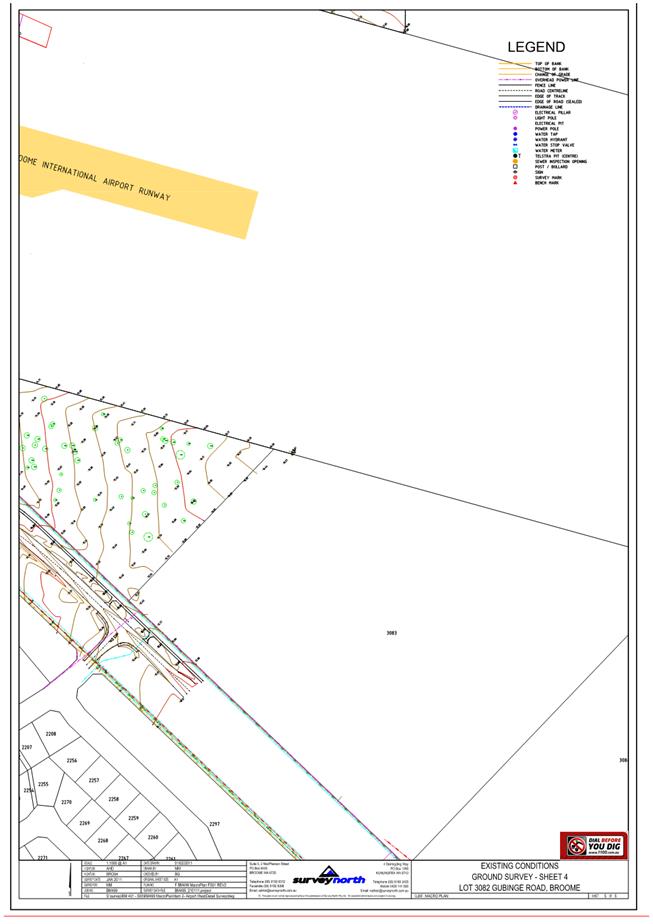
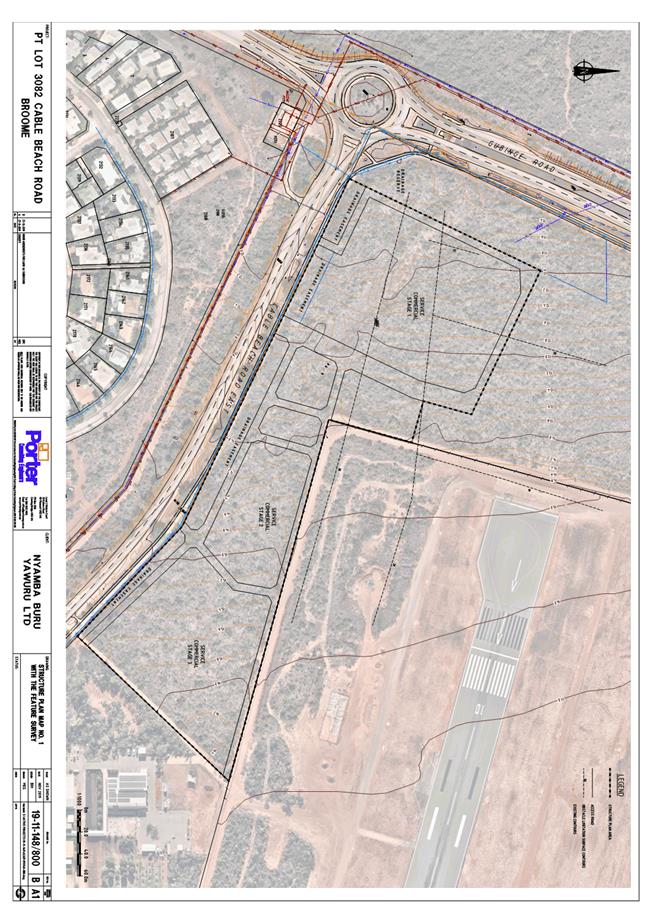
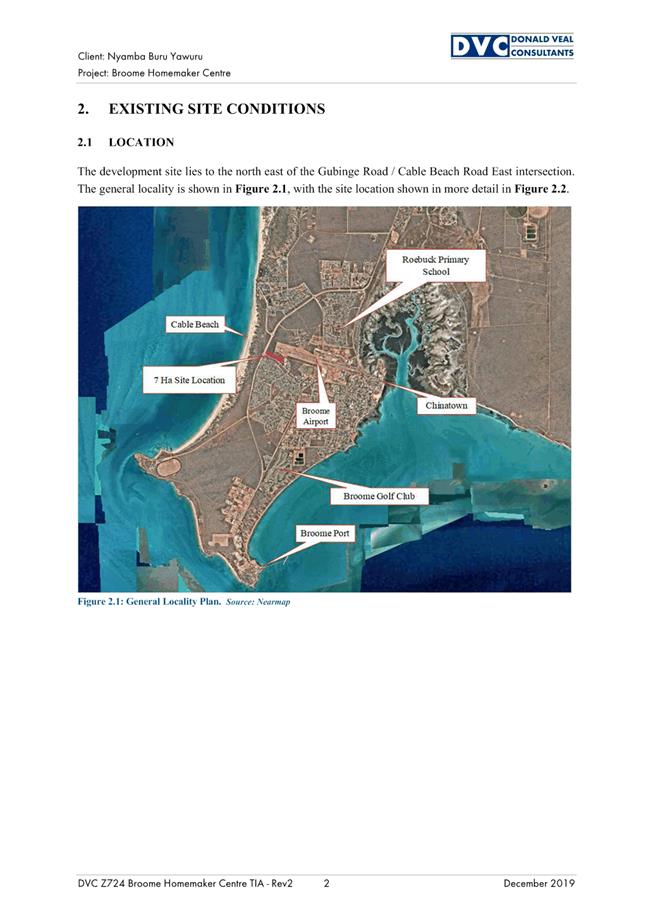
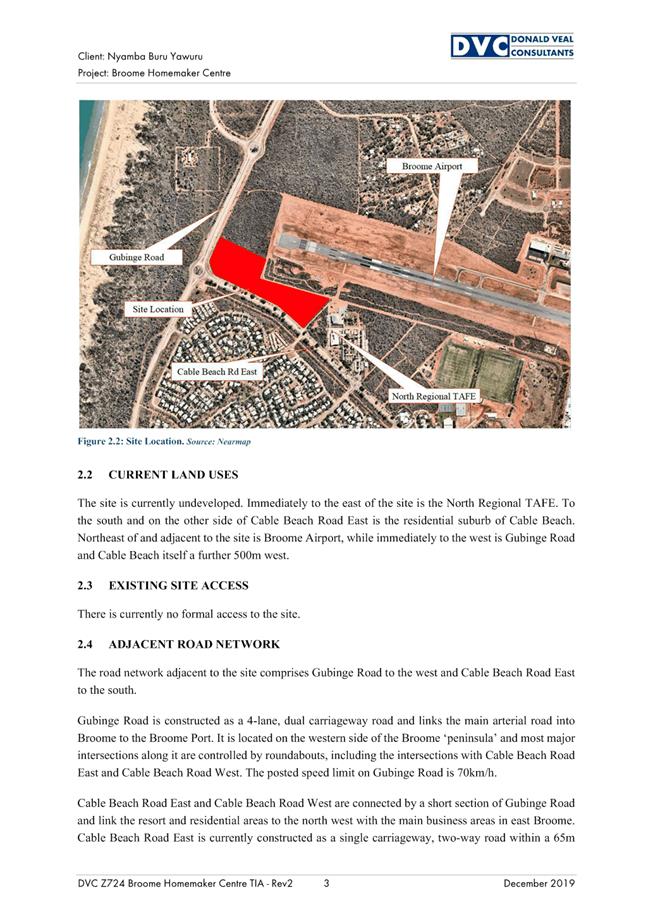
Lot 3082 adjoins Cable Beach Road East to the south, Gubinge Road to the west, Djiagween Road to the north, and the Djiagween Community and Broome International Airport to the east. The site has a total area of 33.04ha and is irregular in shape, as the lot wraps around the eastern extent of the airport runway (see the location plan in Attachment No 1).
The site is vacant and was granted to the Yawuru Native Title Holders Aboriginal Corporation RNTBC through the Indigenous Land Use Agreement (ILUA).
Proposal
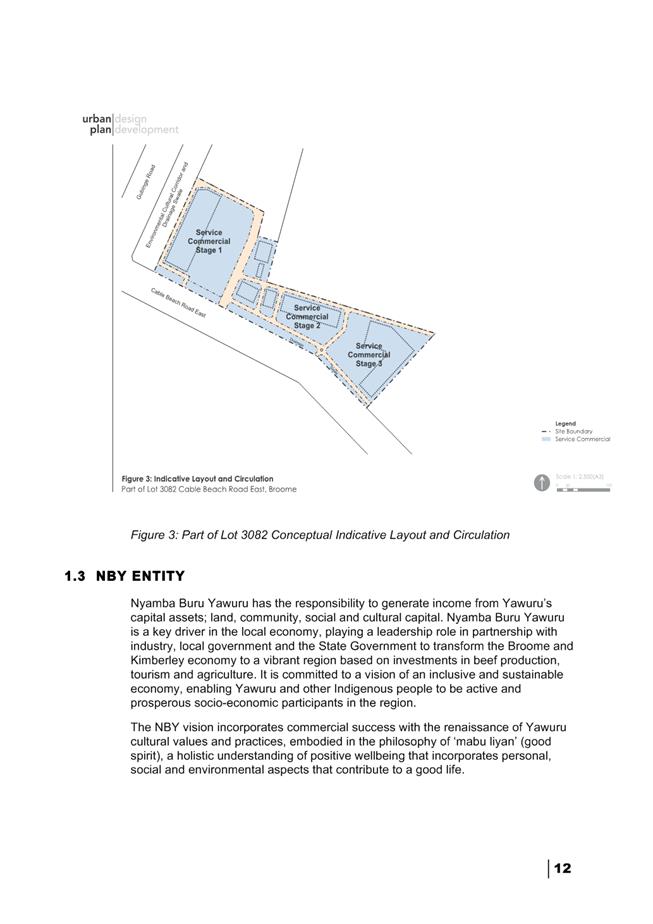
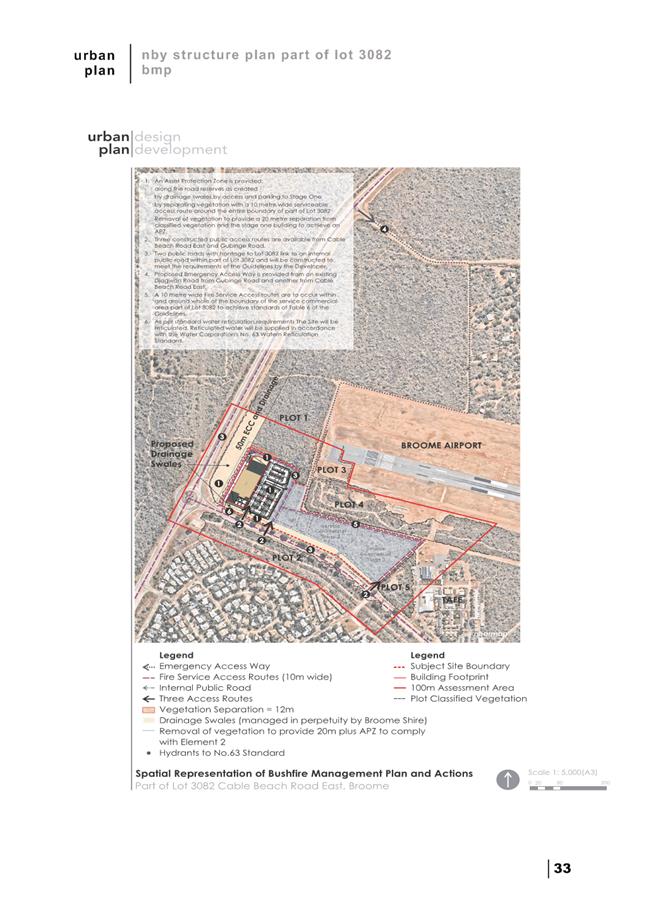
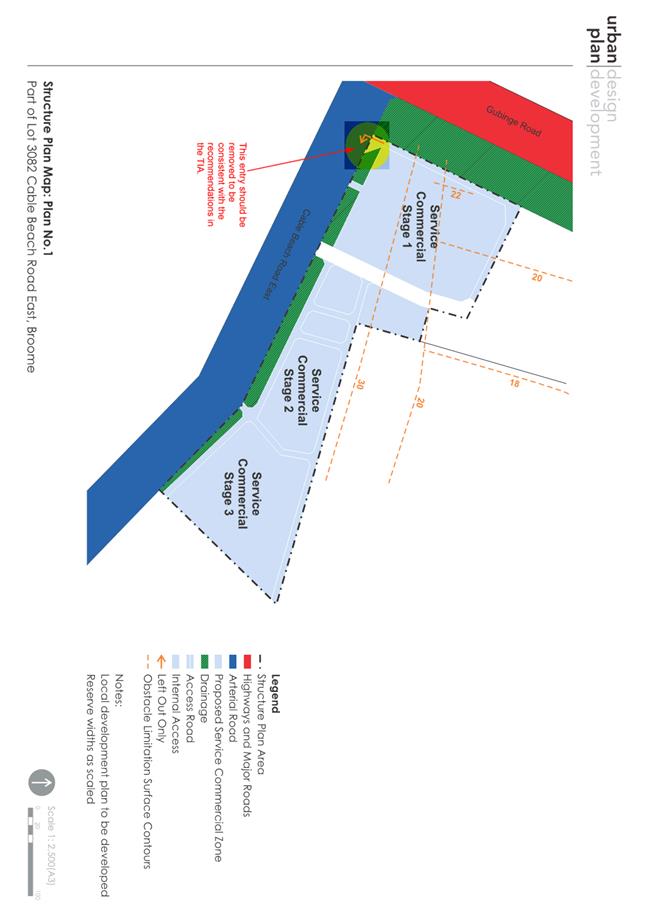
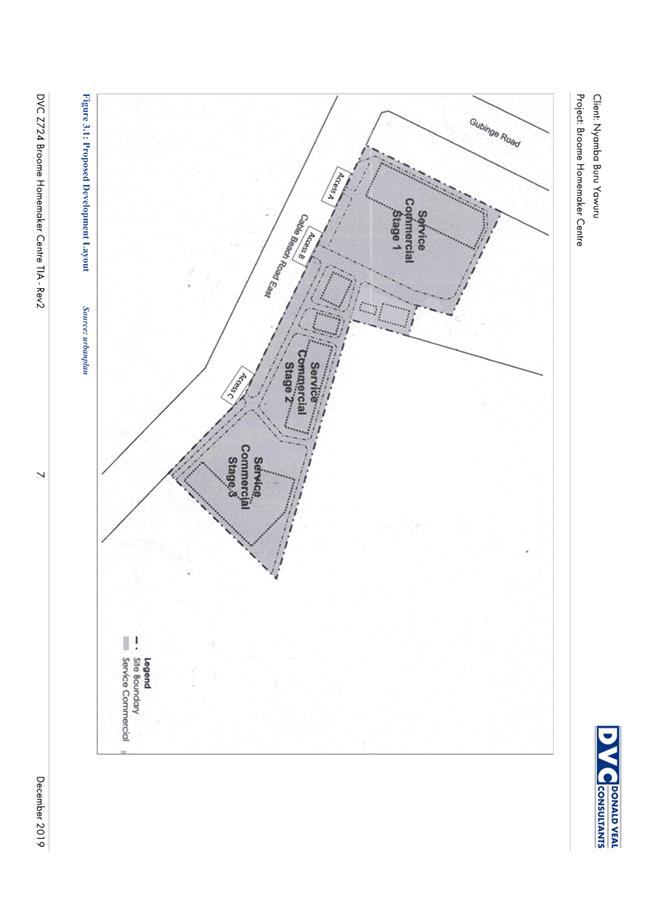
The Structure Plan would apply to a part of Lot 3082, being that portion shown on page 6 and labelled Structure Plan Map: Plan No.1 within the Structure Plan, as shown in Attachment No 2.
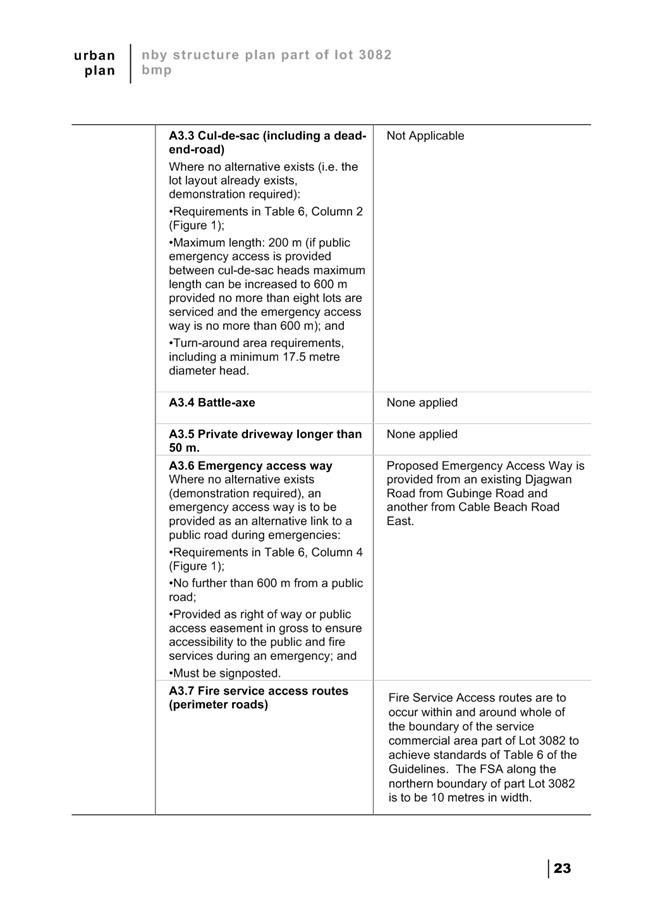
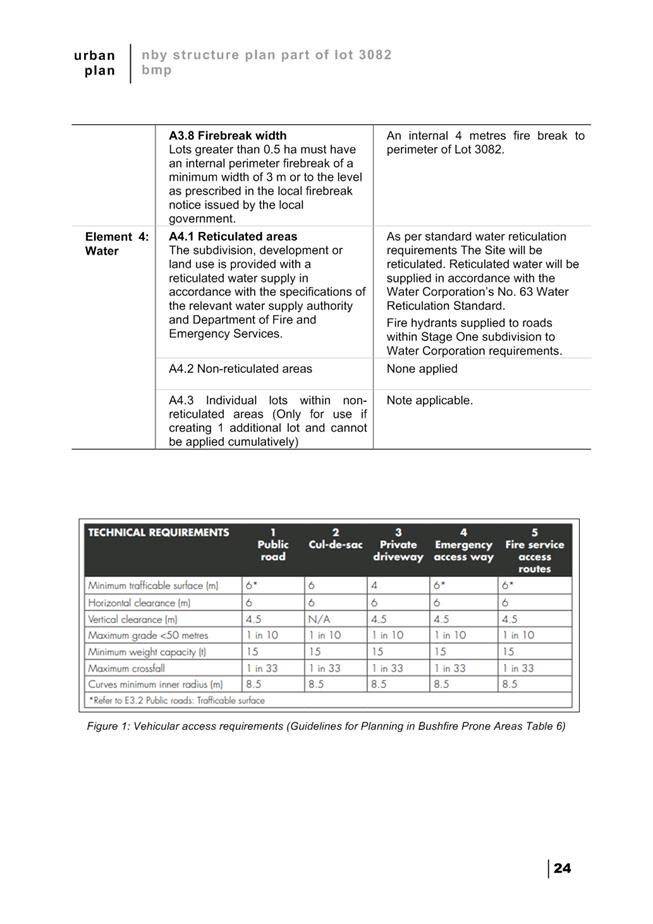
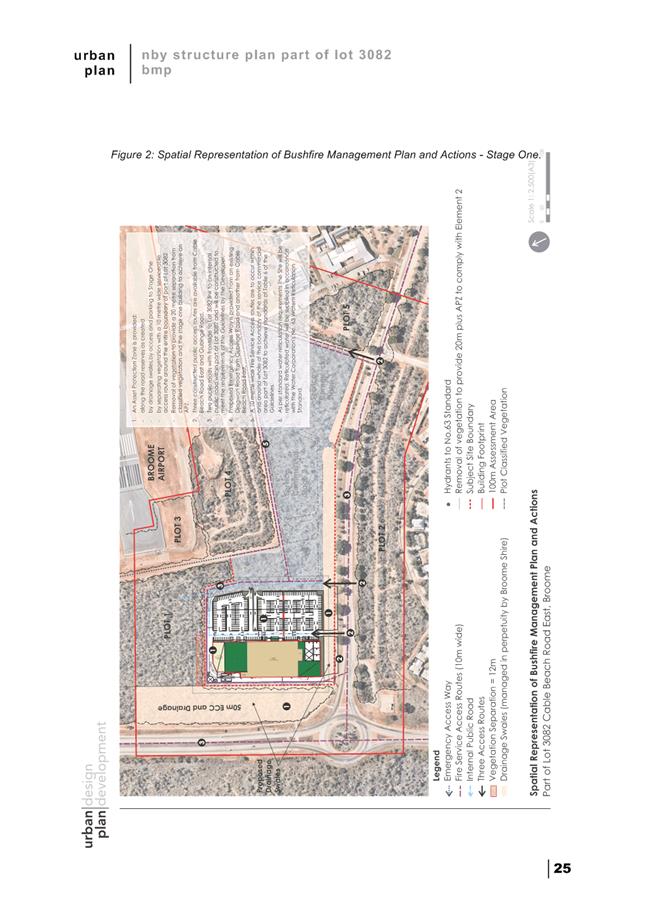
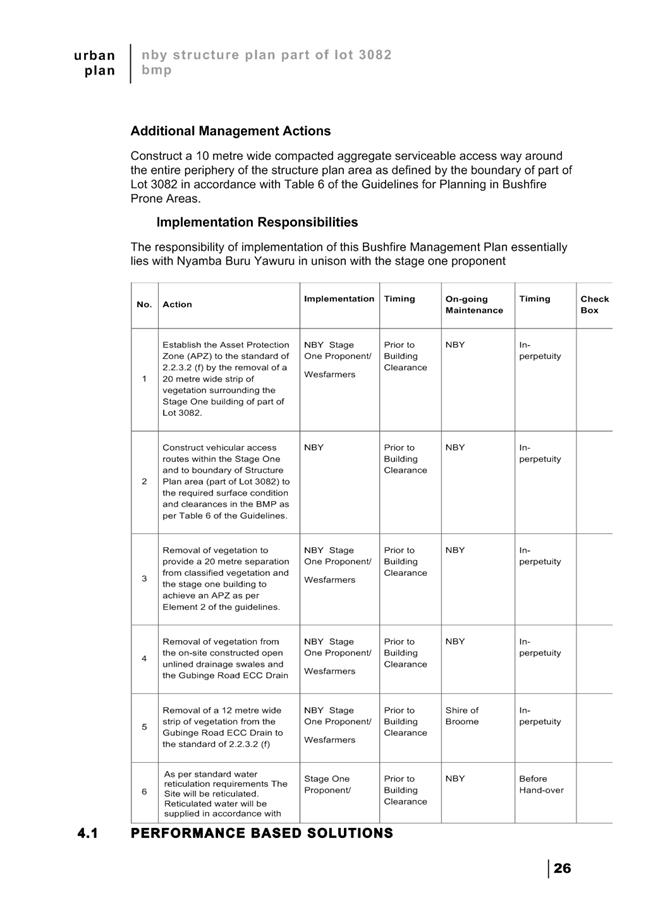
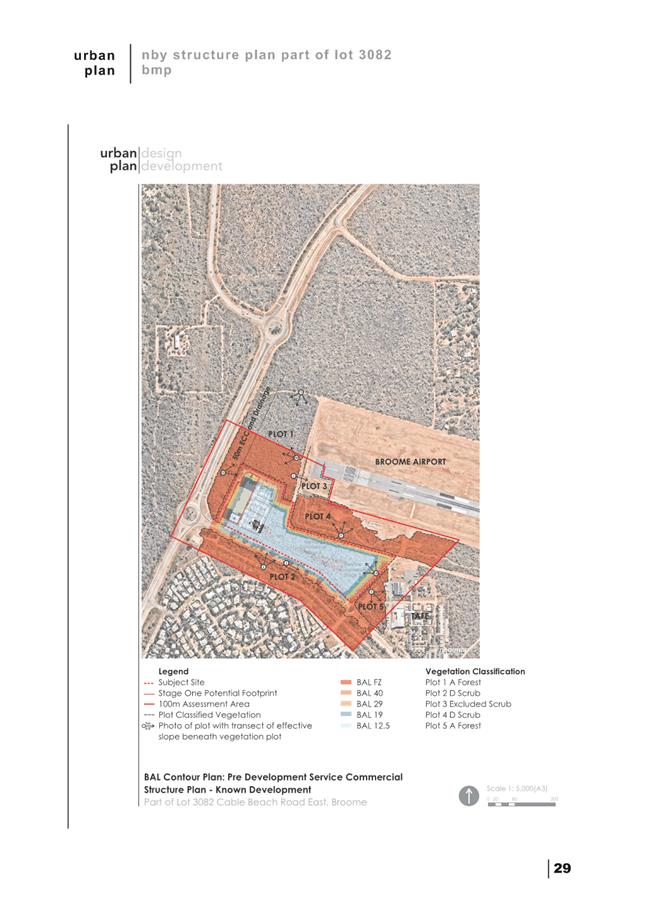
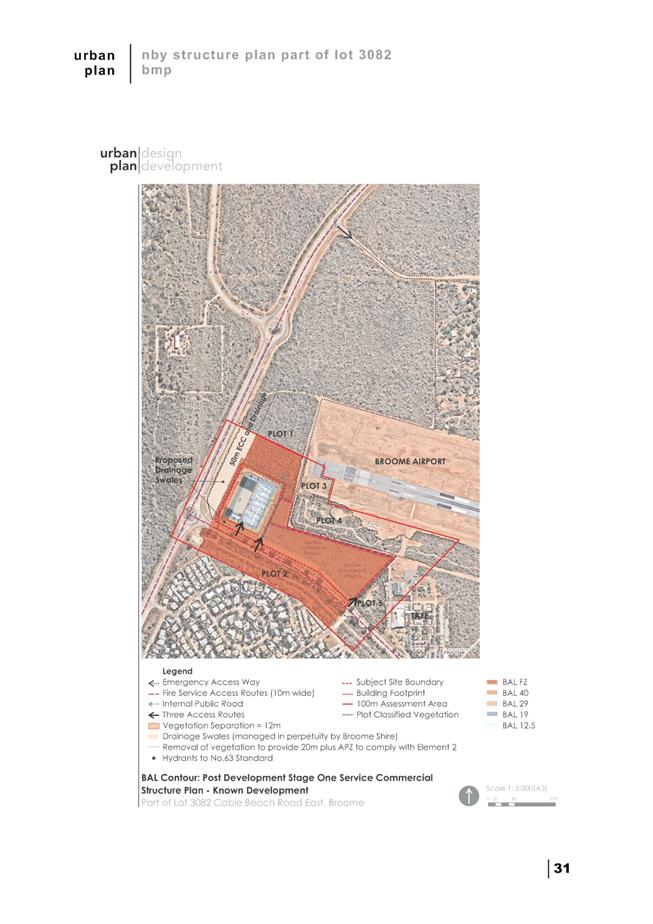
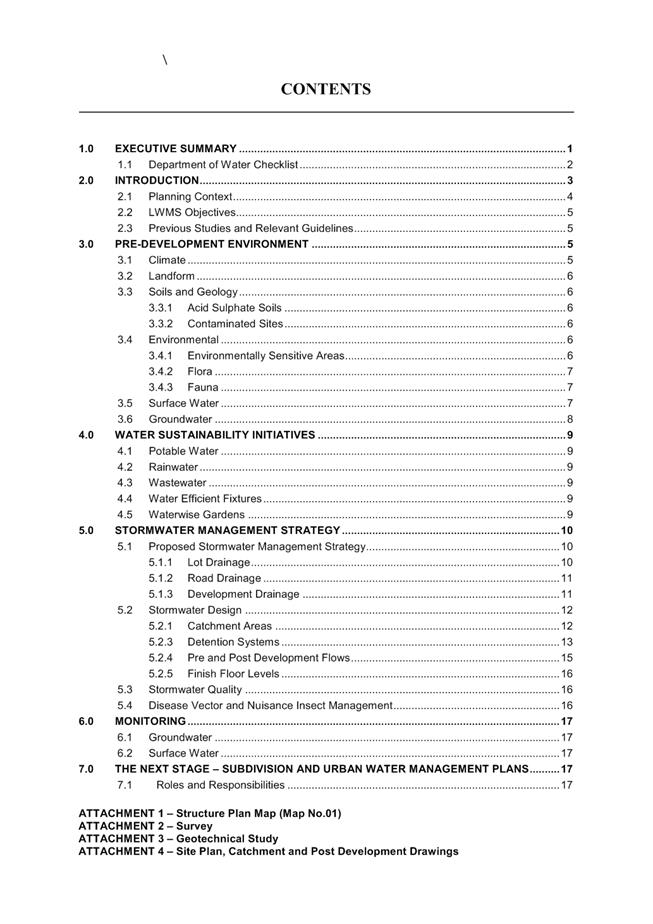
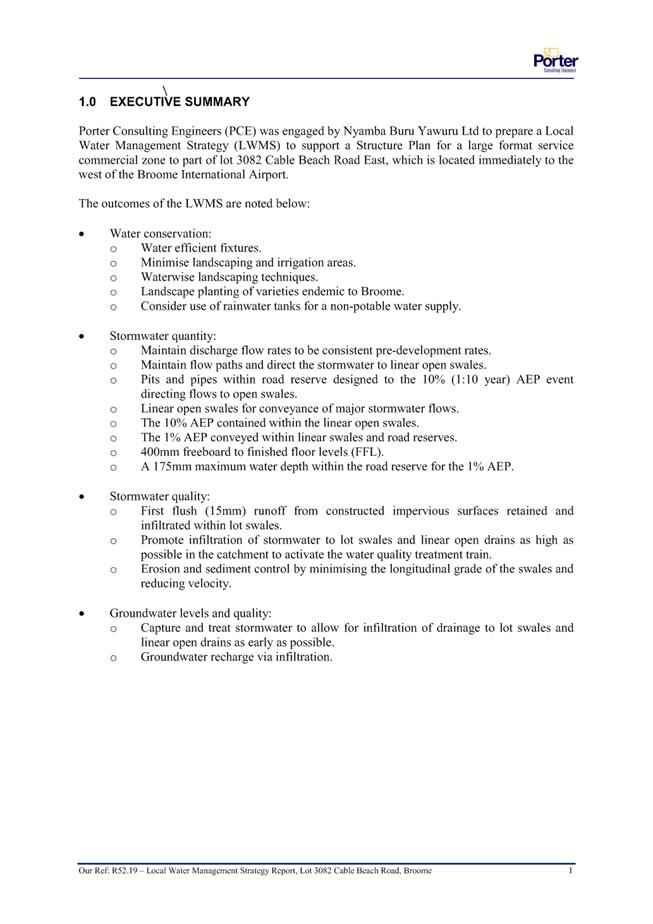
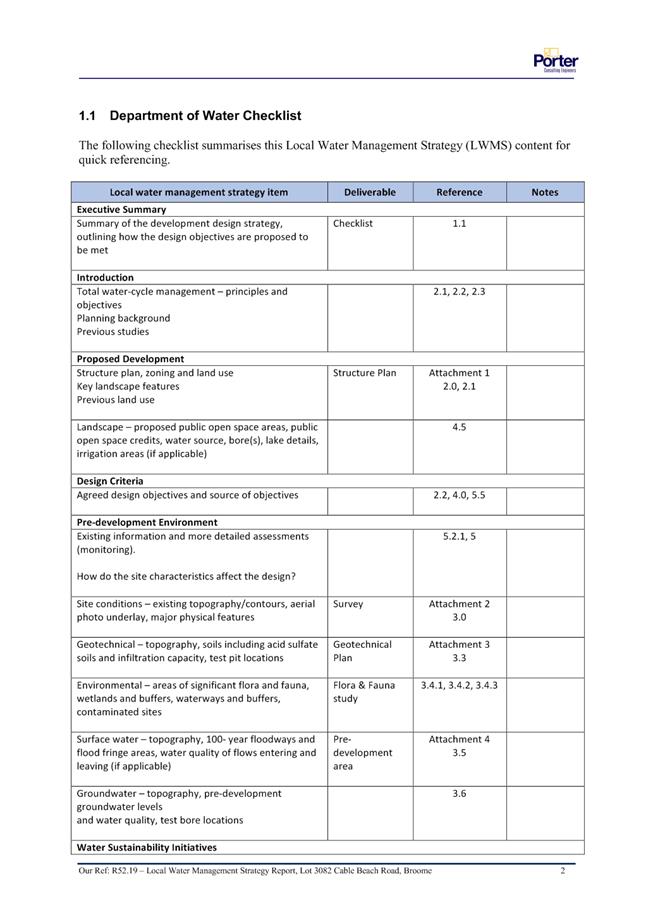
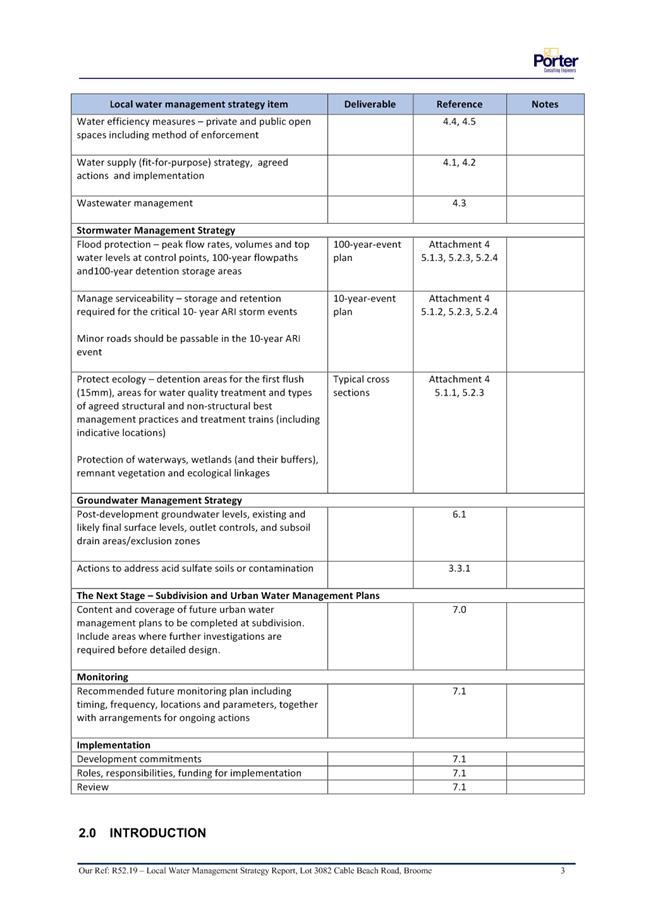
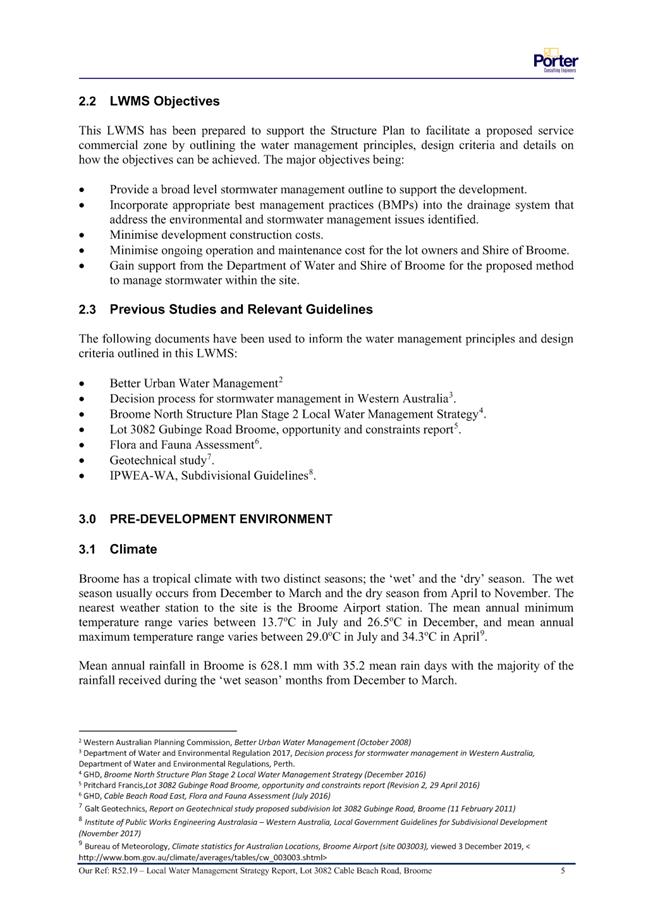
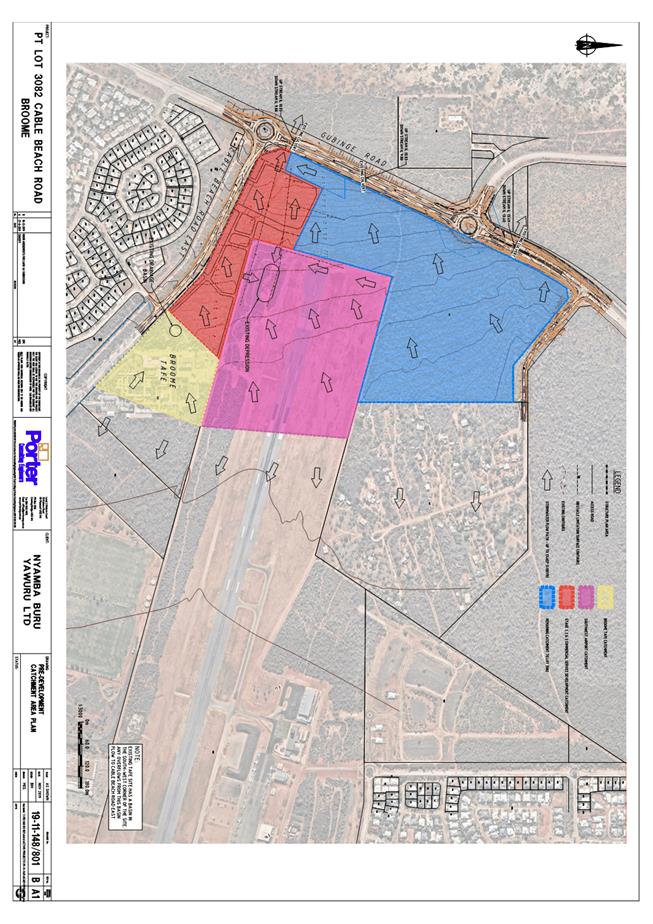
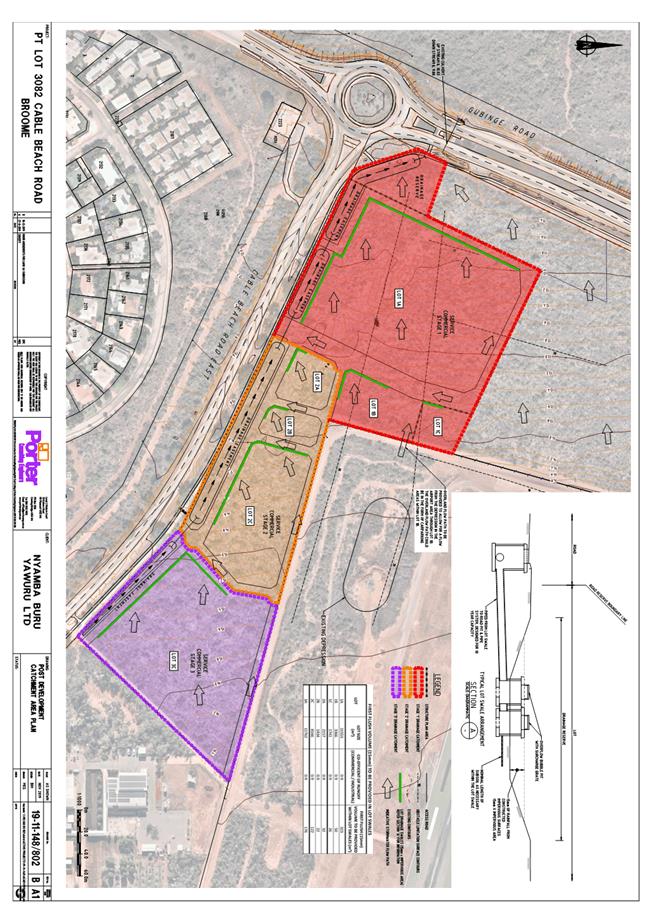
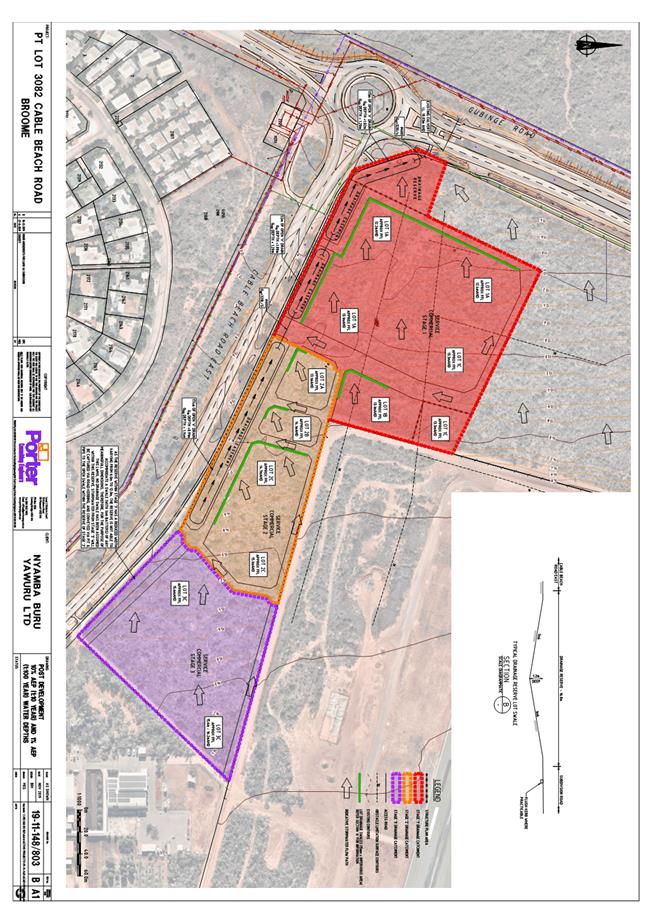
(Note: Appendices to the Structure Plan can be accessed in the previous minutes from the November 2019 Ordinary Council Meeting and are not repeated due to the length. The Bushfire Management Plan (Attachment No 7), Local Water Management Strategy (Attachment No 8) and Transport Impact Assessment (Attachment No 9) are included as changes were requested to these technical appendices as a part of the November 2019 resolution of Council).
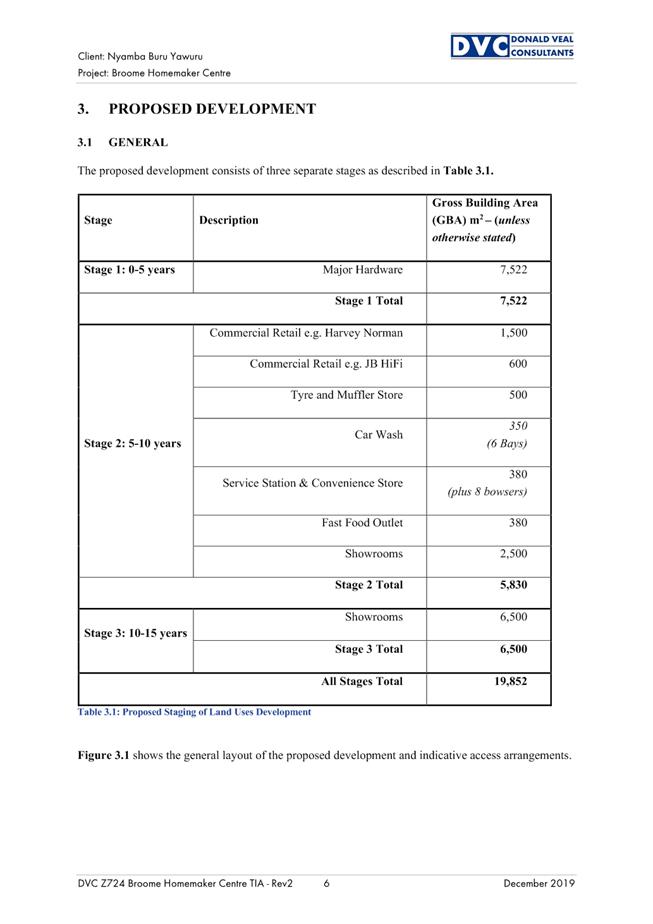
The Structure Plan is proposing that 5.4ha be developed for Service Commercial purposes, allowing for the site to be developed for Service Commercial land uses as set out in the zoning table in Local Planning Scheme No 6, which would allow for fast food outlets, motor vehicle wash, showrooms, warehouses, vehicle tyre sales/repair and motor vehicle, boat or caravan sales and so on. The purposes of the Structure Plan as quoted by the applicant in the Structure Plan Report is:
Part 2, Section 1.1.1 (Purpose) of the Structure Plan states:
The purpose of this Structure Plan is to de-constrain the identified parcel to a development ready position. The aim of this structure plan is to:
• deliver NBY’s vision for the identified parcel;
• achieve Local assessment and State Government approval; and
· facilitate a development application for the stage [1]* large format retail warehousing and subsequent stages of service commercial uses.
*[Note: identification of stage number 1 inserted by Officer to provide clarity]
COMMENT
The proposed Structure Plan, if approved, would enable the site to be developed for Service Commercial purposes in accordance with the zoning table and development standards set out in Local Planning Scheme No 6.
The Structure Plan envisages a range of uses which may include Showrooms, Warehouses, Service Stations and Fast Food Outlet (Drive-Through) which are all “P” permitted uses under the Service Commercial zoning table. However, Development Approval would still be required to assess the details of the proposal including the built form design and site layout.
The Structure Plan has been advertised for public comment as required under the Regulations. Now the public consultation period has closed the Shire must prepare a report on the proposed Structure Plan which is then submitted with the WAPC for determination. The report on the Structure Plan must include the following:
1. A list of the submissions and any comments by the Shire in respect of those submissions;
2. A schedule of any proposed modifications to address issues raised in the submissions;
3. The Shire’s assessment of the proposal based on appropriate planning principles;
4. A recommendation by the Shire on whether the proposed structure plan should be approved by the WAPC, including a recommendation on any proposed modifications.
The comments below will provide an overview of the key components of the report as set out above.
Submissions Received
Public Notice of the proposed Structure Plan was given for the maximum 28 day permitted by the Deemed Provisions. Public Notice was undertaken from 19 December 2019 to 16 January 2020 and included:
1. A notice being placed in the Broome Advertiser;
2. A notice on the Shire website under the ‘Have my Say’ section;
3. Letters being sent to Landowners within 100m of the Structure Plan boundary;
4. Letters being sent to potentially impacted service providers and Government Agencies; and
5. A notice being placed on site along the Cable Beach Road East frontage.
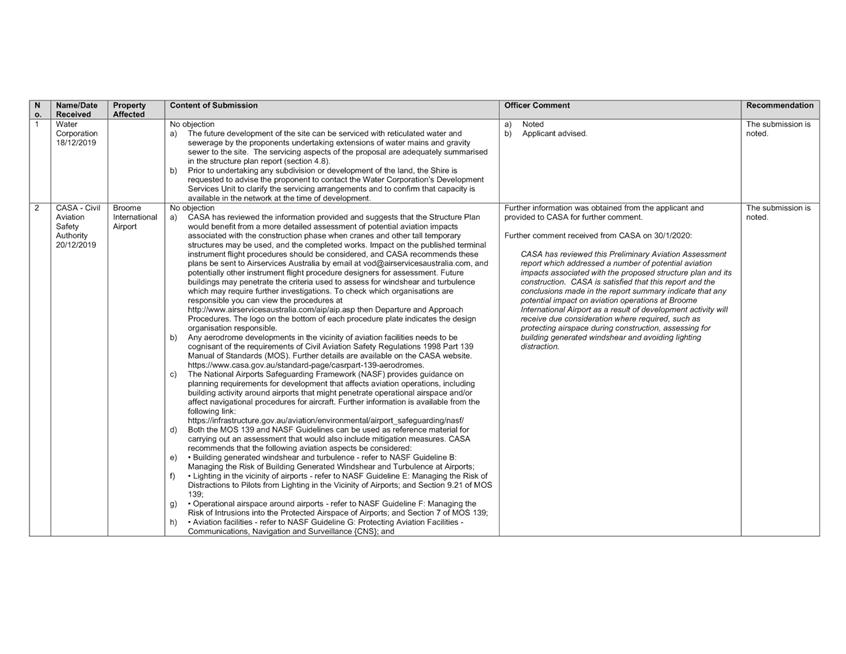
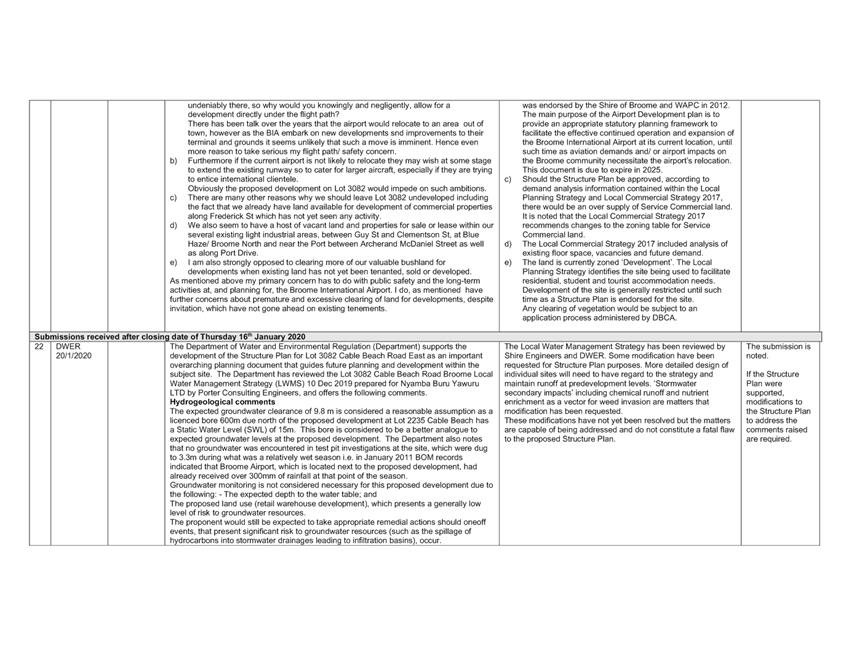
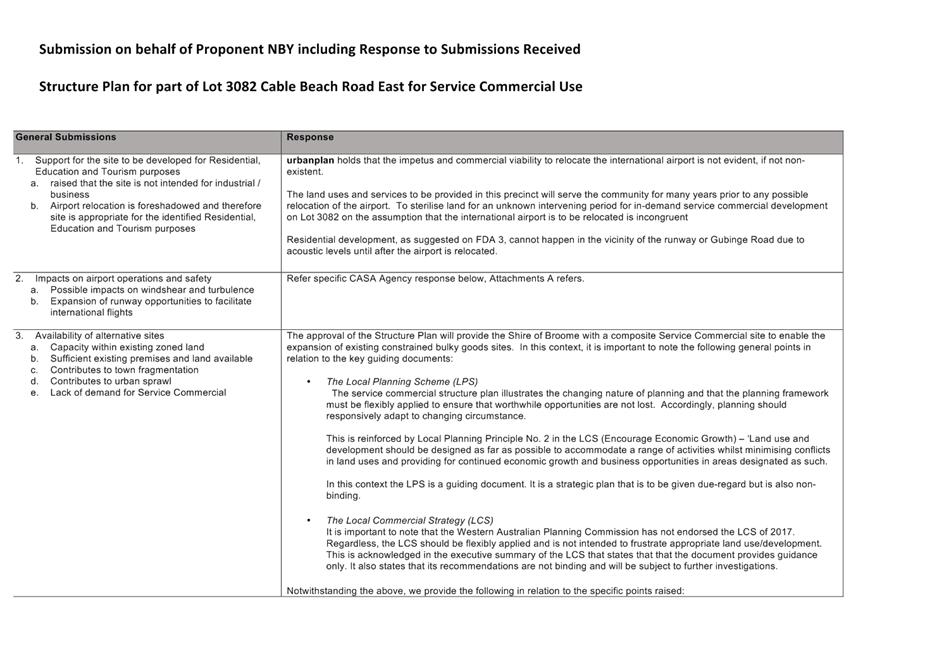
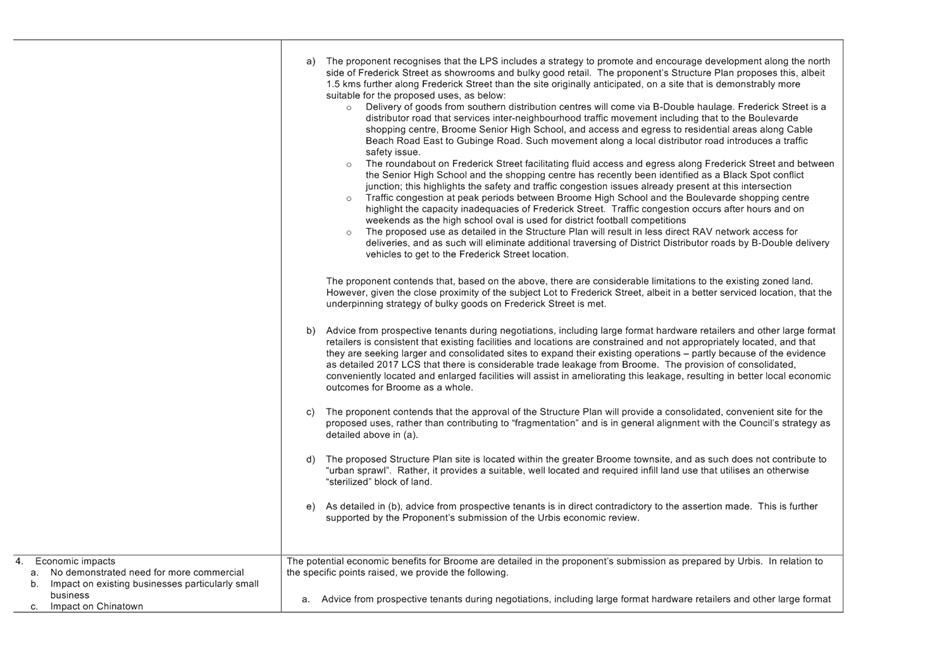
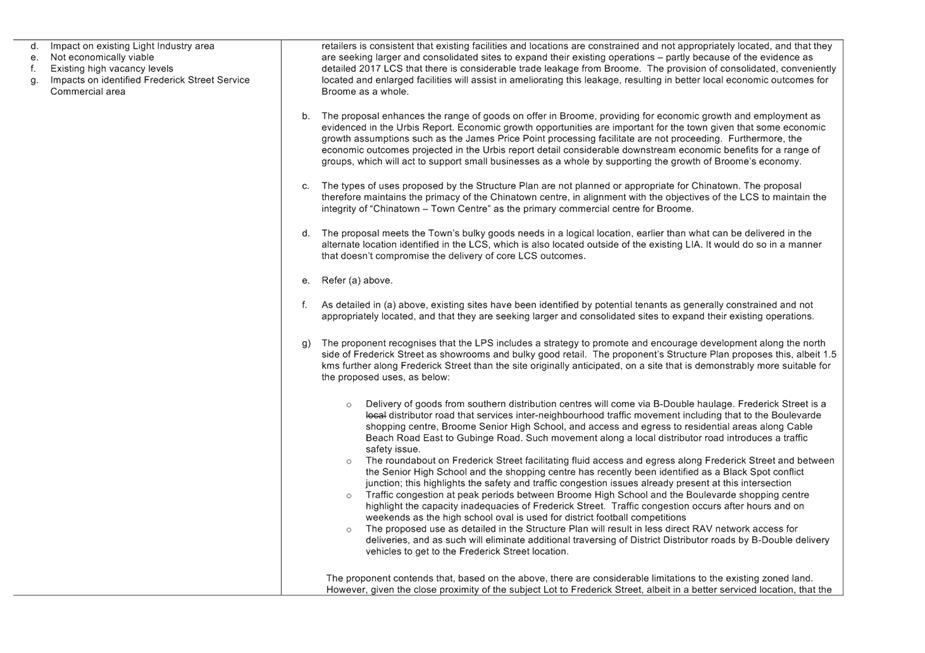
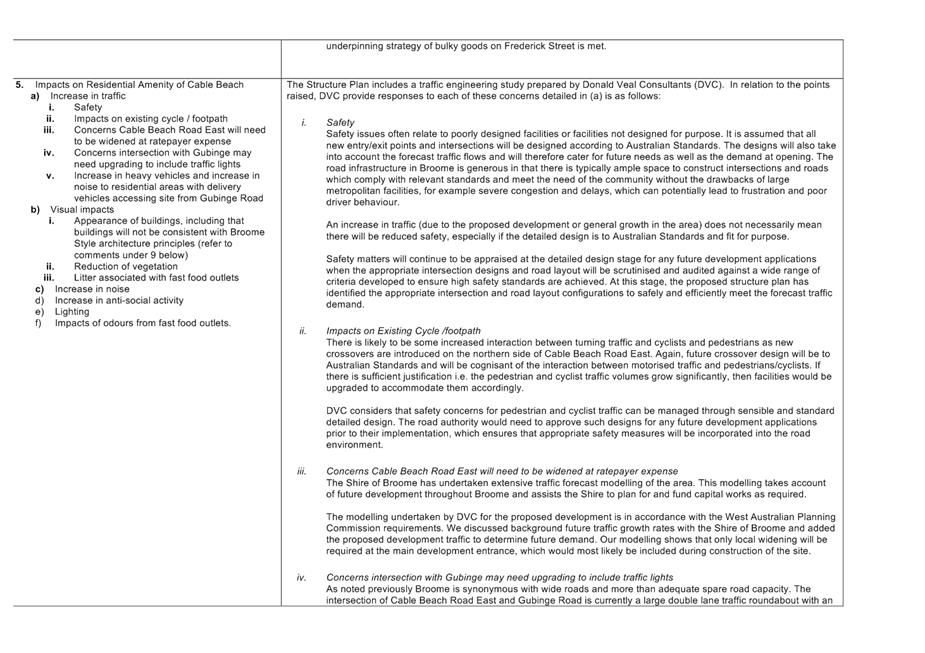
Twenty three (23) submissions were received in response to the Structure Plan. Of these five (5) were from service providers or Government agencies with three (3) offering no objection and two (2) requiring further information and/or changes to technical appendices. Of the eighteen (18) community submissions, seventeen (17) oppose the Structure Plan and one (1) supported it. The submission in support was provided by the landowner NBY.
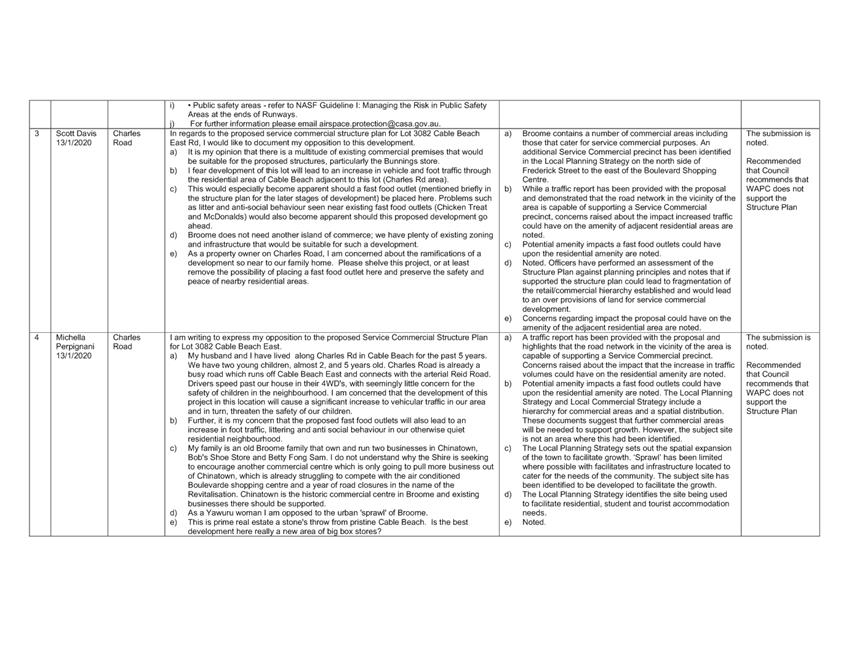
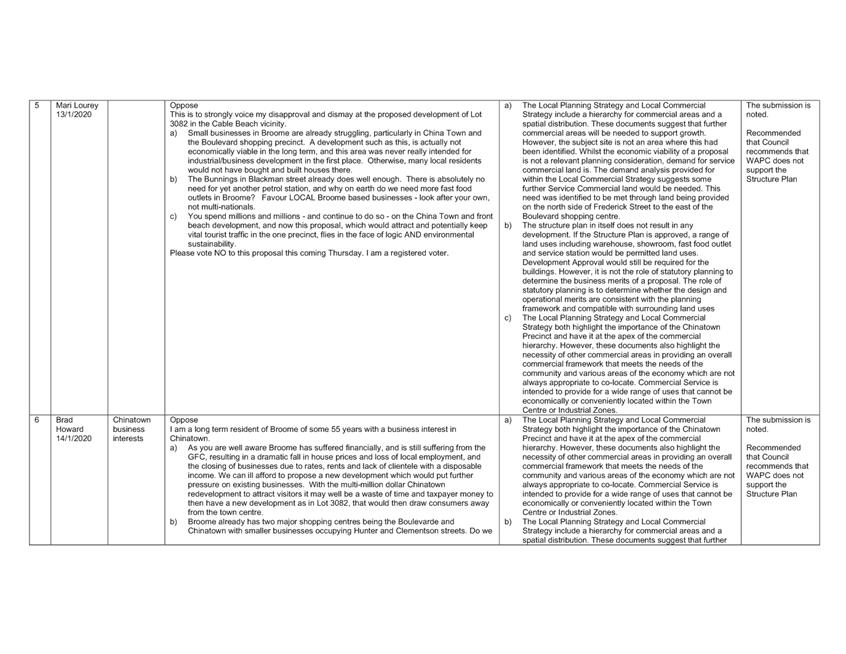
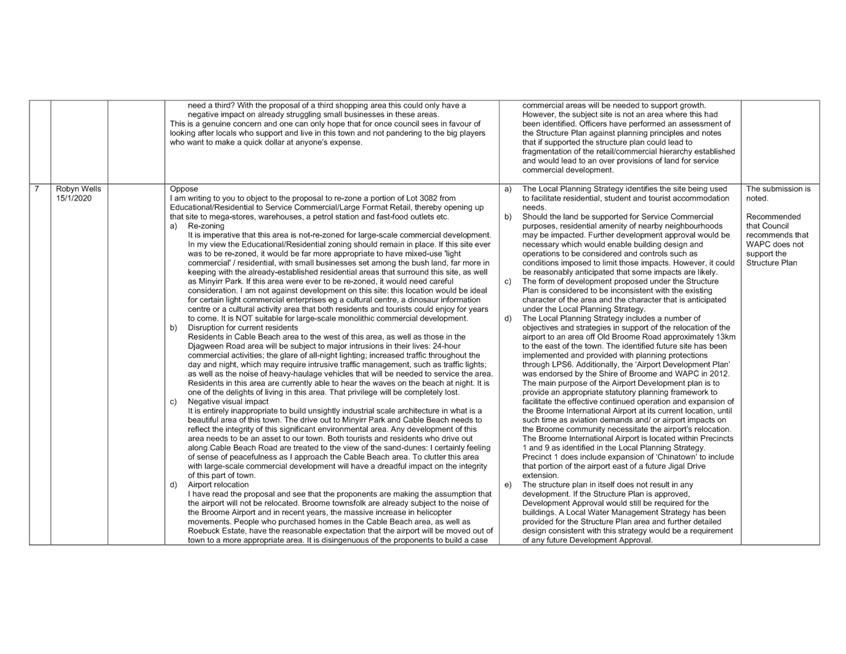
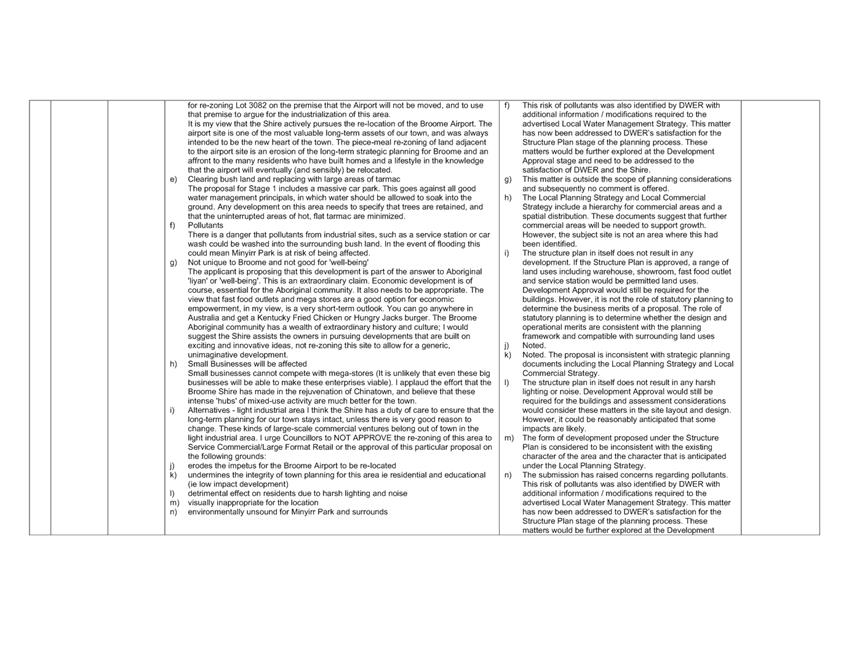
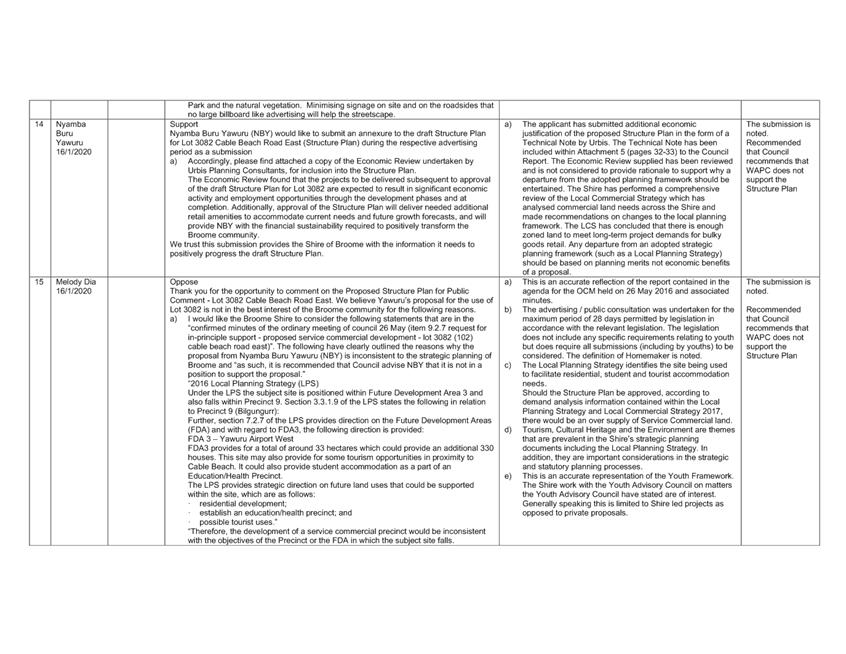
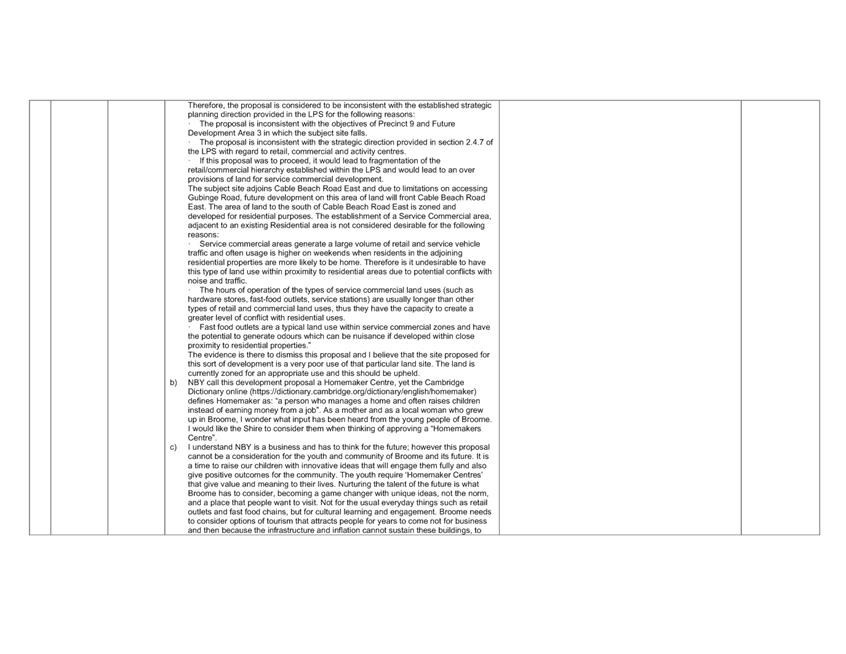
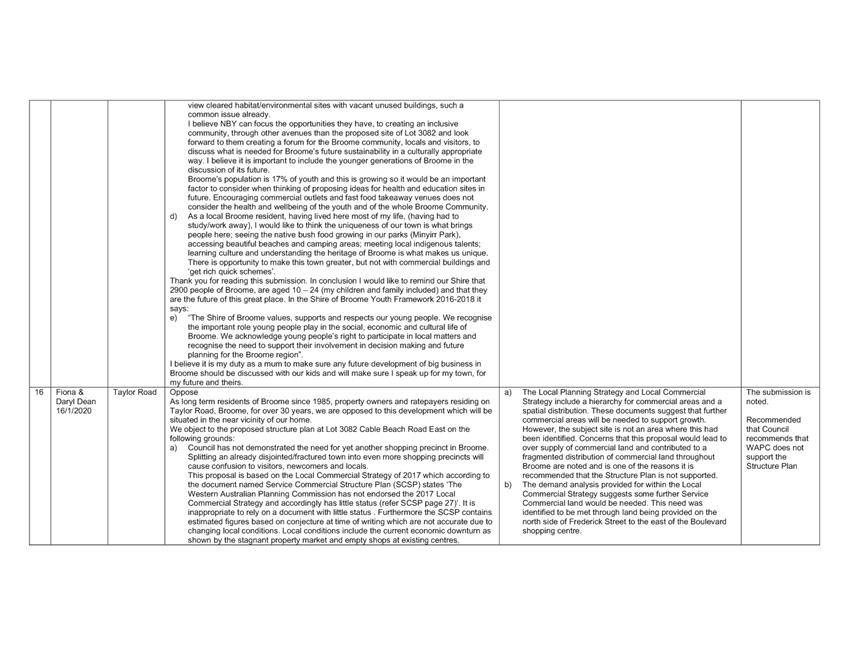
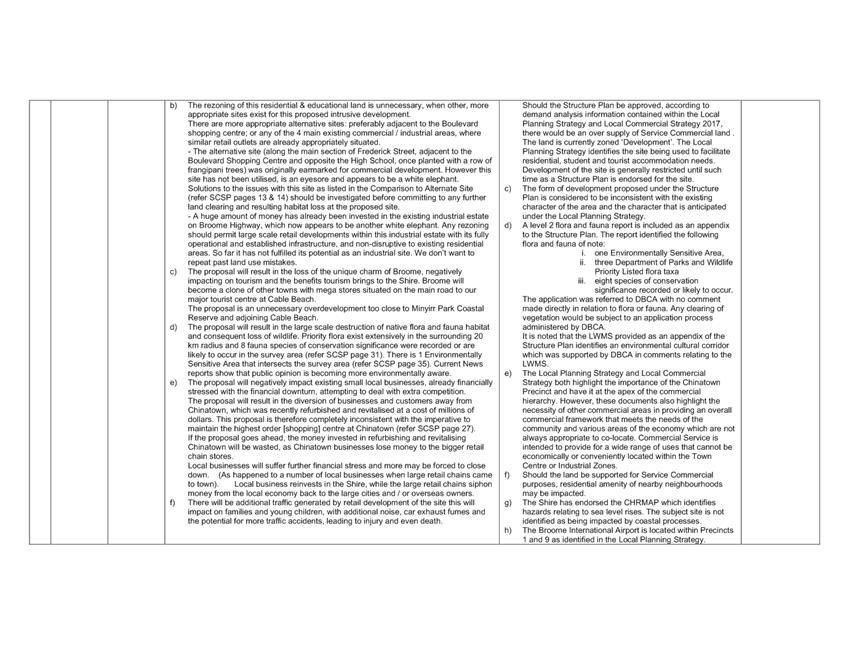
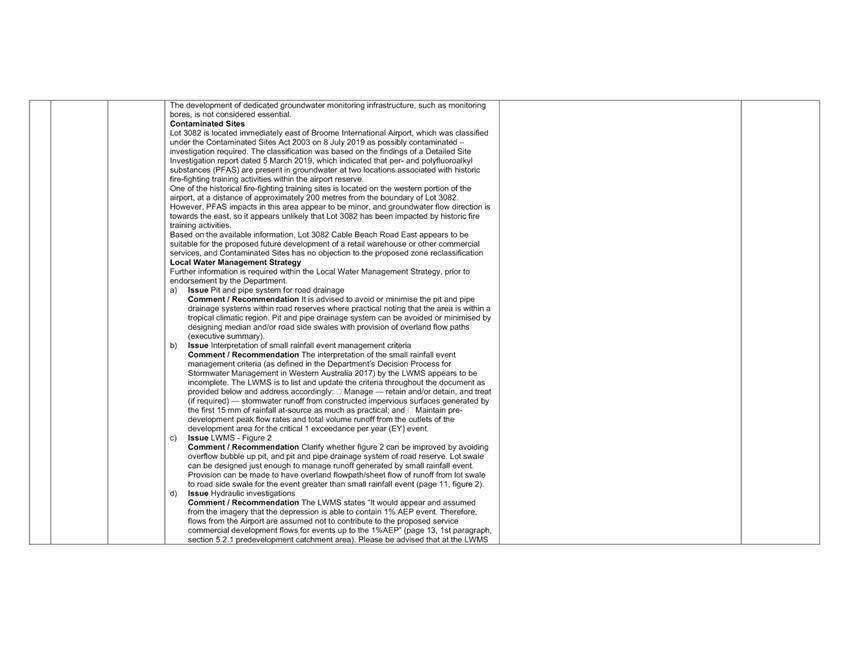
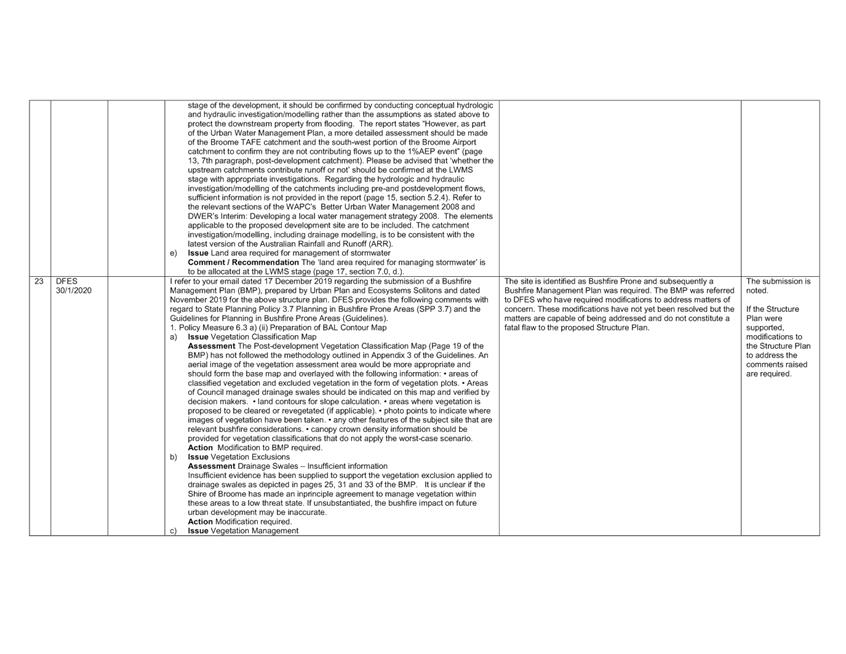
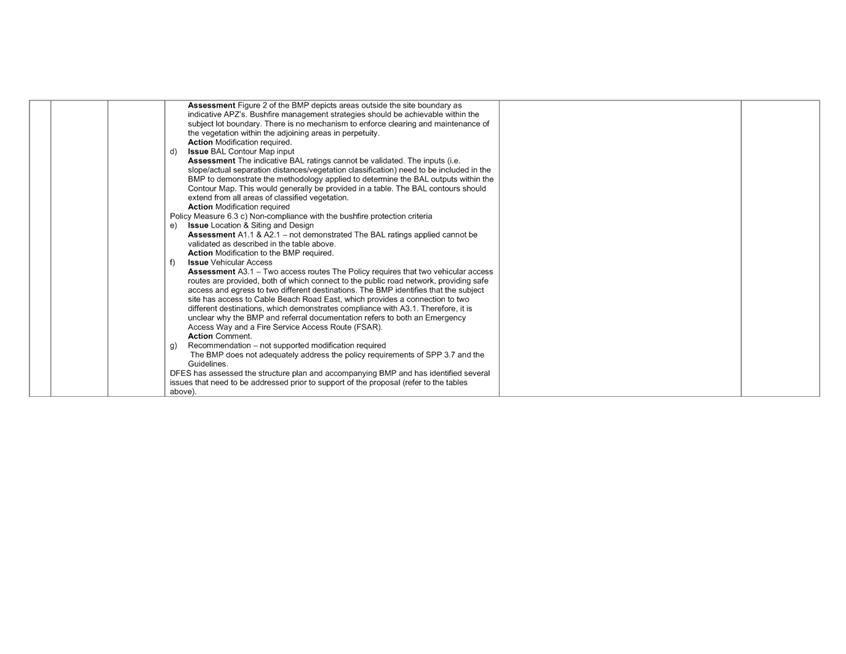
Many submissions are of significant length and detail. A full copy of the submissions received, and officer’s comments are set out in Attachment No 4 – Schedule of Submission. Issues have been summarised to the following 16 points. Issues range from being raised in a single submission to others that were raised in the majority of submissions.
1. Provided support for the site to be developed for Residential, Education and Tourism purposes and:
a. raised that the site is not intended for commercial/business; and
b. Airport relocation is foreshadowed and therefore site is appropriate for the identified Residential, Education and Tourism purposes
2. Impacts on airport operations and safety:
a. Possible impacts on windshear and turbulence; and
b. Expansion of runway opportunities to facilitate international flights.
3. Availability of alternative sites for the proposed land uses including:
a. Capacity within existing zoned land;
b. Sufficient existing premises and land available;
c. Contributes to town fragmentation;
d. Contributes to urban sprawl; and
e. Lack of demand for Service Commercial.
4. Economic impacts, including:
a. No demonstrated need for more commercial land;
b. Impact on existing businesses particularly small business;
c. Impact on Chinatown;
d. Impact on existing Light Industry area;
e. Not economically viable;
f. Existing high vacancy levels; and
g. Impacts on identified Frederick Street Service Commercial area.
5. Impacts on Residential Amenity of Cable Beach, including:
a. Increase in traffic and potential impacts this could have upon:
i. Safety;
ii. Impacts on existing cycle / footpath;
iii. Concerns Cable Beach Road East will need to be widened at ratepayer expense;
iv. Concerns intersection with Gubinge may need upgrading to include traffic lights; and
v. Increase in heavy vehicles and increase in noise to residentials areas with delivery vehicles accessing site from Gubinge Road.
b. Visual impacts, including:
i. Appearance of buildings, including that buildings will not be consistent with Broome Style architecture principles (refer to comments under 9 below);
ii. Reduction of vegetation; and
iii. Litter associated with fast food outlets.
c. Increase in noise;
d. Increase in anti-social activity;
e. Lighting; and
f. Impacts of odours from fast food outlets.
6. Opposition to potential future land uses, including:
a. Bunnings;
b. fast food outlets;
c. petrol / service station; and
d. Large multi national corporations.
7. Environmental impacts on Minyirr Park, including:
a. Risk of pollutants related to Service Commercial / Industrial development runoff;
b. Risk of weeds and introduced species resulting from water runoff;
c. Increased flooding / water runoff resulting from water management of structure plan site; and
d. Secondary impacts of stormwater on Minyirr Park should be considered.
8. Inadequate response to water management:
a. Increased stormwater runoff; and
b. Water quality / pollutant concerns.
9. Impact on Broome’s unique character;
a. Submitters raised that the site is on a tourist / recreation route and links Chinatown to Cable Beach and is a popular bicycle trail.
b. Site has valued scenic / natural state and development would result in loss of vegetation and impacts on flora and fauna.
c. Lack of design standards to reflect Broome character.
d. Request the design guidelines be developed.
10. Inconsistent with strategic documents which have undergone community consultation and adopted by Council, including:
a. Local Planning Strategy; and
b. Local Commercial Strategy.
Some submitters raised that proposal should not be considered reactively but part of whole of town / shire plans.
11. Inadequate consultation, including:
a. Timing over Christmas / New Year; and
b. Consultation with youth.
12. Heat island / thermal mass concerns particularly relating to large car park areas, concerns over inadequate landscaping.
13. Structure plan is confusing and inconsistent in how different matters are addressed.
14. Financial security / reward is not a relevant planning consideration.
15. Concerns development / profit making business will be administered from rate exempt location on Reid Road.
16. Concern that community will not get an opportunity to comment on the development application when submitted.
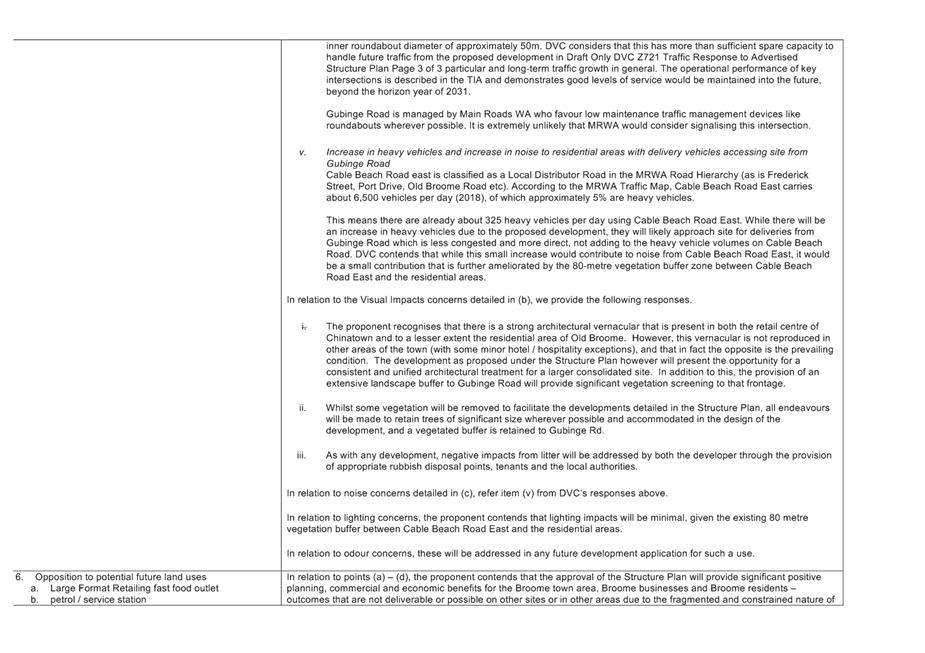
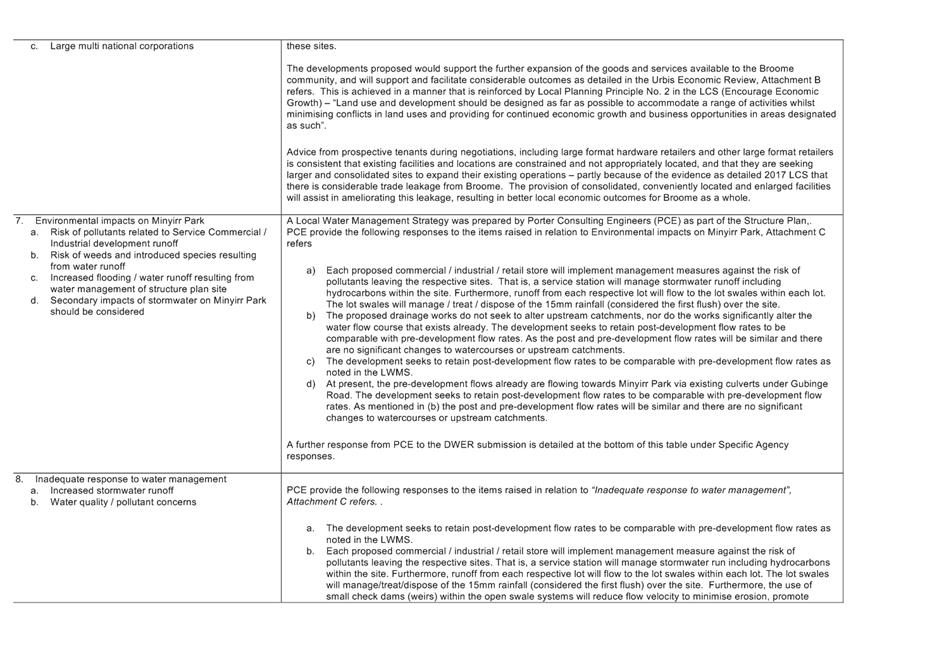
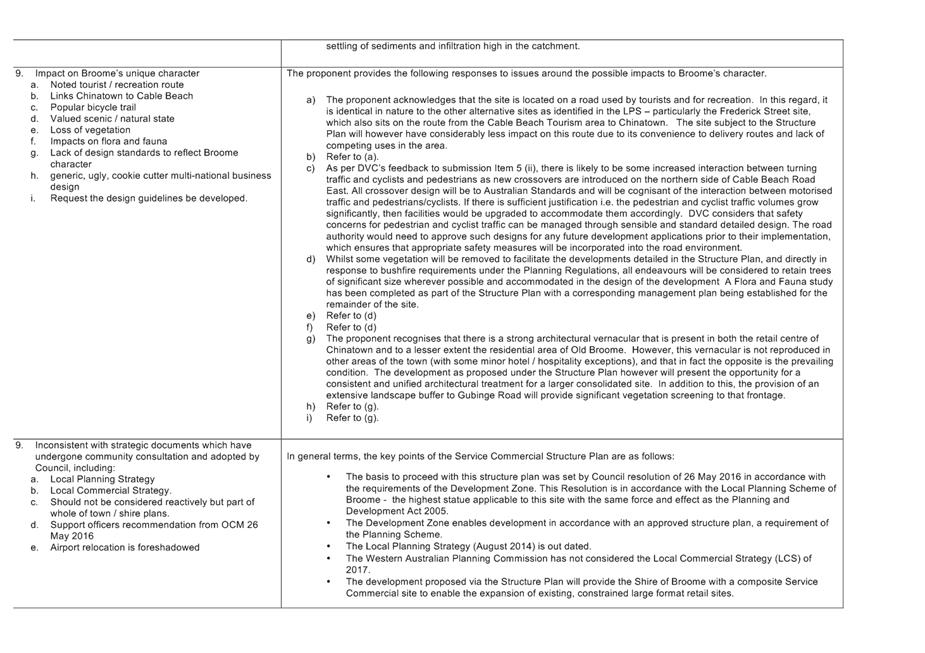
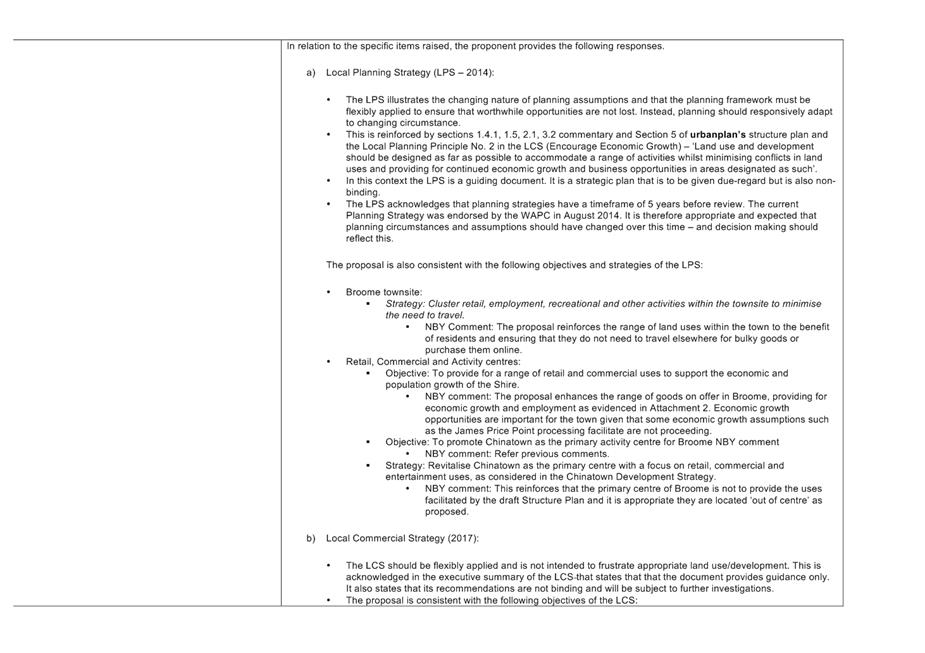
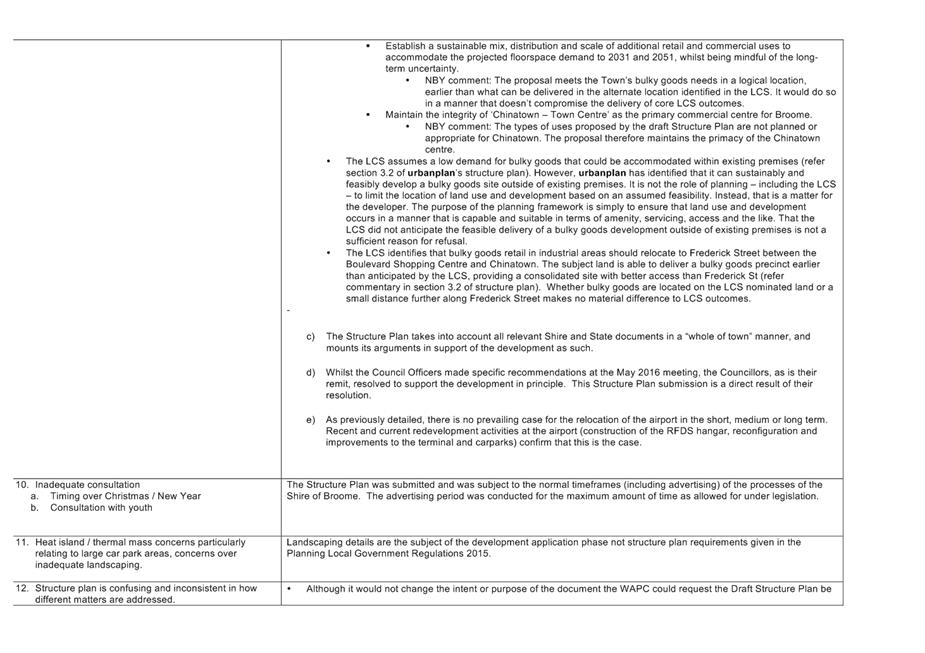
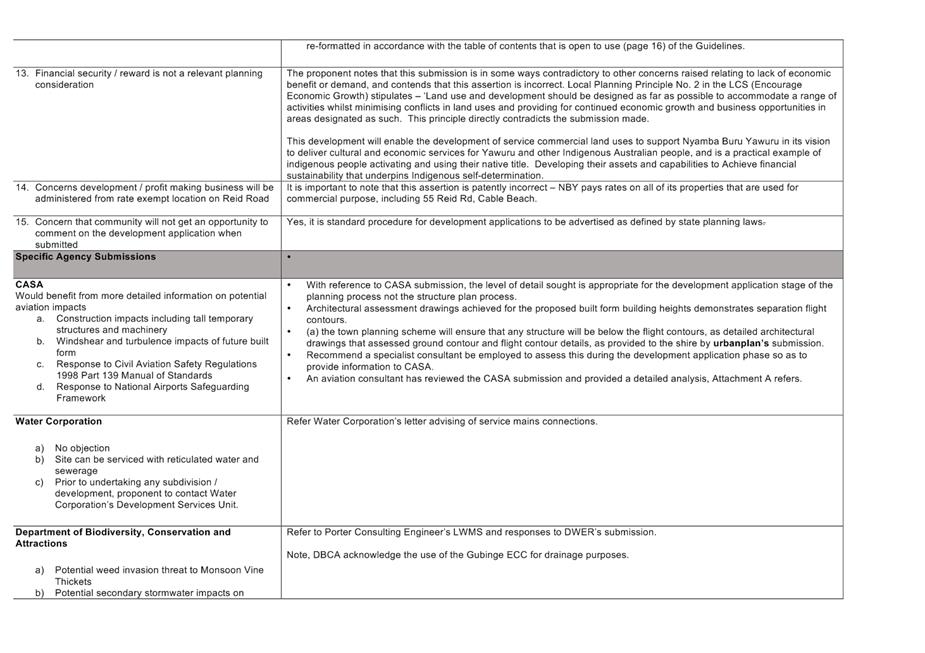
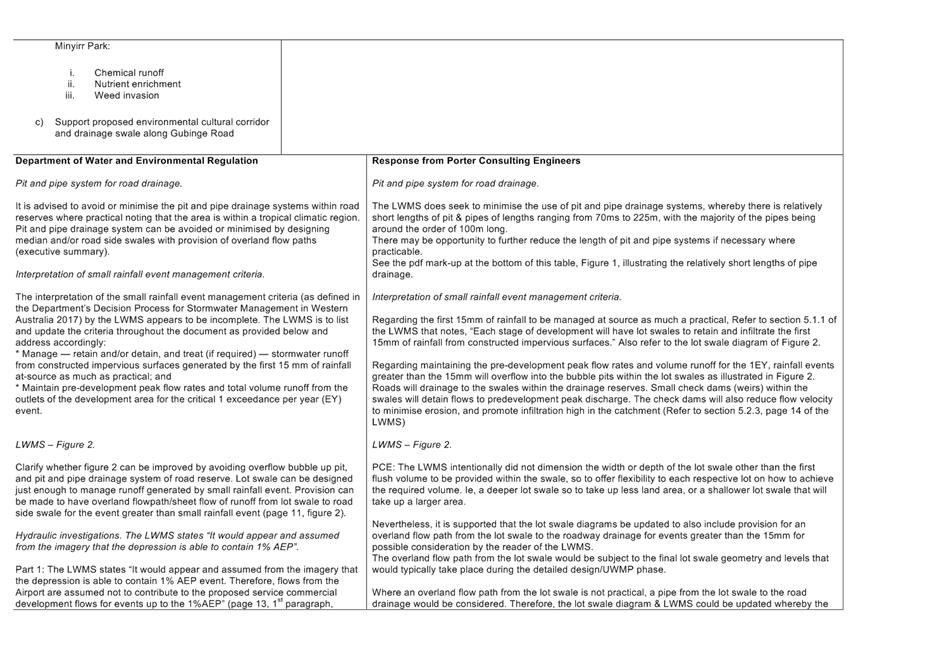
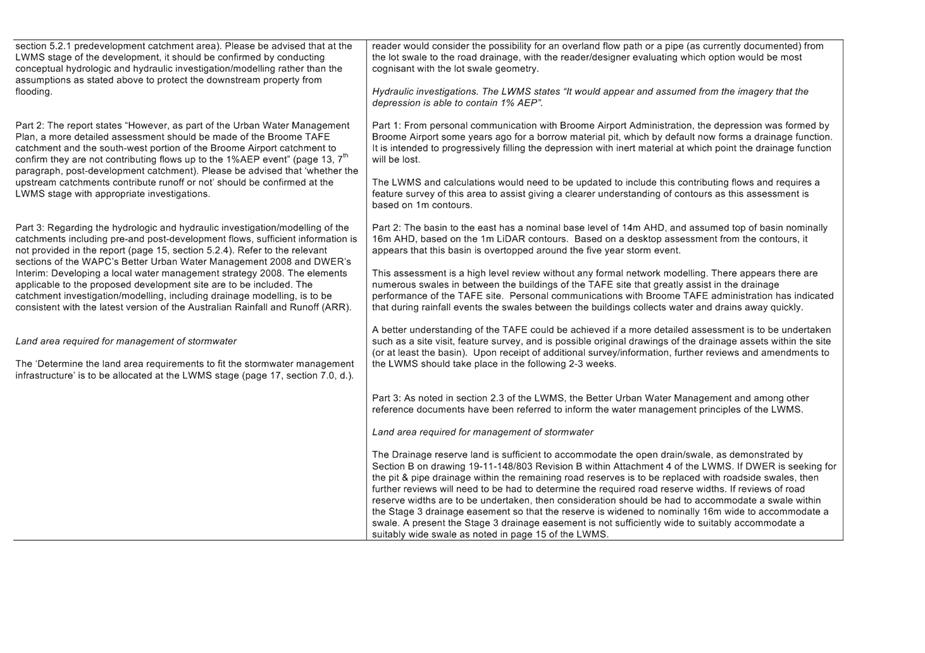
A summary of issues raised was provided to the applicant who provided a response which is contained at Attachment No 5. It should be noted, some submitters’ opposing the Structure Plan have incorrectly assumed or implied that the Shire of Broome is the proponent.
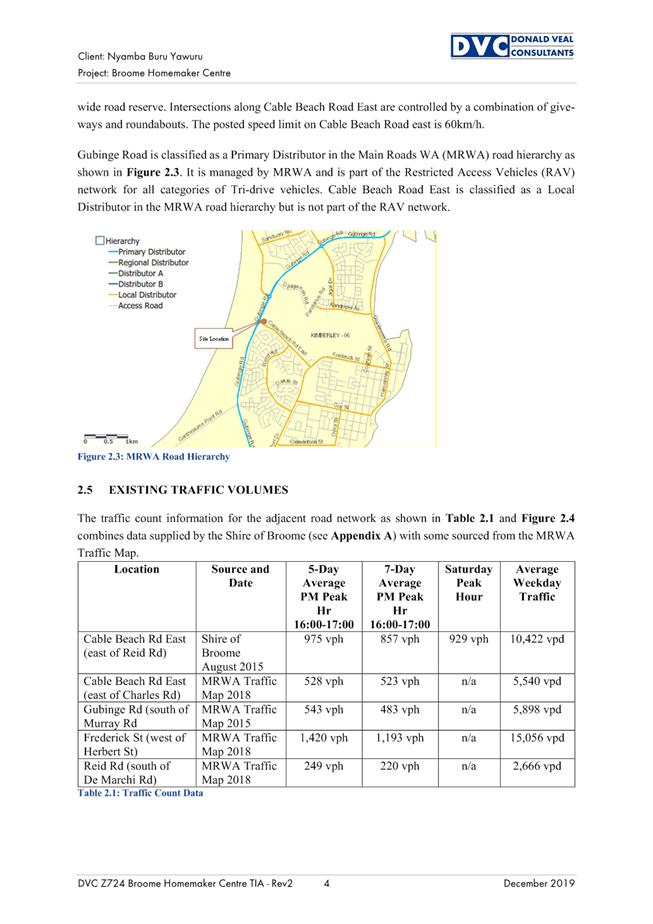
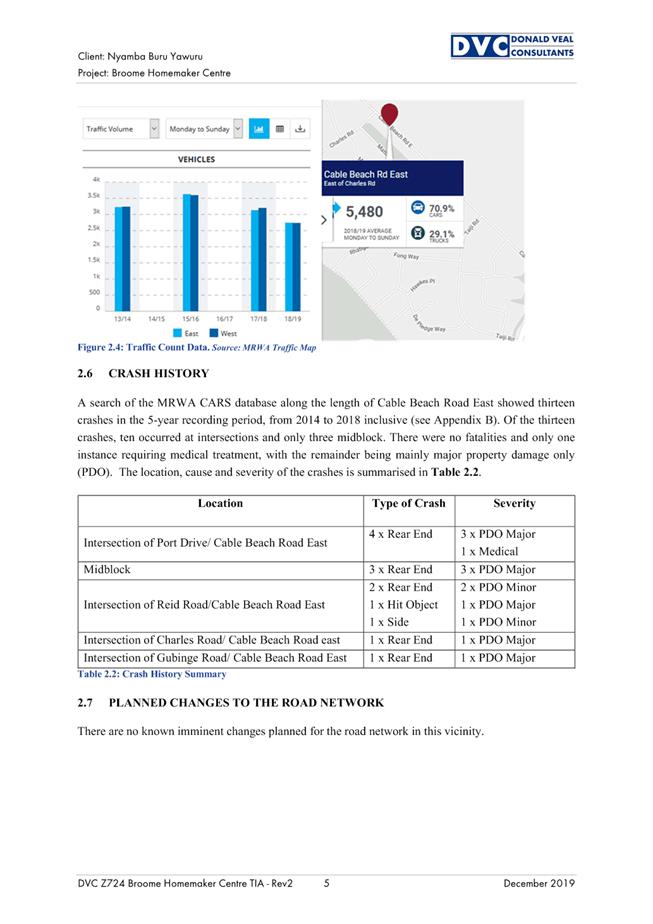
As set out in the Schedule of Submissions, some of the concerns raised are not relevant to the current matter being considered or are to be addressed at the development assessment stage. There are some elements of concerns raised, specifically the potential amenity and character impacts, the siting of the development and concerns over fragmentation and the proposal’s inconsistency with the adopted planning framework which are discussed in more detail in the planning merit assessment of the application below.
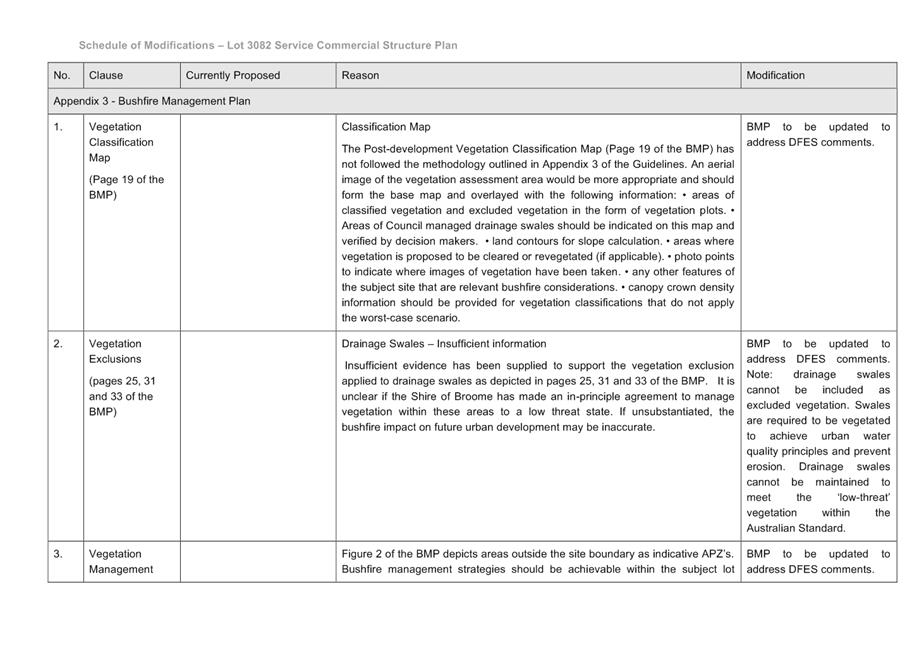
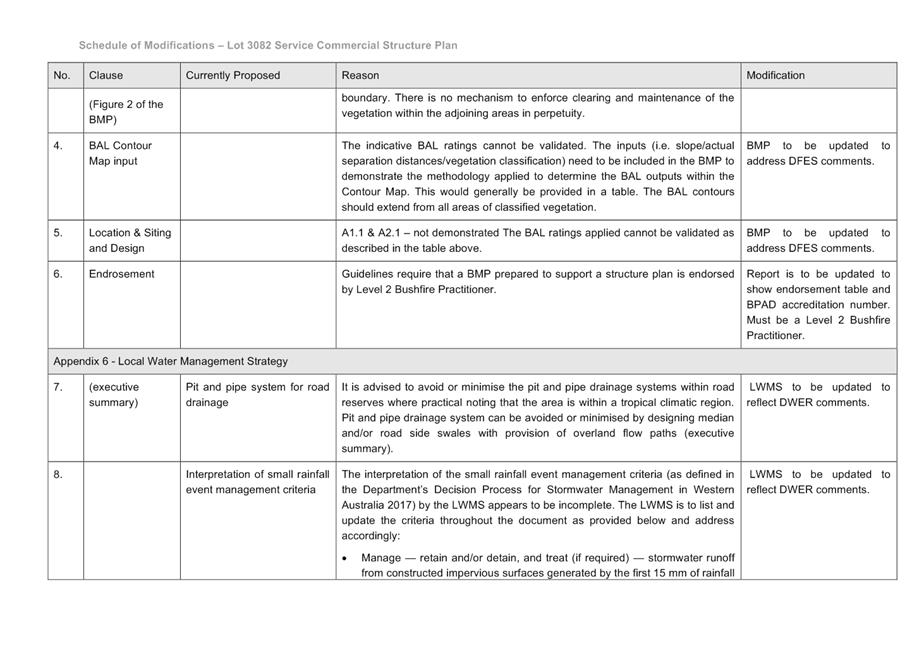
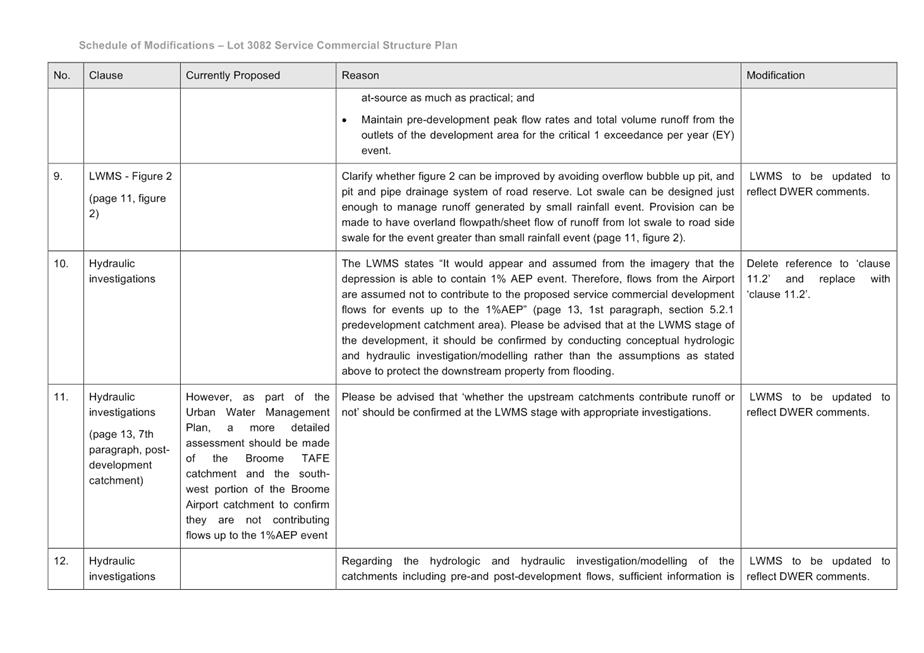
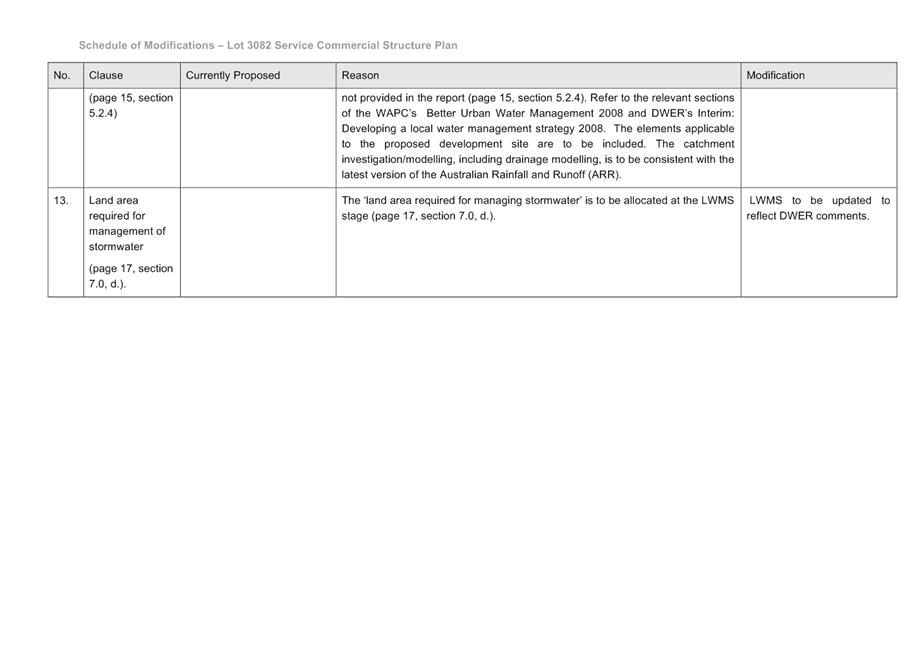
Included in the submissions is feedback from Department of Water and Environmental Regulation (DWER) and Department of Fire and Emergency Services (DFES) in relation to the Local Water Management Strategy and Bushfire Management Plan respectively. These documents are technical appendices, required to ensure appropriate outcomes in relation to matters where these Government Agencies have regulatory/advice functions. Both agencies’ submissions identified changes would be necessary to technical appendices in the event the Structure Plan was to be supported. The changes required appear to be achievable and do not constitute fatal flaws with the proposed Structure Plan. Modifications to the Bushfire Management Plan will require endorsement by a Level 2 Bushfire Planning Practitioner.
Schedule of Modification
A Schedule of Modifications is a requirement under the Regulations to identify any changes required to the Structure Plan to address matters raised through submissions and the planning principle assessment. Given that the recommendation is that the Structure Plan in not supported, no modifications in response to the community submissions are proposed.
However, should the proposal ultimately be supported by Council or WAPC, Attachment No 6 details the required technical modifications needed in response to submissions received from DFES and DWER on the bushfire management plan and local water management strategy respectively. As outlined above, the changes required appear to be achievable and do not constitute fatal flaws of the proposed Structure Plan.
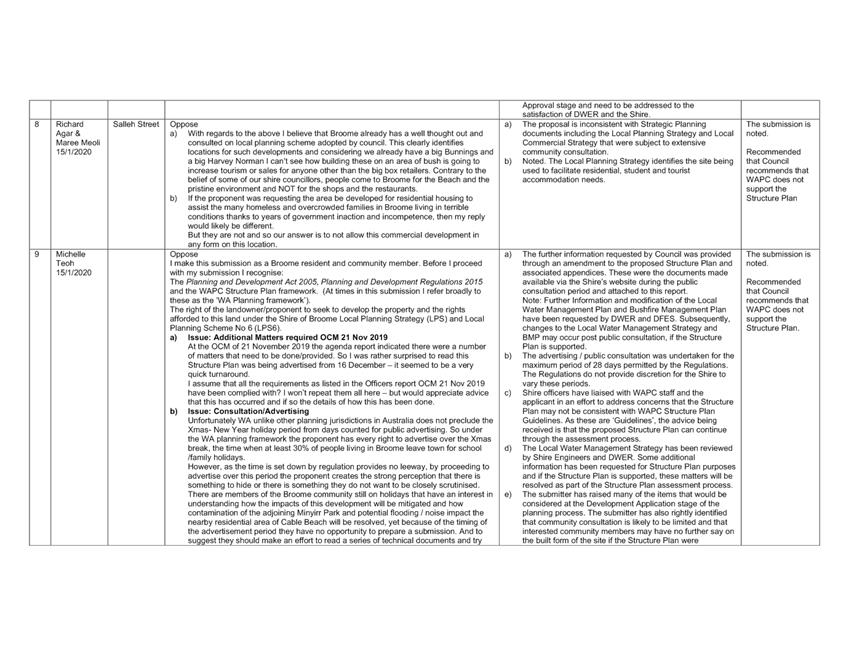
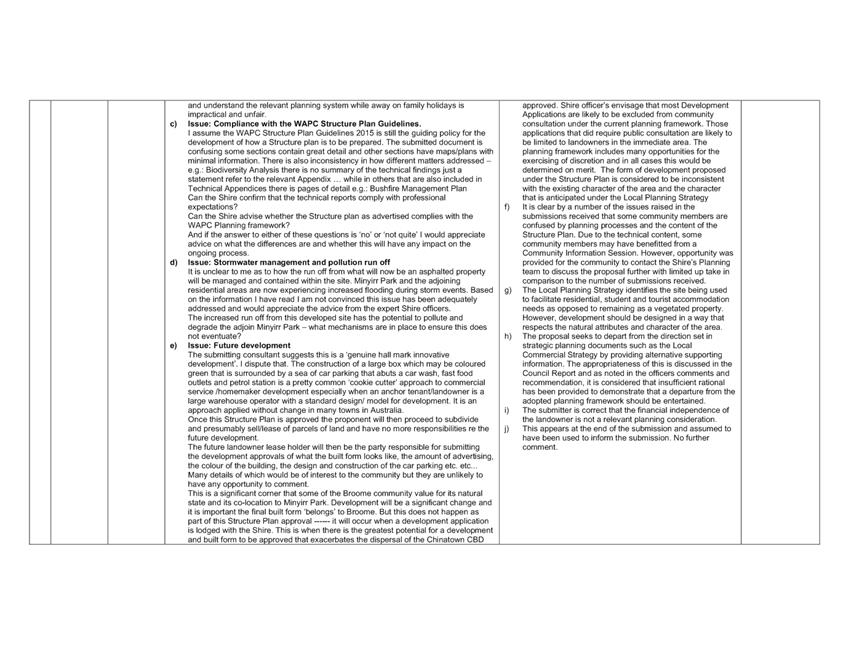
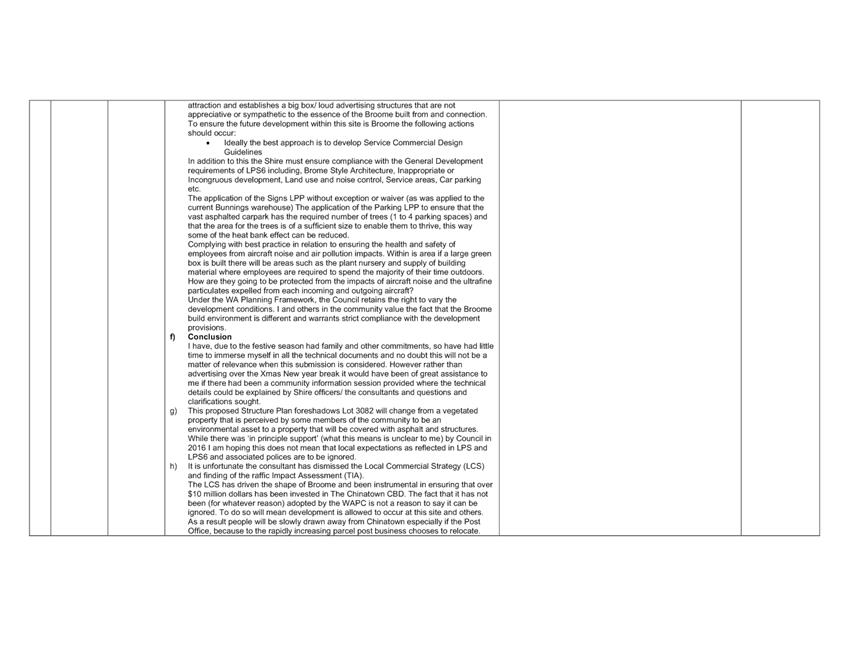
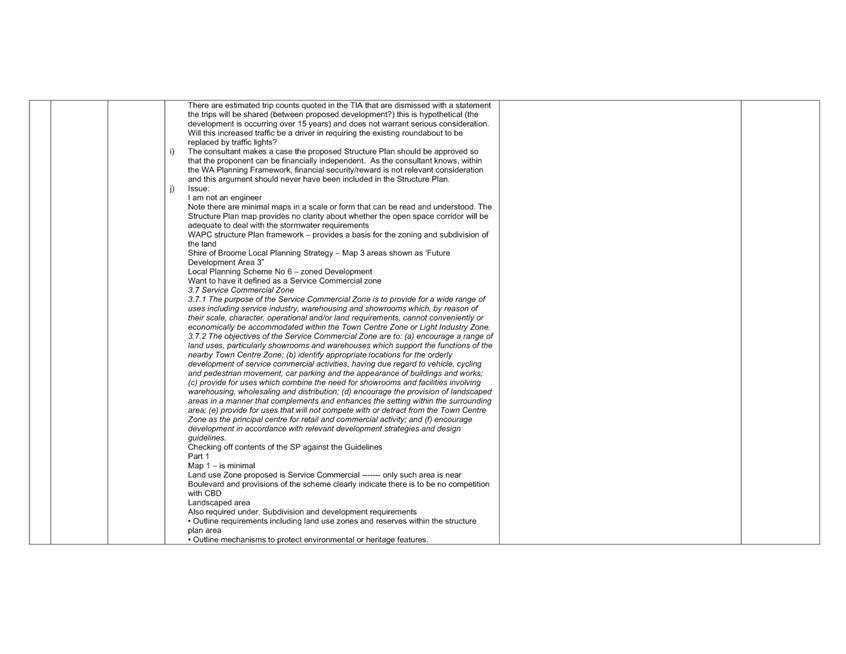
Assessment of Structure Plan on planning principles;
This assessment focuses on the planning framework that has been developed for the site in accordance with the Planning and Development Act 2005 and associated Regulations and will also address other planning principles that have been raised as part of the public submission process that require consideration. The assessment will also include responses to the following statements provided by the applicant as rationale for the site being made available for Service Commercial purposes as proposed by the Structure Plan. The applicant statements are quoted below from the Structure Plan Report and include acronyms that are not defined until the relevant area of assessment further in the report:
Section 1.2 of the Shire’s Strategy notes that the LPS sets out the medium to long term planning directions for the Shire of Broome over the next 10 to 15 years. Further in section 5.0 it is noted for the Strategy to be dynamic and responsive to change the document should undergo a review every 5 years. Such a review process ensures the strategy responds to changes in state, regional and local policy and land use priorities. Therefore, the LPS has two essential misgivings:
1. To assume projected land use in FDA 3 on the basis of the relocation of an international airport is well beyond the scope and planning period of a local planning strategy. Accordingly, Urbanplan holds the position that the FDA 3 is ineffectual.
2. Section 2.4.7 of that Strategy provides guidance on retail and commercial distribution. The newly released Commercial Strategy suggests that composite sites to aggregate service commercial uses is lacking in Broome; the subject part Lot 3082 provides for this requirement by offering a composite site.
It is understood from the above, that the applicant’s rationale for why a departure from the LPS should be entertained is because the LPS is due for review, the current land uses recommended under the LPS for the site are unachievable due to the constraints primarily caused by noise emanating from the airport. Further, applicant is of the view that the Local Commercial Strategy recommends that a composite site for aggregated service commercial uses in Broome is lacking.
Statement 1 will be explored in the LPS section of this report and statement 2 within the Local Commercial Strategy section of this report.
Local Planning Strategy (LPS)
The LPS was prepared by the Shire of Broome and adopted by the WAPC in 2014 and sets out medium-long term planning directions for the Shire of Broome over the next 10 – 15 years.
Under the LPS the subject site is positioned within Future Development Area 3 and also falls within Precinct 9. Section 3.3.1.9 of the LPS states the following in relation to Precinct 9 (Bilgungurr):
Precinct 9 comprises of the western half of the current Broome Airport, the recreational, educational and commercial uses to the south along Cable Beach Road East and Service Commercial lots north of Frederick Street as depicted on LPS Map 3.
Objective:
a) Establish Precinct 9 as an education / health precinct providing for student accommodation, sporting facilities and residential development and potential relocation of the hospital.
Guidelines:
• A development strategy should address the integration of the Broome Boulevard Shopping centre with future development to the north-west once the airport has relocated.
• Zone Future Development Areas 2 – 4 appropriately under the Local Planning Scheme once the airport has relocated to facilitate future development of student and tourist accommodation, sporting facilities and residential development.
Further, section 7.2.7 of the LPS provides direction on the Future Development Areas (FDA) and with regard to FDA3, the following direction is provided:
FDA 3 – Yawuru Airport West
FDA3 provides for a total of around 33 hectares which could provide an additional 330 houses. This site may also provide for some tourism opportunities in proximity to Cable Beach. It could also provide student accommodation as a part of an Education/Health Precinct.
The LPS provides strategic direction on future land uses that could be supported within the site, which are as follows:
· residential development;
· establish an education/health precinct; and
· possible tourist uses.
Therefore, the development of a ‘Service Commercial’ precinct would be inconsistent with the objectives of the Precinct or the FDA in which the subject site falls.
Further, section 2.4.7 of the LPS establishes the strategies and actions for retail and commercial development in Broome which is shown in Figure 9 (included as Attachment No 3). The rationale for the selection of retail and commercial areas was based on the population growth scenarios calculated in the 2012 Community Profile prepared by AEC Group and the Economic Profile also prepared by AEC Group. From the projected population growth figures, the demand for retail/commercial space required to support population growth were forecasted. The LPS then identifies the areas for expansion spatially and sites for retail and commercial expansion were selected to promote a logical and consolidated hierarchy of retail and commercial development within Broome. With regard to ‘Service Commercial’ development, Strategy 4 and Actions 3 and 9 within the LPS state the following:
4. Promote and encourage development along the north side of Frederick Street as showrooms and bulky goods retail.
Action 3 Set out a Service Commercial zone within the local planning scheme that allows for showrooms and bulky goods including car sales, furniture and white goods, which does not compete or detract from the retail primacy of the Town Centre zone in Chinatown.
Action 9 Zone lots north of Frederick Street from Coghlan Street to the Broome Boulevard Shopping Centre as Service Commercial.
Overall the LPS plans for two areas within the Broome townsite for service commercial development. The smaller of the two is the land on the corner of Cable Beach Road and Fredrick Street (the site of the Kimberley Camping Store, Broome Vet Practice, etc) which essentially reflects existing land uses occurring within this area, with some capacity for future development on the vacant and underdeveloped lots. The second area identified for service commercial development is to the north of Fredrick Street extending from the Boulevard Shopping Centre site through to Herbert Street (the western extent of the Town Centre zone). While this designation does cover some of the current operational areas of the airport, the land to the immediate east of the Boulevard Shopping Centre, extending along Fredrick Street, is already zoned ‘Service Commercial’ under LPS6 and had a conditional subdivision approval allowing it to be developed for this purpose. The footprint of this area which is zoned service commercial is approximately 6ha, which is slightly larger than the 5.4ha area proposed by the Structure Plan.
In support of the Structure Plan, the applicant has provided the following statement as rationale for Service Commercial at the site:
1. To assume projected land use in FDA 3 on the basis of the relocation of an international airport is well beyond the scope and planning period of a local planning strategy. Accordingly, Urbanplan holds the position that the FDA 3 is ineffectual.
2. Establish timeframes for the relocation of the Broome International Airport.
And
· To reserve land abutting Broome Road as Public Purpose for aviation and airport uses
· To incorporate an appropriate buffer surrounding the proposed airport site into a special control area to limit establishment of uses that could potentially impact on the operations of the airport.
Whilst no timeframe on the relocation of the airport has been finalised, land has been identified and controls put in place to protect the environs surrounding the proposed airport site off Broome Road approximately 13km east of the town.
Of note, the subject site was previously a Reserve under Town Planning Scheme No 2 (TPS2) which did not provide for any development potential and would not have allowed residential or commercial development. It was zoned ‘Development’ through the gazettal of Town Planning Scheme No 4 (TPS4) in 1999. Under TPS4, prior to development occurring, a Development Plan was required to be adopted. In essence, this process was the equivalent of the current Structure Plan process being pursued and when the subject site was rezoned from a Reserve to Development, it was noted at that point that development would be constrained by the airport.
The Broome Airport Development Plan (ADP) is also relevant. This document was adopted by Council on 26 November 2009 and endorsed by WAPC on 9 October 2012. The ADP includes the following objective:
2. The main purpose of the ADP is to provide an appropriate statutory planning framework to facilitate the effective continued operation and expansion of the Broome International Airport at its current location, until such time as aviation demands and/or airport impacts on the Broome community necessitate the airport’s relocation.
The ADP is due to expire in 2025. Furthermore, the Shire’s LPS is due for review this year. This will be an opportune time to revisit the need for and timing of the airport relocation and land uses which surround the site.
The applicant, in responding to the submissions received (Attachment No 4) has also expressed that the LPS is a guiding document, that is to be given due-regard and is non-binding. The applicant also expresses that the planning framework must be applied flexibly to ensure that opportunities are not lost.
These positions are noted, however the Shire’s planning framework with regard to the distribution of Service Commercial land has been analysed over time through different revisions of Local Commercial Strategies, which included Strategies prepared in 1998, 2007 and again more recently in 2017. All versions of the Local Commercial Strategies did not recommend that the subject site be developed for Service Commercial purposes. The 2007 version of the Local Commercial Strategy identified that in relation to bulky goods/large format retail, in the absence of an appropriate zone, these type of uses were gravitating to the light and service industry areas. The 2007 LCS recognised that these industrial areas are not a desirable location and concluded that the most logical location for this activity is Fredrick Street between Chinatown and the Boulevard. This position was reviewed in the 2017 LCS, please refer to comments below in this regard.
Since the adoption of the 2007 LCS, the following actions have occurred which confirm the preferred location for service commercial development is on Frederick Street:
· The Airport Development Plan was adopted by the Shire in November 2009, which showed that there was adequate area along Frederick Street, surplus to the operation of the airport, to accommodate service commercial development.
· In June 2012, Council adopted Local Development Plan No 8 (previously called Detailed Area Plan) which establishes a structure and layout for the development of this service commercial area and development controls with regard to location of car parking, building orientation, etc.
· In 2015 the LPS was endorsed by the Western Australian Planning Commission (WAPC) which shows this area on Fredrick Street, in addition to a wider portion of the airport site, being the preferred location for service commercial development.
· Local Planning Scheme No 6 (LPS6) was gazetted in 2015, which zones land on Frederick Street for Service Commercial purposes.
The spatial distribution of commercial land uses through Broome have been considered in adoption of the above informing documents. To depart from this on the grounds that a landowner wants to realise development potential of a site, should not take precedent over other planning principles or the current planning framework. Further it is noted that the Shire’s LPS is due for review, however, to entertain a departure from the established framework without compelling planning grounds is also considered premature and inconsistent with principles of orderly and proper planning. This is acknowledged in some of the submissions which raised that proposals should not be considered reactively but part of whole of town / shire plans. It should also be noted, that the review of the LPS will be guided by informing documents, including the Local Commercial Strategy, which was adopted by Council in 2017 and as detailed below, 2017 LCS does not recommend that additional land is required for Service Commercial purposes.
Therefore, the proposal is considered to be inconsistent with the established strategic planning direction provided in the LPS for the following reasons:
a) The proposal is inconsistent with the objectives of Precinct 9 and Future Development Area 3 in which the subject site falls;
b) The proposal is inconsistent with the strategic direction provided in section 2.4.7 of the LPS with regard to retail, commercial and activity centres;
c) Insufficient justification has been supplied to demonstrate a departure from the current local planning strategy is warranted.
Local Commercial Strategy 2017 (LCS17)
The Shire’s Local Commercial Strategy (LCS17) was prepared by Geografia and adopted by Council on 19 October 2017. The LCS17 reviewed the previous Local Commercial Strategy adopted by Council on 7 June 2007 (LCS07).
LCS07 was an informing document of the LPS. The context of LCS17 is that it has reviewed the LCS07 recommendations, drawing on insights from local commercial enterprises, government and major facility operators, population trends and household and business expenditure data, to prepare recommendations for a new medium and long-term Commercial Land Strategy.
Of specific consequence to the merits of the proposed Structure Plan, is that LCS17 recommends that the existing ‘Service Commercial’ zoning north of Frederick Street be reviewed with the intent of reducing the amount of ‘Service Commercial’ zoned land (by replacing with a more suitable zoning) or by altering the land uses it provides for to accommodate forecast commercial floorspace requirements.
The applicant contends that the LCS17 supports the variation to the planning framework by suggesting that ‘composite sites to aggregate service commercial uses is lacking in Broome; the subject part Lot 3082 provides for this requirement by offering a composite site’.
Whilst ‘composite site’ is not referenced in LCS17 or the LPS, it is understood that the applicant’s reference to ‘composite sites’, is intended to highlight a shortage of available land for composite business with a large development footprint. In this regard the following findings from Section 4.5 – Summary of results of LCS17 are considered relevant:
Over the medium to long term, Broome is unlikely to be able to support a new discount department store and bulky goods retail establishment. Any additional floorspace demand can probably be met through renovations and extensions of existing facilities. Under a high population growth scenario, there may be demand for a new discount department store (beyond 2046).
And
The analysis indicates that, in aggregate at least, Broome has sufficient land to supply retail and commercial demand needs to 2051. The vacant land (by lot size) indicates there may be sufficient land supply to meet medium term demands for all retail services (Table 11). However, notwithstanding the adequate aggregate supply, detailed data by building and land lot size suggests there may be insufficient supply of appropriately sized and located lots as well as building size, to meet projected demand (Table 10). There is also uncertainly on the developability of some of the identified vacant lots, due to their potential dislocation from the main retail precincts (e.g. vacant Town Centre zoned lots on Chapple Street).
At present one (1) vacant precinct is zoned for ‘Service Commercial’ purposes. This is the precinct on the north side of Frederick Street adjoining the Boulevard Shopping Centre. This site is a large site and is undeveloped, has an adopted Local Development Plan and had conditional subdivision approval. The undeveloped nature of this precinct provides flexibility for composite businesses that require a large development footprint.
LCS17 concludes that sufficient lands are available to meet commercial needs up to 2051 including larger lots for Service Commercial purposes. Furthermore LCS17 suggests review of the existing Service Commercial zoned land to accommodate forecast requirements whilst continuing to provide for ‘Showroom’ uses to encourage relocation of bulky goods retailers from the ‘Light and Service Industry’ zone.
To support a proposal that would result in an additional area for Service Commercial land uses would result in an overallocation of land, would lead to fragmentation of commercial uses around the townsite of Broome and is considered inconsistent with the principles of orderly and proper planning.
The applicant has also raised in Attachment No 5 that the WAPC has not endorsed the 2017 LCS. This is correct, however it should be noted that a LCS does not require adoption by the WAPC under the Regulations and the Act. LCS’s are typically planning informing studies that are prepared by local governments to inform the preparation of the Local Planning Strategy and are not required to be endorsed by the WAPC. The LCS07 informed the preparation of the Local Planning Strategy which was adopted by the WAPC. The recommendations in the LCS17 will similarly inform the review of the Local Planning Strategy.
· Local Planning Scheme No 6 (LPS6)
Under the provisions of LPS6, the subject site is zoned ‘Development’. Clause 4.16 of LPS6 sets out the purpose and objectives of the Development zone and states the following:
4.16.1 The purpose of the Development Zone is:
(a) to identify areas requiring comprehensive planning prior to subdivision and development
(b) to coordinate subdivision, land use and development in areas requiring comprehensive planning.
4.16.2 The objectives of the Development Zone are to:
(a) provide for a range of mixed land uses and subdivision in accordance with an adopted structure plan;
(b) enable the preservation and management of areas of cultural and environmental significance;
(c) provide for the coordinated provision of infrastructure, facilities and developable land through relevant structure plans and associated development contribution plans.
The site and development requirements for land zoned ‘Development’ is established under Clause 4.44.1 of the LPS6 which states development approval or subdivision will not be supported unless a structure plan has been adopted. The Scheme provisions do give discretion to the Shire to waive the need for a structure plan, where the land use proposed is a minor extension to an existing use, a minor additional use or a minor land use change.
Therefore, within the areas zoned ‘Development’ the layout, development controls and permissible land uses will be determined under the adopted structure plan. Once the structure plan has been prepared and proceeds to a subdivision application, ordinarily the zoning of the land is then ‘normalised’ through a scheme amendment, so the land is zoned in accordance with the provisions of the structure plan. An example of this is the area covered by Local Development Plan No 1 in Broome North. The area forming part of this structure plan has now been normalised in LPS6 with Residential, Local Centre and Reserves zoned in accordance with the adopted Structure Plan.
Therefore, to support a future Warehouse, Service Station and/or Fast Food Outlets as desired by the landowner, a Structure Plan should be prepared which shows the subject portion of the land with a zoning that supports those uses. Under the Zoning Table as it currently sits, ‘Service Commercial’ would permit these land uses.
It should be noted, that the Scheme itself is silent on the type of land uses and zone that should occur through the Development zones in the Shire. It is the Local Planning Strategy that provides guidance when the question as to whether a use or form of development proposed under a Structure Plan should be approved. As set out above, the Structure Plan is deemed inconsistent with the Local Planning Strategy and the applicant has not supplied sufficient rationale as to why a departure from the Strategy should be supported.
Under LPS6, the subject site falls within Special Control Area (SCA) ‘Existing Broome International Airport’. The objective of this SCA is to control development within close proximity to the airport to ensure the ongoing safe operation of the airport. For any new development within the area, the Shire must have due regard to the Australian Noise Exposure Forecast (ANEF) Contours and the Broome Airport Obstacle Limitation Surface Plan.
With respect to the noise limitations, the site predominantly falls between the 25 and 30 ANEF contours. The ‘Building Site Acceptability Based on ANEF Contours’ table contained within Schedule 10 of LPS6 establishes that the types of development that could be entertained in this area are; public buildings; hotel, motel and hostels; commercial buildings; light industrial; and, other industrial uses. With regards to the obstacle limitations, this varies across the site, from 20m in the north to 40m along the portion of the site which fronts Cable Beach Road East.
It is noted that house, home unit, flat, school, university and hospital are classed as ‘unacceptable’ at greater than 25 ANEF. This is a key component of the applicant’s justification that the land should therefore be made available for Service Commercial use. In this regard, it is reiterated that the land was previously a Reserve under TPS2. The rezoning to ‘Development’, through the adoption of TPS4 and the subsequent development potential it brought to the site, has been connected to the relocation of the airport. Furthermore, it should be noted that the land uses of student accommodation and tourist land uses recommended under the LPS may be capable of being developed on site under the current SCA provisions, however, would have to implement noise attenuation.
Other Planning Principles
In addition to an assessment of the proposal against the planning framework, the submissions received have raised planning principles that require consideration in assessment of this application, including:
· Amenity impacts;
· Fragmentation/sprawling of development; and
· Impact on character;
The applicant’s rationale for the unsuitability of the other zoned Service Commercial land for the proposed land use will also be explored. If this was the case, this would provide the planning rational for a departure from the adopted planning framework.
Amenity Impacts
The subject site adjoins Cable Beach Road East and due to limitations on accessing Gubinge Road, the development that could occur if the Structure Plan was approved will front Cable Beach Road East. The area of land to the south of Cable Beach Road East is zoned and developed for residential purposes. The establishment of a Service Commercial area, adjacent to an existing Residential area is not considered desirable for the following reasons:
· Service commercial areas generate a large volume of retail and service vehicle traffic and often usage is higher on weekends when residents in the adjoining residential properties are more likely to be home. Therefore, is it undesirable to have this type of land use within proximity to residential areas due to potential conflicts with noise and traffic.
· The hours of operation of the types of service commercial land uses (such as hardware stores, fast-food outlets, service stations) are usually longer than other types of retail and commercial land uses, thus they have the capacity to create a greater level of conflict with residential uses.
· Fast food outlets are a typical land use within service commercial zones and have the potential to generate odours which can be nuisance if developed within close proximity to residential properties.
Based on the above, it is considered that the proposed siting of a Service Commercial precinct in this location in inconsistent with sound planning principles and typically would be better placed adjacent to existing commercial land uses and away from residential areas, which is what is provided for under the LPS and the LCS.
Fragmentation/sprawling development
A number of the submissions raised the impact this proposal could have upon existing commercial areas. Some submissions also expressed that this proposal would further fragment the pattern of development in town and contribute to unnecessary sprawl.
In this regard, the development of a service commercial precinct on the subject site is not considered appropriate as it does not provide a logical nor preferred location for this type of land use. Figure 9 of the LPS (Attachment No 3), demonstrates a rational pattern of commercial development throughout the townsite of Broome, which was reviewed through the adoption of LCS17. The identification of the service commercial area on Frederick Street acts as a natural extension of commercial activity which transitions from the primary and traditional town centre being Chinatown, to the existing commercial uses along Fredrick Street, through to the Boulevard and concluding at the intersection of Cable Beach Road East and Fredrick Street. To leap-frog this area and develop at the subject site, would fragment what is a logical extension of commercial activity and create another independent commercial area in Broome, which is not consistent with good planning practice.
The service commercial area identified along Fredrick Street is also preferable location for this type of land use, as it is located immediately adjacent to Broome Senior High School and the Boulevard Shopping Centre, both of which generate a high number of vehicle movements and are car dominant land uses and present a commercial built form. Service commercial areas similarly generate high number of vehicle movements and are very car dominant, as such it is appropriate that these type of activities are consolidated into one central location. This hierarchy proposed under the LPS and LCS will see commercial/retail development consolidated in one location and support the primacy of Chinatown as the principle town centre area.
LPS6 currently zones the Frederick Street parcel of land Service Commercial. If the Structure Plan were approved, there would be a third service commercial precinct provided for and the planning framework would permit all three sites to be developed for service commercial uses. This would lead to an over provision of land for service commercial uses.
In relation to character, a number of the submissions have referenced the negative impact the proposal would have upon the character of the area. SPP 7.0 – Design of the Built Environment (SPP 7.0) provides direction in this regard and provides a framework for design of the built environment across Western Australia. It applies to all levels of the planning hierarchy — from large-scale structure planning, and major public works projects to development applications and subdivision considerations and is therefore applicable in the assessment of the planning merits of this Structure Plan.
SPP 7.0 establishes 10 design principles which define ‘good design’ and should be applied to inform the design, review and decision-making processes for built environment proposals across the State. The first design principle is ‘context and character’ and the following description in SPP 7.0 are noted:
· Successful places are distinctive and memorable, with a character that people can appreciate easily.
· Good design responds intelligently and sensitively to these factors in order to positively contribute to the identity of an area including adjacent sites, streetscapes and the surrounding neighbourhood.
· New development should integrate into its landscape/townscape setting, reinforcing local distinctiveness and responding sympathetically to local building forms and patterns of development.
· Building materials, construction techniques and details should, where appropriate, enhance local distinctiveness.
· Good design also responds positively to the intended future character of an area.
· Consideration of local context is particularly important for sites in established areas that are undergoing change or identified for change.
The existing character and context of the subject site and surrounding area is currently natural bushland, however the Scheme does identify the site as ‘Development’ and therefore the existing character will change. While some submissions raise that their preference would be to see the site retained as natural vegetation, the planning framework for some time (since gazettal of TPS4) has zoned the site ‘Development’ and therefore implied that the site characteristics will change. This is a consequence of any development of undisturbed areas and is accepted.
The character and built form that would result from a Service Commercial development would typically lead to large format, box-style, bulky commercial buildings, with large parking areas, limited landscaping and architectural features. The character of this form of development would be inconsistent with the character intended under the Local Planning Strategy (which is residential, student and tourist accommodation land uses). While it is noted that if the existing zoned Service Commercial land on Frederick Street were developed, the form of building style would likely result in a similar commercial character and built form, the context of this location is different, it is ‘framed’ by similar building typologies and is more typical of the character of that immediate location (i.e the Boulevard Shopping Centre, airport building, vehicle car yards and service stations). Development of a Service Commercial built form at the Frederick Street service commercial zoned land, would be more in-keeping with the existing identity and streetscape of this location and would be more in sympathy with the pattern of development in this location.
In simple terms, from a character perspective, service commercial development at the subject site is not consistent with the character that is anticipated under the Local Planning Strategy and is not typical of the character of the vicinity of the development. This is referenced in some of the submissions received that express objection to the proposal based on the building form that would result, noting that the Cable Beach Road East drive provides the linkage to the ‘tourist’ areas, which is largely characterised by natural bushland (i.e. Minyirr Park) and landscaped settings of the Cable Beach residential and tourist areas. The form of development that would result if the Structure Plan was approved, would be inconsistent with the character of the area, inconsistent with the streetscape and the surrounding neighbourhood and does not integrate to the townscape setting and patterns of development established in Broome.
Some of the submissions reference that design guidelines should be prepared to guide future development on site. While an LPP/design guideline could be developed, it would not change the overall form of the development and its likely it would still be inconsistent with the character of the area.
Other design principles in SPP 7.0 of relevance to the Structure Plan include:
· Built Form and Scale - Good design ensures that the massing and height of development is appropriate to its setting and successfully negotiates between existing built form and the intended future character of the local area.
The massing and height of the built form that would be expected from a service commercial development would be inconsistent with the sites setting, the existing built form in this location and the intended future character of the local area.
· Landscape Quality - Good landscape design employs hard and soft landscape and urban design elements to create external environments that interact in a considered manner with built form, resulting in well integrated, engaging places that contribute to local identity and streetscape character.
The form of service commercial development is typically characterised by hard built form with minimal landscaping. This form of development would be inconsistent with the local identity and streetscape in the vicinity of the subject site.
Based on the above, it is concluded that the proposal is inconsistent with the design principles ‘context and character’, ‘built form and scale’ and ‘landscape quality’ within SPP 7.0.
Applicant’s Comparison of Alternative Sites
Section 1.5 of the Structure Plan report provides the applicant rationale for why the subject site should be preferable than the currently zoned Service Commercial site. This is important to explore as this may provide the rationale for a departure from the local planning framework.
In this regard the applicant contends the following as is quoted from the Structure Plan report:
The proponent recognises that the LPS includes a strategy to promote and encourage development along the north side of Frederick Street as showrooms and bulky good retail. The proponent’s Structure Plan proposes this, albeit 1.5 kms further along Frederick Street than the site originally anticipated, on a site that is demonstrably more suitable for the proposed uses, as below:
· Delivery of goods from southern distribution centres will come via B-Double haulage. Frederick Street is a distributor road that services inter-neighbourhood traffic movement including that to the Boulevarde shopping centre, Broome Senior High School, and access and egress to residential areas along Cable Beach Road East to Gubinge Road. Such movement along a local distributor road introduces a traffic safety issue.
· The roundabout on Frederick Street facilitating fluid access and egress along Frederick Street and between the Senior High School and the shopping centre has recently been identified as a Black Spot conflict junction; this highlights the safety and traffic congestion issues already present at this intersection.
· Traffic congestion at peak periods between Broome High School and the Boulevarde shopping centre highlight the capacity inadequacies of Frederick Street. Traffic congestion occurs after hours and on weekends as the high school oval is used for district football competitions
· The proposed use as detailed in the Structure Plan will result in less direct RAV network access for deliveries, and as such will eliminate additional traversing of District Distributor roads by B-Double delivery vehicles to get to the Frederick Street location.
The proponent contends that, based on the above, there are considerable limitations to the existing zoned land giving rise for the Shire to consider varying the Local Planning Strategy.
In this regard the following is noted:
· Frederick Street is currently on the Restricted Access Vehicle (RAV) network which allows for larger commercial vehicles to traverse this road. Cable Beach Road East is currently not on the RAV network, therefore B-Double vehicles are currently not permitted to access this road.
· Both Frederick Street and Cable Beach Road East are identified as the same road hierarchy under LPS6 and the District Traffic Study. To put forward a view that Frederick Street is not capable of supporting the traffic generated by a service commercial development is not consistent with the findings of the traffic modelling perform in the District Traffic Study (2016) or the hierarchy adopted under LPS6 and section 3.2.7 of the Local Planning Strategy.
· The District Traffic Study (2016) models the increase in traffic flows that would be generated by the current planning framework (i.e. the service commercial land on Frederick Street being developed). The District Traffic Study concludes that the portion of Frederick Street will maintain an adequate level of service to cater for the projected traffic increases, without any upgrades.
· The Blackspot funding application currently submitted relates to the entry and exit points to the Broome Senior High School only and does not extend to the round-about along Frederick Street. The modelling performed under the District Traffic Study (2016) confirms that these intersections maintain an adequate level of service.
· The Traffic Impact Statement prepared to support the Cable Beach Road East Service Commercial Structure Plan outlines that all in-bound service vehicles would access the site from the west (from Gubinge Road). However, all outbound movements, would need to travel in an easterly direction, therefore development on this site would also result in an increase in additional large vehicle movements on Frederick Street in any event.
Therefore the rationale supplied by the applicant to suggest that the subject site should be developed as it is more suitable than the current Service Commercial site is not supported.
Summary
Consistent with the advice provided by Council following the May 2016 Ordinary Council Meeting the applicant has submitted a Structure Plan for assessment and advertising as provided under the Shire of Broome Local Planning Scheme No 6 and the Regulations.
The merits of the proposed structure plan and the rationale for the departure that the Structure Plan has proposed against the local planning framework has been discussed in the comments above. In accordance with the Regulations a review of the all the submissions received and an assessment of the proposal on the planning merits has been performed. Based on the review, it is recommended that Council resolve to advise the WAPC that the Structure Plan should not be approved.
The rationale for the recommendation is set out in the comments above and in summary include the following:
· The Structure Plan is inconsistent with the Local Planning Strategy and Local Commercial Strategy;
· The support of the Structure Plan would adversely impact the pattern of commercial development in Broome by over supplying ‘Service Commercial’ land and further fragmenting the commercial distribution around Broome;
· The applicant has not supplied sufficient rationale to demonstrate a departure from the local planning framework should be supported. The reasons for the unsuitability of the existing zoned Service Commercial land in Broome are not supported by the District Traffic Study, LPS6 or the guidance provided under the Local Planning Strategy.
· The public submissions received have highlighted deficiencies with the proposal and highlights the sites unsuitability to be developed for service commercial purposes.
· Sufficient and appropriately zoned land is available for the proposed land use elsewhere in Broome.
· The proposal is inconsistent with the design principles of ‘context and character’, ‘built form and scale’ and ‘landscape quality’ within SPP 7.0.
The resolution of Council and this report will be forwarded to the WAPC, where the Commission will then make a decision on whether to approve the structure plan, require modification or refuse the Structure Plan.
CONSULTATION
Public Notice of the proposed Structure Plan was given for the maximum 28 day permitted by the Deemed Provisions. The responses received during the public comment period are provided above and a detailed assessment is provided in the Schedule of Submissions contained in Attachment No 4.
STATUTORY ENVIRONMENT
Planning and Development (Local Planning Schemes) Regulations 2015 – Part 4
18. Advertising structure plan
(1) The local government must, within 28 days of preparing a structure plan or accepting an application for a structure plan to be assessed and advertised —
(a) advertise the proposed structure plan in accordance with subclause (2); and
(b) seek comments in relation to the proposed structure plan from any public authority or utility service provider that the local government considers appropriate; and
(c) provide to the Commission —
(i) a copy of the proposed structure plan and all accompanying material; and
(ii) details of the advertising and consultation arrangements for the plan.
(2) The local government must advertise the structure plan in one or more of the following ways —
(a) by giving notice of the proposed structure plan to owners and occupiers who, in the opinion of the local government, are likely to be affected by the approval of the structure plan, including a statement that submissions may be made to the local government by a specified day being a day not less than 14 days and not more than 28 days, or a later day approved by the Commission, from the day on which the notice is given to the person;
(b) by publishing a notice of the proposed structure plan in a newspaper circulating in the Scheme area including a statement that submissions may be made to the local government by a specified day being a day not less than 14 days and not more than 28 days, or a later day approved by the Commission, from the day on which the notice is published;
(c) by publishing a notice of the proposed structure plan on the local government website including a statement that submissions may be made to the local government by a specified day being a day not less than 14 days and not more than 28 days, or a later day approved by the Commission, from the day on which the notice is published;
(d) by erecting a sign or signs in a conspicuous place on the land the subject of the proposed structure plan giving notice of the proposed plan for a period of not less than 14 days and not more than 28 days from the day on which the sign is erected including on each sign a statement that submissions may be made to the local government by a specified day being a day not less than 14 days and not more than 28 days, or a later day approved by the Commission, from the day on which the sign is erected.
(3) The local government —
(a) must make a structure plan advertised under subclause (2) and the material accompanying it available for public inspection during business hours at the offices of the local government; and
(b) may publish the structure plan and the material accompanying it on the website of the local government.
(4) If a local government fails to advertise a structure plan in accordance with this clause, the Commission may take reasonable steps to ensure that the plan is advertised.
(5) All costs incurred by the Commission in the exercise of the power conferred by subclause (4) may, with the approval of the Minister, be recovered from the local government as a debt due to the Commission.
19. Consideration of submissions
(1) The local government —
(a) must consider all submissions made to the local government within the period specified in a notice advertising the structure plan; and
(b) may consider submissions made to the local government after that time; and
(c) may request further information from a person who prepared the structure plan; and
(d) may advertise any modifications proposed to the structure plan to address issues raised in submissions.
(2) If a local government makes a decision under subclause (1)(d) the local government must take any steps the local government considers appropriate to advertise the proposed modification to the structure plan.
(3) Modifications to a structure plan may not be advertised on more than one occasion without the approval of the Commission.
20. Local government report to Commission
(1) The local government must prepare a report on the proposed structure plan and provide it to the Commission no later than 60 days after the day that is the latest of —
(a) the last day for making submissions specified in a notice given or published under clause 18(2); or
(b) the last day for making submissions after a proposed modification of the structure plan is advertised under clause 19(2); or
(c) a day agreed by the Commission.
(2) The report on the proposed structure plan must include the following —
(a) a list of the submissions considered by the local government, including, if relevant, any submissions received on a proposed modification to the structure plan advertised under clause 19(2);
(b) any comments by the local government in respect of those submissions;
(c) a schedule of any proposed modifications to address issues raised in the submissions;
(d) the local government’s assessment of the proposal based on appropriate planning principles;
(e) a recommendation by the local government on whether the proposed structure plan should be approved by the Commission, including a recommendation on any proposed modifications.
(1) On receipt of a report on a proposed structure plan, the Commission must consider the plan and the report and may —
(a) approve the structure plan; or
(b) require the local government or the person who prepared the structure plan to —
(i) modify the plan in the manner specified by the Commission; and
(ii) resubmit the modified plan to the Commission for approval;
or
(c) refuse to approve the structure plan.
(2) Before making a decision under subclause (1), the Commission may, if the Commission considers that major modifications have been made to the structure plan since it was advertised, direct the local government to readvertise the structure plan in the manner specified by the Commission.
(3) The Commission may not direct the local government to readvertise the structure plan on more than one occasion.
(4) If the Commission is not given a report on a proposed structure plan in accordance with clause 20(1), the Commission may make a decision on the proposed structure plan under subclause (1) in the absence of the report.
(5) The Commission is to be taken to have refused to approve a structure plan if the Commission has not made a decision under subclause (1) within —
(a) 120 days of the day on which the local government provides the report to the Commission, excluding any period between the Commission requiring modifications to the structure plan and the resubmission of the modified plan; or
(b) a longer period agreed in writing between the Commission and the person who prepared the proposed structure plan.
(6) Despite subclause (5), the Commission may decide whether or not to approve a structure plan after the period applicable under subclause (5) has expired, and the validity of the decision is not affected by the expiry.
(7) The Commission must give the local government and any person who prepared the proposed structure plan written notice of its decision to approve or to refuse to approve a structure plan.
POLICY IMPLICATIONS
5.22 Shire of Broome Structure Plan and Subdivision Standards.
FINANCIAL IMPLICATIONS
A fee of $9,076.55 has been charged for the assessment of the Structure Plan.
RISK
There is risk of reputational damage due to the multi-faceted role of Council. In this instance, Council has a regulatory role to play in the administration and assessment of the Structure Plan that is guided by legislation.
Unfortunately, Council’s regulatory role can at times be in conflict with its advocacy function to support investment and economic development. In this instance, while the intent of the proposal from NBY it to assist in financial independence is noted, this needs to be considered in the context of the local planning framework, which is an established framework, developed with significant community engagement and input and informed by a number of planning strategies.
Departures from the adopted planning framework, including the Local Planning Strategy, should be exercised with caution as such documents provide the premises for all planning decisions. To undermine the value of the Local Planning Strategy by approving departures, in the absence of sound planning rationale and a comprehensive review process is not considered good practice. Such decisions lead to uncertainty, can impact upon investment decisions and can create community angst.
It is also noted for Council, some submitters’ opposing the Structure Plan have incorrectly assumed or implied that the Shire of Broome is the proponent.
STRATEGIC IMPLICATIONS
Our Place Goal – Help to protect the nature and built environment and cultural heritage of Broome whilst recognising the unique sense of the place:
Realistic and sustainable land use strategies for the Shire within state and national frameworks and in consultation with the community
A built environment that reflects tropical climate design principles and
A natural environment for the benefit and enjoyment of current and future generations
Retention and expansion of Broome’s iconic tourism assets and reputation
Our Prosperity Goal – Create the means to enable local jobs creation and lifestyle affordability for the current and future population:
Affordable and equitable services and infrastructure
Affordable land for residential, industrial, commercial and community use
Key economic development strategies for the Shire which are aligned to regional outcomes working through recognised planning and development groups/committees
Our Organisation Goal – Continually enhance the Shire’s organisational capacity to service the needs of a growing community:
Sustainable and integrated strategic and operational plans
Effective community engagement
VOTING REQUIREMENTS
Simple Majority
|
REPORT RECOMMENDATION: That Council: Council pursuant to Part 4 of Schedule 2 – Deemed Provisions of the Planning and Development (Local Planning Schemes) Regulations 2015: 1. Considers the submissions received during the public consultation included as Attachment No 4 to this report. 2. Recommends that the Western Australian Planning Commission refuses to adopt the Service Commercial Structure Plan for Lot 3082 Cable Beach Road East, for the following reasons: (a) The proposal is inconsistent with the objectives and guidelines for Precinct 9 and the recommendations for Future Development Area 3 contained within the Local Planning Strategy. (b) The proposal is inconsistent with the objectives, strategies and actions for retail, commercial and activity centres contained within the Local Planning Strategy. (c) The proposal is inconsistent with the planning framework, which has progressed since the adoption of the Local Commercial Strategy in 1998, 2007 and is inconsistent with the updated Local Commercial Strategy adopted by Council in 2017. (d) The proposal would result in an over-allocation of land for service commercial purposes, which would lead to an ad-hoc and fragmented distribution of retail and commercial floor space in the Broome townsite. (e) The site is not considered an appropriate location for the development of a service commercial precinct by reason of potential impact the proposal could have upon amenity, character and a logical distribution of commercial development in Broome. (f) Sufficient and appropriately zoned land is available for the proposed Service Commercial use elsewhere in Broome; (g) The applicant has not provided sufficient rationale or planning reasons to support a departure from the local planning framework. (h) The Structure Plan would be inconsistent with design principles of ‘context and character’, ‘built form and scale’ and ‘landscape quality’ within SPP 7.0 – Design of the Built Environment. |
The Chair noted that due to financial interest declarations there is not the required quorum to consider Item 9.2.1 and that the item will be deferred to a later date.
|
Location Plan |
|
|
Structure Plan Report |
|
|
Local Planning Strategy spatial distribution of retail & commercial lands |
|
|
Schedule of Submissions |
|
|
Applicant's response to submissions |
|
|
Schedule of Modifications |
|
|
Bushfire Management Plan |
|
|
Local Water Management Plan |
|
|
Traffic Impact Assessment |
Minutes – Ordinary Meeting of Council 27 February 2020 Page 1 of 2
|
SUMMARY: The Shire has received a development application seeking approval for the change of use of an existing Single House to a Residential Building at 50 Durack Crescent, Broome. The application has been assessed against the Shire’s Local Planning Scheme No 6 and the Local Planning Policy 5.15 – Forms of Residential Accommodation other than a Single House. The application is being referred to Council for determination as a significant number of submissions have been received. This report recommends that the application be refused. |
BACKGROUND
Previous Considerations
Nil.
Site and Surrounds
Lot 252, (50) Durack Crescent, Broome is an 872sqm property, which is zoned Residential with a R15 density coding, under Local Planning Scheme No. 6 (LPS6). The site is currently developed with a Single House and outbuilding. Surrounding properties are zoned Residential with density coding’s varying between R10-R20. Surrounding properties are predominately developed with Single Houses, however, there are some properties that have been developed with Grouped Dwellings and others that remain vacant (see Attachment 1).
Proposal
The application is seeking to change the use of the existing Single House to a Residential Building. The Residential Building would be utilised as a supported living facility for adult residents (18 years and over) on a short term basis (21 night maximum stay) while they are attending training courses in Broome. The Residential Building plans are provided in Attachment 2 and the Management Plan for the facility is provided in Attachment 3.
It is noted that a number of submissions suggested that the proposal was for a ‘Bed and Breakfast Accommodation’ in accordance with Local Planning Policy 5.15. This is discussed in detail later in the report.
COMMENT
An assessment of the application against the Local Planning Framework is set out below.
Local Planning Scheme No. 6 (LPS6)
As detailed above, the subject site is zoned ‘Residential’ with a density coding of R15. In accordance with Clause 3.17 of LPS6, ‘Residential Building’ is an ‘A’ use meaning that the use is not permitted unless development approval is granted after giving notice.
As discretion is to be exercised, it is important to focus on the purpose and objectives of the zone in determining whether the proposal is appropriate or not.
Purpose and objectives of the Residential zone
Clause 3.2.1 of LPS6 states:
The purpose of the Residential Zone is to provide for residential development at a range of densities with a variety of housing to meet the needs of different household types through the application of the Residential Design Codes, as varied by the Scheme and any Local Planning Policy adopted under Part 5 of the Residential Design Codes.
Clause 3.2.2 of LPS6 states:
The objectives of the Residential Zone are to:
(a) Allow development in accordance with the Residential Design Codes
(b) Provide for climatically responsive housing forms that are consistent with energy efficiency and sustainable design principles set out in design guidelines adopted by the local government; and
(c) Ensure the built form is in accordance with Broome-style architecture as specified in clause 4.12 and with applicable local design guidelines
Whilst ‘residential development’ is not defined in LPS6, it is defined in the Residential Design Codes (R Codes) as:
Development of permanent accommodation for people, and may include all dwellings, the residential component of mixed-use development, and residential buildings proposing permanent accommodation.
Council has not adopted any design guidelines for the subject site. However, Local Planning Policy 5.15 Forms of Residential Accommodation other than Single House, provides guidance for the proposed ‘Residential Building’ use. A ‘Residential Building’ is a form of housing specified in the R Codes and defined as:
A building or portion of a building, together with rooms and outbuildings separate from such building but incidental thereto; such building being used or intended, adapted or designed to be used for the purpose of human habitation:
· Temporarily by two or more persons;
· Permanently by seven or more persons, who do not comprise a single family, but does not include a hospital or sanatorium, a prison, a hotel, a motel or a residential school.
In this instance, the proposal involves the use of an existing building that was designed and constructed as a ‘Single House’ as a ‘Residential Building’ for temporary accommodation (up to 21 days). By providing for temporary accommodation, the proposal would not be providing ‘residential development’ which is the primary purpose of the Residential zone. This issue is a matter of concern raised consistently in submissions and is discussed further in the submission section of the report.
As the proposal does not involve any works, the only general development requirement needing consideration under LPS6 is car parking.
Car Parking
For a ‘Residential Building’, Appendix 9 requires that 1 bay be provided per bedroom plus 1 bay for any caretaker/manager. The proposal includes four (4) bedrooms and although a caretaker is not proposed, it is intended that the facility will be staffed/managed. Therefore, five (5) car bays should be provided. The proposal only includes four (4) bays, one for each bedroom which is consistent with the requirements of Local Planning Policy 5.15 but inconsistent with LPS6. Importantly, where inconsistencies arise LPS6 would prevail. Although only four (4) car parking bays are provided, there are opportunities to provide additional car parking on site in a tandem bay configuration.
In conclusion, as the ‘Residential Building’ is proposing temporary accommodation as opposed to permanent accommodation, the use is not considered to be consistent with the purpose of the Residential zone.
Local Planning Policy 5.15 – Forms of Residential Accommodation other than a Single House (LPP 5.15)
LPP 5.15 guides decision making relating to the range of land uses other than a Single House that provide for residential accommodation. The policy makes reference to and includes the definition for both ‘Bed and Breakfast Accommodation’ and ‘Residential Building’. The LPP has been referenced often within submissions and has led to submitters suggesting the proposal is for ‘Bed and Breakfast Accommodation’ and should be refused as it fails to comply with general provisions 8.0 of this LPP. A response is included in this section.
Policy Objectives
1. To facilitate the development of appropriately located and high quality residential accommodation.
The proposal is for the change of use to an existing building only. No changes are proposed to the existing ‘Single House’ building to facilitate its use as a ‘Residential Building’. The style and quality of the building is consistent with surrounding properties having been originally designed and constructed as a Single House. The building is considered to be of a high quality.
The subject site is located in a Residential Zone with the purpose of this zone to provide for ‘Residential Development’ as opposed to temporary accommodation. The temporary nature of the accommodation has been consistently raised as a concern in the submissions received with submitters contending that it would be inappropriately located at the current site. The application does not provide any information on why the site was chosen. However, a meeting with the applicant identified that the building layout was a key consideration as the building layout is integral to meeting their operational purpose.
2. To define the use, management and level of service provided for Residential Buildings.
The proposal has met with most development standards and management requirements specified in the Policy. Further details of how the proposal achieves individual requirements of section 9.0 and 10.0 of the Policy are provided in this relevant sections below.
3. To ensure various forms of accommodation are of a compatible scale and design with surrounding development.
From an appearance/streetscape perspective the proposal achieves this objective by utilising an existing building which was developed as a Single House. The scale and design is consistent with other development in the area. No alterations of the building are proposed to facilitate the Residential Building land use.
The application is however proposing to accommodate up to eight (8) people in a four (4) bedroom building on a short-stay basis. As raised in the submissions received, this type of short-stay accommodation of a building by this many people, whom are unrelated, would not be typical of the scale of the surrounding development.
4. To ensure that the establishment of alternative forms of residential accommodation in the residential zone protect the social and residential amenity
Concerns have been raised through the public consultation period that the social amenity will be compromised due to the temporary / short stay nature of occupancy if the Residential Building is to be approved. Of particular concern to those whom put in submissions is the risk of anti social activity such as crime, noise and public drinking. This policy includes the requirement for a Management Plan, which has been provided by the applicant. The Management Plan is discussed in detail in the relevant section below.
Given the lack of permanent occupant on site, the short stay of the occupants and the number of occupants proposed by this proposal, it is considered that the application does not achieve this objective of the policy.
General Provisions and Land Use definition
As mentioned earlier, the classification of the use has been an area of contention for submitters. Many of the submitters contend that the building should be considered as a ‘Bed and Breakfast’ as opposed to a ‘Residential Building’. These contentions are made primarily in response to Clause 8.0 of the LPP which states:
The use of rooms within a single house for accommodation of persons on a short term basis is classified as ‘Bed and Breakfast’ land use and must meet any relevant Local Planning Policy.
The key contention of submitters focuses on the fact the building was originally developed as and subsequently used as a ‘Single House’. The simplest way to describe the situation and why this general provision is not applicable is:
The building on site is currently approved for use as a ‘Single House’. A ‘Single House’ is defined as:
a dwelling standing wholly on its own green title or survey strata lot, together with any easement over adjoining land for support of a wall or for access or services and excludes dwellings on titles with areas held in common property.
The definition for ‘Dwelling’ is:
as defined in the R-Codes (as amended) which currently states: a building or portion of a building being used, adapted, or designed or intended to be used for the purpose of human habitation on a permanent basis by a single person, a single family, or no more than six persons who do not comprise a single family.
A request has now been received to use that existing building as:
A supported living facility for short term residents only (21-night maximum) while they are attending training courses in Broome.
This can not be considered a ‘Bed and Breakfast Accommodation’ as ‘Bed and Breakfast Accommodation’ is defined as:
means a dwelling, used by a resident of the dwelling, to provide accommodation for persons away from their normal place of residence on a short term commercial basis and includes the provision of breakfast.
As the proposed development does not include anyone permanently habiting the building, it does not meet the definition of ‘dwelling’ which in turn means it can not be a ‘Bed and Breakfast Accommodation’. Furthermore, this precludes it from being a ‘Single House’.
The proposal has therefore been correctly described as a ‘Residential Building’ which is defined as follows:
as defined in the R-Codes (as amended) which currently state: A building or portion of a building, together with rooms and outbuildings separate from such buildings but incidental thereto; such building being used or intended, adapted or designed to be used for the purpose of human habitation:
• temporarily by two or more persons; or
• permanently by seven or more persons, who do not comprise a single family, but does not include a hospital, a prison, a hotel, a motel or a residential school.
For these reasons, General Provision 8.0 is not applicable to the proposed development as the development proposed is a ‘Residential Building’ and not a ‘Bed and Breakfast’.
Section 9.0 of the LPP outlines a number of standards for Residential Buildings as follows:
a) A maximum of 5 bedrooms (10 people) including a bedroom for the caretaker shall be permitted in a Residential Building;
The Residential Building would contain 4 bedrooms intending to provide for up to eight (8) residents, however does not propose to have a permanent resident ‘caretaker’.
b) The area of any bedroom shall not exceed 20 m2 excluding the area of the bathroom;
Bedroom 4 is 20.25m2 excluding the bathroom. All other bedrooms are below 20m2 excluding ensuite bathrooms. It is understood the 20m2 size maximum is intended to assist in preventing self contained living within bedrooms such as provided for by motels which is a separately defined land use. The building contains multiple communal areas including the ‘TV Room’ which provides access to Bedroom 4. There is some risk that the TV room could be closed off and provided for use only in conjunction with Bedroom 4. The .25m2 variation (1.25% larger than the specified 20m2) to the bedroom is minor and not considered to be of consequence in its own right. However, due to the possibility of use in conjunction with the TV room, this section of the building could be used to support self contained living.
c) No kitchens are permitted in the bedrooms;
No kitchen facilities are shown within any of the bedrooms.
d) A central kitchen/dining/living area must be provided in the residential building along with a communal laundry facility;
An open plan space incorporates a central kitchen, dining area and living area. An additional tv room incorporating a sink is also provided. Communal laundry facilities are accessible from the outdoor living area.
e) One car parking bay shall be provided on site for each bedroom;
Four (4) bays have been provided for in accordance with this provision. However, as identified earlier in the report, this provision is inconsistent with LPS6 which also requires a bay for a caretaker/manager. As the facility is proposed to be staffed, it is considered that the staff would be acting as a ‘manager’ and necessitate the provision of an additional car parking bay.
f) A maximum of two of the car parking bays can be visible from the street, the remaining bays must be positioned behind the building, out of view of the street, and all vehicles are to be parked inside the property boundary;
Of the four (4) car bays provided, only two (2) are visible from the street with the other two (2) being located behind a gate inside the property boundary the restricts visibility of the bays.
g) The site must be landscaped consistent with the appearance of a single house. A landscaping plan is required to be submitted with an application to demonstrate this; and
A landscaping plan has not been provided with the application. However, the site has already been developed and landscaped. The site was developed as a Single House and a site inspection confirmed the existing landscaping reflects that of the area and is consistent with that of a Single House. In addition, the Management Plan provides for monthly gardening and lawn maintenance by a contractor.
h) The Residential Building shall have the appearance of a Single House and it should be possible to use the building as a Single House unit if not used as a Residential Building.
The building intended to be used as a Residential Building was originally developed for and used as a Single House. No alterations are proposed to the structure. Therefore, if it were to cease being used as a Residential Building it could revert to being used as a Single House.
Section 10.0 of the LPP requires that a Management Plan must be prepared for a Residential Building including the following:
a) Control of noise and other disturbances, including the appropriate use of outdoor entertainment areas;
Whilst control of noise and use of the outdoor entertainment area is not specifically mentioned within the Management Plan, the Management Plan does include details of a resident ‘Occupancy Agreement’ (page 20 of Attachment 3) and ‘Behaviour and Responsibility Agreement’(page 22 of Attachment 3). These agreements focus on the broader issue of ‘antisocial behaviour’. Of relevance is item 3 of the summary of agreement contained within the ‘Occupancy Agreement’ which requires that residents:
Not allow any antisocial behaviour in and/or around Durack Crescent facility.
This issue has been raised as a concern in submissions.
b) Complaints management procedure, which is to include the provision of the telephone number of the accommodation owner and operator to adjoining neighbours;
A ‘Complaints Management Procedure’ (page 20 of Attachment 3) has been provided. This procedure identifies an eight (8) step response process for the recording of and resolving of complaints by the facility operator MADALAH. Of interest is the policy implementation section which identifies the Broome Manager with the advice of the General Manager as being responsible for complaint resolution. The response process includes liaison with the complainant and repetition of process until the complaint is resolved.
The Procedure also identifies that neighbours and community members in the vicinity of the Residential Building are provided with the contact details for the Broome Manager and General Manager. This issue has been raised as a concern in submissions
c) The use and on-going maintenance of the premises, landscaping and gardens, and any common property areas or common facilities (where applicable);
The Management Plan includes a ‘Maintenance Schedule’ (page 5 of Attachment 3) that covers a broad range of issues including gardening and lawns. This issue has been raised as a concern in submissions.
Submissions
In accordance with Local Planning Policy 5.14 – Public Consultation, the application was deemed to be Level C, and therefore, the Shire of Broome referred the proposal to landowners within 100m, placed a public notice in the Broome Advertiser, required a Notice to be placed on site and made details of the application available on the Shire of Broome website. The initial 21-day comment period was extended by a further 14 days in response to the level of community interest and community concerns related to the timing of the comment period over the Christmas / New Year break.
At the close of the comment period, twenty-four (24) individual submissions were received. Of those, twenty-two (22) submissions opposed the proposal, one (1) provided no objection and one (1) sought further information. In addition, one (1) group submission was received and was supported by twenty-two (22) people. Many of those people also provided an individual submission.
Detailed comment has been provided in response to each submission within the Schedule of Submissions in Attachment 4. However, a general summary is provided as follows:
a) Concerns relating to short stay use and guests;
b) Lack of a permanent resident;
c) The use would be better located elsewhere;
d) Consultation was inadequate;
e) Inadequate response to residential and social amenity; and
f) Failure to comply with LPP 5.15.
The submissions raised a number of concerns but also included predominately negative assumptions relating to those persons who would utilise the facility and anti social activity that would result. The summary of concerns are responded to as follows:
a) Concerns relating to short stay use and guests.
Submitters have highlighted that the area is a residential area with many families and long term residents. Submissions contend that the land was not zoned for short stay or commercial activities and that they do not support such uses. Submitters regularly referred to another facility thought to be a ‘Residential Building’ in Pelcan Gardens and impacts that had been experienced which they attribute to that facility including anti-social activity and police needing to attend the site on multiple occasions. Investigations found that the facility located at Pelcan Gardens was developed as a four (4) Bed Mobility Dwelling by the Department of Communities. The Department of Communities are exempt from the need to obtain development approval. The facility provides permanent residential living and care for persons with disabilities and is managed by Far North.
The lack of accountability for short term guests who had no ongoing association to the neighbourhood was provided as rationale for reduced standards of behaviour and increase in anti social activities from those short term guests. This was perhaps best summarised in a submission as follows:
Short stay residents can be expected to have different values regarding their social, physical, cultural and behavioural environment than residents who have chosen to settle long-term in a community. This extends to Shire by-laws that residents comply with but may not be known or understood by short term residents.
The concerns raised by the submitters regarding the short stay/transient nature of the occupation is noted. When coupled with the other concern raised in the submissions, that there would be no permanent occupant, the potential impact this development could have upon the social character and amenity is acknowledged.
b) Lack of a permanent resident
Many submissions expressed concerns that there would not be a permanent resident. The contention being that would result in a lack of supervision which would reduce the accountability of short stay guest and increase the likelihood of anti social activities.
The application advises that the facility would be staffed when occupied but was unclear on the extent of that staffing. Discussions with the applicant have confirmed that it is intended to staff the property in the morning and evenings to provide support/assistance to the occupants during these hours, however no overnight staffing is proposed. The application would benefit from more details on the rationale for staffing of the facility.
Given the concerns raised in submissions relating to short stay as described above, it is agreed that the facility would benefit from a permanent resident. This person/s would be able to describe the local neighbourhood nuances to short stay guests and call out actions or behaviours that were not appropriate in the neighbourhood.
c) The use would be better located elsewhere
Many submissions suggest that the facility would be more appropriately located elsewhere such as the ‘Town Centre’ zone where ‘Residential Building’ is a permitted use under LPS6.
Direction for locations of different land uses is provided through the strategic planning process as opposed to the statutory planning process. Whilst a ‘Residential Building’ use could be undertaken in the Town Centre zone without the need for development approval, strategic planning has determined that there are other zones / locations that a ‘Residential Building’ may be suitable. The ‘Residential’ zone is one such location. The purpose of the statutory planning process is to assesses the merits of the proposal to ascertain whether the subject site is an appropriate location for the ‘Residential Building’ as opposed to the best location for the ‘Residential Building. However, for the reasons set out above, a merit-based assessment of this application has been performed and it is recommended that the application is refused.
d) Consultation was inadequate
The timing of consultation as well as the required public notice on site not being observed, were described in some submissions as reasons why the consultation was not adequate.
An initial three (3) week consultation period was extended to five (5) weeks in response to concerns relating to the timing of consultation. Some submitters also raised concern that a notice had not been placed on site. Under the Public Consultation Policy, the applicant is required to place a copy of the ad notice on site. An officer inspection of the site failed to observe a notice on site prior to the notice period being extended. This was raised with the applicant and a subsequent site visit identified a sign on site. Whilst the LPP has not been complied with in this regard, the other forms of public notice and level of submissions suggest that the public notice undertaken was successful in raising awareness of the proposal. If Council considers that the notice not being on site has unduly impacted on consultation, the application could be readvertised.
e) Inadequate response to residential and social amenity
Many of the submissions raised concerns relating to residential and/or social amenity impacts. In explaining their concerns, submitters focused on the users of the facility as opposed to the structure’s design and appearance. However, the impacts of multiple vehicles being parked on verges has been raised on multiple occasions as well as general deterioration of the property including gardens as a consequence of no permanent resident.
The primary concerns relate to the expected behaviour of users and their guests due to the ‘short stay’ circumstances and what has been described as an inadequate response to these risks in the submitted Management Plan.
Specific matters that have been raised on multiple occasions are:
· Anti-social activity including crime, public drinking and smoking;
· Increased vehicle movement and associate safety risks particularly with children playing and the location of the subject site on a corner;
· Reduction of safety as a consequence of continual turnover of guests at the proposed facility;
· Inappropriate rating of risks in the risk matrix contained in the Management Plan;
· Management Plan is ‘Generic’ as opposed to focussing on the subject site;
· Inappropriate response to complaint resolution; and
· Lack of social accountability and deterioration of premise due to no permanent resident.
Whilst these are concerns, the submissions often suggest that they would be the norm as opposed to a heightened risk of occurrence. The adequacy of the Management Plan is detailed in the relevant section of the LPP 5.15 assessment.
f) Failure to comply with LPP 5.15
A detailed assessment of the application’s compliance with LPP 5.15 has been provided earlier in the report.
Summary
The site has been developed for and used as a Single Dwelling. No changes are proposed to the structures on site and therefore the visual appearance of the site can reasonably be expected to retain its visual appearance as a dwelling. The existing building predominately meets the development standards specified for this use except for a minor variation needed for one of the bedrooms.
‘Residential Building’ is a discretionary use on the site. The intended purpose is to:
Provide a safe, supported living environment for people aged 18 and over who are accessing training opportunities in Broome. These residents would be booked through their training or employment body only, rather than being self-referred or a drop in service.
Given that the proposed ‘Residential Building’ is for temporary residents as opposed to permanent residents, it is inconsistent with the purpose of the Residential zone and is recommended for refusal.
In addition, whilst the Management Plan seeks to reduce the likelihood of adverse impacts on the social and residential amenity of the neighbourhood, it is considered that without a permanent resident and reduction of the number of guests, the amenity issues can not be appropriately addressed.
The amount of changes necessary and the integral aspects of the application they represent means that to support the application would effectively change what was applied for. Therefore, the application is recommended for refusal.
CONSULTATION
In accordance with Local Planning Policy 5.14 – Public Consultation, the application was deemed to be Level C, and therefore, all landowners within 100m of the site were provided with notice of the proposal, a notice was placed on the site and also in the Broome Advertiser and on the Shire’s website. The community was provided with a 21-day period to provide comment on the proposal, this comment period was extended by 14 days to account for the Christmas Break.
A summary of the issues raised, and response is detailed under the ‘submissions’ heading above. A summary of each submission and the officer’s comments is also provided in Attachment 4, Schedule of Submissions.
STATUTORY ENVIRONMENT
Planning and Development Act 2005
Planning and Development (Local Planning Schemes) Regulations 2015
68. (2) The local government may determine an application for development approval by —
(a) granting development approval without conditions; or
(b) granting development approval with conditions; or
(c) refusing to grant development approval.
Local Planning Scheme No.6
POLICY IMPLICATIONS
A variation to development standard 9.0 b) within Local Planning Policy 5.15 is proposed. The extent of the variation (.25m2 or 1.25%) is not considered to impact on the objective of the development standard to prevent self contained motel room style living.
FINANCIAL IMPLICATIONS
Nil
RISK
Decision Appealed
Should Council refuse the application, the applicant may appeal Council’s decision to the State Administrative Tribunal.
Reputational Risk
Should Council approve the application, there is a risk to Council’s reputation, particularly within the immediate neighbourhood where significant levels of community objection was received.
STRATEGIC IMPLICATIONS
Our People Goal – Foster a community environment that is accessible, affordable, inclusive, healthy and safe:
Effective communication
Affordable services and initiatives to satisfy community need
Accessible and safe community spaces
A healthy and safe environment
Our Place Goal – Help to protect the nature and built environment and cultural heritage of Broome whilst recognising the unique sense of the place:
Realistic and sustainable land use strategies for the Shire within state and national frameworks and in consultation with the community
A built environment that reflects tropical climate design principles and
A natural environment for the benefit and enjoyment of current and future generations
Our Prosperity Goal – Create the means to enable local jobs creation and lifestyle affordability for the current and future population:
Affordable and equitable services and infrastructure
Affordable land for residential, industrial, commercial and community use
Our Organisation Goal – Continually enhance the Shire’s organisational capacity to service the needs of a growing community:
Sustainable and integrated strategic and operational plans
Effective community engagement
VOTING REQUIREMENTS
Simple Majority
|
Minute No. C/0220/016 Moved: Cr B Rudeforth Seconded: Cr D Male That Council: 1. Refuses the application for development approval 2019/97 for a Residential Building at 50 Durack Crescent, Broome for the following reasons: (a) A Residential Building providing temporary accommodation is inconsistent with the purpose of the Residential Zone; (b) The application is inconsistent with the objectives of Local Planning Policy 5.15 – Forms of Residential Accommodation other than a Single Dwelling; (c) The application will result in unacceptable risk of adverse residential amenity impacts; and (d) The submissions received have raised the impact the development could have upon the character of the locality and social impacts which have not been appropriately mitigated in the application; and 2. Notifies the applicant that if aggrieved by this decision there is a right of review by the State Administrative Tribunal in accordance with the Planning and Development Act 2—5 Part 14. An application must be made within 28 days of the determination.
|
|
Locality Plan |
|
|
Layout Plan (Confidential to Councillors and Directors Only) This attachment is confidential in accordance with section 5.23(2) of the Local Government Act 1995 section 5.23(2)(b) as it contains “the personal affairs of any person”. |
|
|
Management Plan |
|
|
Schedule of Submissions |
Minutes – Ordinary Meeting of Council 27 February 2020 Page 1 of 2
|
SUMMARY: Section 3.59 of the Local Government Act 1995 requires Local Governments to prepare a Business Plan before entering into a Major Land Transaction. This report seeks Council endorsement to advertise the Draft Business Plan for Roebuck Bay Caravan Park and Town Beach Café. |
BACKGROUND
Previous Considerations
Roebuck Bay Caravan Park
OMC 15 October 2015 Item 9.2.6
OMC 17 December 2015 Item 9.2.6
OMC 13 December 2018 Item 9.2.9
Town Beach Café
OMC 25 February 2016 Item 9.3.1
OMC 30 June 2016 Item 9.1.1
OMC 16 November 2016 Item 9.4.1
OMC 30 March 2017 Item 9.2.7
SMC 7 June 2017 Item 6.4.1
OMC 27 July 2017 Item 9.4.4
OMC 28 September 2017 Item 9.3.1
The short-term leases for Roebuck Bay Caravan Park and Town Beach Café expire on the 12 October 2020. These were planned to coincide to provide the opportunity for one operator to manage and redevelop both sites.
Both sites are currently vested to the Shire of Broome under Management Order 31340 administered under the Land Administration Act 1997(LAA). The Site forms part of the parcel identified under Crown Title 3164/464 otherwise known as portion of Lot 555 on Plan 77711. The purpose set out on the Management Order is for Caravan Park, Café, Recreation, Drainage, Historical and Cultural Display only.
Roebuck Bay Caravan Park
Roebuck Bay Caravan Park is located at 91 Walcott Street, Broome. The site is zoned Special Use Site, Caravan Park, comprises of approximately 7.4643ha, and is ideally situated on the Roebuck Bay foreshore. Offering absolute beach frontage and proximity to the Broome central town site, it represents a premier tourism opportunity.
Roebuck Bay Caravan Park requires upgrades to bring it up to a four/five-star standard facility and capitalise on its exceptional coastal location. Redevelopment costs are estimated at $8.4 million excluding GST.
· Lease History
The Roebuck Bay Caravan Park was operated by long term tenants, with the lease expiring in December 2017. Prior to the expiry the Shire of Broome went out to tender RFT17-01 for Lease and Redevelopment of the Roebuck Bay Caravan Park. All tenders were rejected and after consideration of available options, a second tender was issued RFT17-03 for a short-term management lease of Roebuck Bay Caravan Park.
RFT17-03 was awarded to Discovery Holiday Parks Pty Limited (“Discovery”) and a short-term lease was entered for a term of 2 years and 10 months from the 13 December 2017 to 12 October 2020.
Brighthouse Consulting – Roebuck Bay Caravan Park Master Plan
In 2014 the Shire of Broome (SoB) commissioned Brighthouse Consulting to provide a framework for the redevelopment of Roebuck Bay Caravan Park into a modern tourist and residential caravan park and accommodation facility that provides sustainable benefits to the local community and generations to come.
In October 2019 the Shire of Broome reengaged Brighthouse Consulting to update the Master Plan document, specifically:
· High level revision of the site master plan (inclusion of a community coastal footpath connecting Town Beach to Demco Drive, change of boundary to include a car park in the northern end of the lot, update to reflect change in tourism sector)
· Updated financial modelling based on changes to the master plan
The updated Roebuck Bay Master Plan is intended to be used as a guiding document during the tender process. It provides the SoB with an understanding of the potential financial return of the site and has been used to inform information required for the Business Plan. Final elements of this document are being finalised by Brighthouse Consulting, these elements do not effect expected financial return of the site (Attachment 1 and 2).
Town Beach Café
Town Beach Café is located on Robinson Street Broome, Western Australia. The current café site is 187 square metres (including alfresco) and offers absolute beach frontage. This location presents a premier business opportunity. The café is also directly adjacent to the Roebuck Bay Caravan Park and provides a service to guests.
Town Beach Café is currently being operated under a short-term lease which expires on the 12 October 2020. Town Beach Café has been operating in Broome for over 27 years and therefore has been a constant provider in the market.
ENGAWA are currently preparing concept plans for the Town Beach Café. These are still being finalised and will be used to guide development at the site.
The Shire of Broome has invested significant funding in upgrading the Town Beach Foreshore. It is anticipated more visitors will be drawn to the site to utilise the new facilities.
The Shire would like to see the café upgraded to cater for increased visitor numbers and offer a year-round service.
|
Item |
Timeframe / Status |
|
Request an extension to the 21-year Management Order from Department of Planning Lands and Heritage (DPLH) |
Extension has been requested and DPLH have indicated they are likely to approve 21-years + 21-year option. A draft copy of the lease will be sent to DPLH in the next few weeks for comment. |
|
Business Plans for Roebuck Bay Caravan Park and Town Beach Café endorsed by SoB Council, allowing for public comment |
OMC 27 February 2020 |
|
Advertise Business Plan for 6 weeks of public comment |
29 February 2020 – 13 April 2020 |
|
Present final Business Plans to SoB Council for endorsement |
OMC 25 April 2020 |
|
Completion of Geotechnical and Erodibility Study |
1 May 2020 |
|
Advertise tender for Roebuck Bay Caravan Park and Town Beach Café for 6 weeks |
May – July 2020 |
|
Present tender for Management and Redevelopment of Roebuck Bay Caravan Park and Town Beach Café to July OMC for endorsement |
OMC 30 July 2020 |
|
Final lease documentation for Roebuck Bay Caravan Park singed by the Minister. |
August 2020 |
|
Expiry of current lease for Roebuck Bay Caravan Park and Town Beach Café |
12 October 2020 |
It is anticipated that the Town Beach Café footprint may be increased in size during the upgrade from the current footprint, this will be determined through the public tender process.
Project Timeline
Geotechnical and Erodibility Investigation
In 2017 the Shire of Broome completed the Coastal Hazard Risk Management and Adaptation Plan (CHRMAP) http://www.broome.wa.gov.au/Building-Development/Major-Projects/Broome-Townsite-Coastal-Hazard-Risk-Management-and-Adaptation-Plan-CHRMAP
The CHRMAP included the Roebuck Bay Caravan Park site as being at extreme risk of coastal erosion in 2040, 2070, and 2110. The Town Beach Café is at a medium risk of erosion mainly as a result of sea level rise.
The Shire engaged Seashore Engineering in late 2019 to undertake a Geotechnical and Erodibility Investigation. This study is currently underway and investigating underlaying geology of the area. The study will identify three options to respond to the erosion risk and investigate one of those options in further detail.
This work is planned to be completed by the 1 May 2020. Findings and recommendations from this report will be used to inform the tender process for the Roebuck Bay Caravan Park and Town Beach Café.
COMMENT
Section 3.59 of the Local Government Act 1995 details the process governing ‘Commercial Enterprises’ by local governments, including ‘Major Land Transactions’.
A ‘Major Land Transaction’ is defined by the Act to be a land transaction that is exempt under the Act, and where the total value of:
a) The consideration under the transaction; and
b) Anything done by the local government for achieving the purposes of the transaction, is more, or is worth more, than $2 million.
Before entering into a ‘Major Land Transaction’, the Shire is required to prepare a Business Plan that includes an overall assessment of the land transactions including:
· Expected effect on the provision of services and facilities by the Shire;
· Expected effect on other persons providing services and facilities in the region;
· Expected financial effect on the Shire;
· Expected effect on the Shire’s Plan for the future;
· The ability of the Shire to manage the performance of the transaction; and
· Any other matter prescribed for the purposes of the subsection.
The Business Plan is designed to:
a) Inform the public with respect to the Shire of Broome’s proposal to undertake a ‘Major Land Transaction’ of the above sites;
b) Provide the opportunity for the public to made submissions regarding the Business Plan and the proposed disposal of this property; and
c) Satisfy the requirements of Section 3.59 of the Local Government Act 1995
Two separate Business Plans have been prepared for Roebuck Bay Caravan Park and Town Beach Café. Please see Attachments 3 and 4. Council is requested to endorse these documents to advertise for public comment.
CONSULTATION
Section 3.59 of the Local Government Act 1995 requires the Shire of Broome to give state-wide and local public notice of the Major Land Transaction inviting public submissions for a minimum period of six weeks.
A notice advertising this Business Plan and seeking public submissions will be placed in the West Australian and Broome Advertiser on the following dates:
· West Australian – Saturday 29 February 2020
· Broome Advertiser – Thursday 5 March 2020
The Business Plan will be available to view at www.broome.wa.gov.au or in hard copy at the Shire Administration Office, 27 Weld Street Broome WA.
Submissions are to be addressed to:
Chief Executive Officer
Shire of Broome
Business Plan, Major Land Transaction Roebuck Bay Caravan Park and/or Town Beach Café
Public submissions will close at 4.00pm WST on Monday 13 April 2020.
Following the public submission period both Business Plans will be presented to the 30 April 2020 Ordinary Meeting of Council for consideration of public comments received and for final endorsement to proceed with the major land transaction/s.
STATUTORY ENVIRONMENT
3.58. Disposing of property
(1) In this section —
dispose includes to sell, lease, or otherwise dispose of, whether absolutely or not;
property includes the whole or any part of the interest of a local government in property, but does not include money.
(2) Except as stated in this section, a local government can only dispose of property to —
a) the highest bidder at public auction; or
b) the person who at public tender called by the local government makes what is, in the opinion of the local government, the most acceptable tender, whether or not it is the highest tender.
(3) A local government can dispose of property other than under subsection (2) if, before agreeing to dispose of the property —
a) it gives local public notice of the proposed disposition —
(i) describing the property concerned; and
(ii) giving details of the proposed disposition; and
(iii) inviting submissions to be made to the local government before a date to be specified in the notice, being a date not less than 2 weeks after the notice is first given;
And
b) it considers any submissions made to it before the date specified in the notice and, if its decision is made by the council or a committee, the decision and the reasons for it are recorded in the minutes of the meeting at which the decision was made.
(4) The details of a proposed disposition that are required by subsection (3)(a)(ii) include —
a) the names of all other parties concerned; and
b) the consideration to be received by the local government for the disposition; and
c) the market value of the disposition —
(i) as ascertained by a valuation carried out not more than 6 months before the proposed disposition; or
(ii) as declared by a resolution of the local government on the basis of a valuation carried out more than 6 months before the proposed disposition that the local government believes to be a true indication of the value at the time of the proposed disposition.
(5) This section does not apply to —
a) a disposition of an interest in land under the Land Administration Act 1997 section 189 or 190; or
b) a disposition of property in the course of carrying on a trading undertaking as defined in section 3.59; or
c) anything that the local government provides to a particular person, for a fee or otherwise, in the performance of a function that it has under any written law; or
d) any other disposition that is excluded by regulations from the application of this section.
[Section 3.58 amended by No. 49 of 2004 s. 27; No. 17 of 2009 s. 10.]
3.59 . Commercial enterprises by local governments
(1) In this section —
acquire has a meaning that accords with the meaning of dispose;
dispose includes to sell, lease, or otherwise dispose of, whether absolutely or not;
land transaction means an agreement, or several agreements for a common purpose, under which a local government is to —
a) acquire or dispose of an interest in land; or
b) develop land;
major land transaction means a land transaction other than an exempt land transaction if the total value of —
a) the consideration under the transaction; and
b) anything done by the local government for achieving the purpose of the transaction,
is more, or is worth more, than the amount prescribed for the purposes of this definition;
major trading undertaking means a trading undertaking that —
a) in the last completed financial year, involved; or
b) in the current financial year or the financial year after the current financial year, is likely to involve,
expenditure by the local government of more than the amount prescribed for the purposes of this definition, except an exempt trading undertaking;
trading undertaking means an activity carried on by a local government with a view to producing profit to it, or any other activity carried on by it that is of a kind prescribed for the purposes of this definition, but does not include anything referred to in paragraph (a) or (b) of the definition of land transaction .
(2) Before it —
a) commences a major trading undertaking; or
b) enters into a major land transaction; or
c) enters into a land transaction that is preparatory to entry into a major land transaction, a local government is to prepare a business plan.
(3) The business plan is to include an overall assessment of the major trading undertaking or major land transaction and is to include details of —
a) its expected effect on the provision of facilities and services by the local government; and
b) its expected effect on other persons providing facilities and services in the district; and
c) its expected financial effect on the local government; and
d) its expected effect on matters referred to in the local government’s current plan prepared under section 5.56; and
e) the ability of the local government to manage the undertaking or the performance of the transaction; and
f) any other matter prescribed for the purposes of this subsection.
(4) The local government is to —
a) give Statewide public notice stating that —
(i) (i)the local government proposes to commence the major trading undertaking or enter into the major land transaction described in the notice or into a land transaction that is preparatory to that major land transaction; and
(ii) (ii)a copy of the business plan may be inspected or obtained at any place specified in the notice; and
(iii) submissions about the proposed undertaking or transaction may be made to the local government before a day to be specified in the notice, being a day that is not less than 6 weeks after the notice is given;
and
b) make a copy of the business plan available for public inspection in accordance with the notice.
(5) After the last day for submissions, the local government is to consider any submissions made and may decide* to proceed with the undertaking or transaction as proposed or so that it is not significantly different from what was proposed.
* Absolute majority required.
(5a) A notice under subsection (4) is also to be published and exhibited as if it were a local public notice.
(6) If the local government wishes to commence an undertaking or transaction that is significantly different from what was proposed it can only do so after it has complied with this section in respect of its new proposal.
(7) The local government can only commence the undertaking or enter into the transaction with the approval of the Minister if it is of a kind for which the regulations require the Minister’s approval.
(8) A local government can only continue carrying on a trading undertaking after it has become a major trading undertaking if it has complied with the requirements of this section that apply to commencing a major trading undertaking, and for the purpose of applying this section in that case a reference in it to commencing the undertaking includes a reference to continuing the undertaking.
(9)A local government can only enter into an agreement, or do anything else, as a result of which a land transaction would become a major land transaction if it has complied with the requirements of this section that apply to entering into a major land transaction, and for the purpose of applying this section in that case a reference in it to entering into the transaction includes a reference to doing anything that would result in the transaction becoming a major land transaction.
(10) For the purposes of this section, regulations may —
a) prescribe any land transaction to be an exempt land transaction;
b) prescribe any trading undertaking to be an exempt trading undertaking.
[Section 3.59 amended by No. 1 of 1998 s. 12; No. 64 of 1998 s. 18(1) and (2).]
POLICY IMPLICATIONS
3.3.3 Caravan Parks and Camping Grounds – Maximum number of sites of a particular type that may be used at a facility
The maximum number of sites at caravan parks within the Broome townsite that can be used at a facility (caravan park) for long stay site and / or on-site caravan sites is to be limited to forty percent.
FINANCIAL IMPLICATIONS
Roebuck Bay Caravan Park
The Shire of Broome currently budget $500,000 per annum for the rental income from Roebuck Bay Caravan Park.
The Shire of Broome will advertise the lease and redevelopment of the Roebuck Bay Caravan Park as a public tender for a 21 year period with an option for an additional 21 years.
In preparing this Business Plan Brighthouse Consulting were engaged by the Shire of Broome to update the 2014 Roebuck Bay Caravan Park Master Plan. The updated Master Plan estimates the following financial effect on the Shire:
|
Capital Investment |
|
|
Approximately $8.4 million excluding GST over a 5-year period |
|
|
Rent / Lease Fees |
|
|
One-time opportunity fee |
$500,000 excluding GST at the commencement of the lease |
|
Variable component |
7.5% of quarterly revenue |
|
Fixed component |
$12,500 per month plus CPI |
Town Beach Café
The existing Town Beach Café footprint is 187 metres square (including the alfresco space). The Shire of Broome receives $52,360 per annum excluding GST for this property. This figure is subject to annual CPI increases.
The Shire of Broome is seeking to improve the quality of the facility and potentially increase the footprint of the café. This is likely to see an increased rental return.
Costs for the redevelopment are unknown. Depending on the final design construction costs could range between $1 million - $2 million.
The Shire of Broome will look to partner with the private sector through a lease agreement to redevelop and manage the café. Capital investment by the successful lessee is likely to see a discounted rent for a portion of the lease agreement.
The Shire of Broome will seek a valuation report through an independent company for the property prior to entering into a lease agreement.
RISK
|
Risk |
Type (Health, Financial Impact, Service Interruption, Compliance, Reputational, Property Environment) |
Rank (based on measures of consequence and likelihood) |
Mitigation |
|
Project timeframes. The current lease for Roebuck Bay Caravan Park and Town Beach Café expires on the 12 October 2020. |
Financial Impact Service Interruption Reputational |
High |
A project timeline has been prepared for the long-term lease and redevelopment of Roebuck Bay Caravan Park and Town Beach Café. |
|
No suitable submission received during the long-term tender and redevelopment phase |
Financial Reputational |
Medium |
Brighthouse Consulting have been engaged to assist and provide expert advice during the tender phase. |
|
Outcomes of the Geotechnical and Erodibility Investigations |
Reputational Financial |
Medium |
Information included in tender documentation. Tender will be released following the finalisation of the Geotechnical and Erodibility Investigations. |
STRATEGIC IMPLICATIONS
Our People Goal – Foster a community environment that is accessible, affordable, inclusive, healthy and safe:
Effective communication
Our Place Goal – Help to protect the nature and built environment and cultural heritage of Broome whilst recognising the unique sense of the place:
Retention and expansion of Broome’s iconic tourism assets and reputation
Our Prosperity Goal – Create the means to enable local jobs creation and lifestyle affordability for the current and future population:
Affordable and equitable services and infrastructure
Affordable land for residential, industrial, commercial and community use
VOTING REQUIREMENTS
Simple Majority
|
Minute No. C/0220/017 Moved: Cr D Male Seconded: Cr C Mitchell That Council: 1. Endorse the Draft Business Plans for Roebuck Bay Caravan Park (Attachment 3) and Town Beach Café (Attachment 4) as attached; 2. Requests the Chief Executive Officer commences State-wide and local public notice of the Business Plan for a six week period and request that all public comments are collated and the Business Plans presented back to Council for final endorsement. |
|
2020 Updated Roebuck Bay Caravan Park Master Plan |
|
|
2020 Updated Roebuck Bay Caravan Park Financials -Brighthouse Consulting |
|
|
Business Plan Roebuck Bay Caravan Park |
|
|
Business Plan Town Beach Cafe |
Minutes – Ordinary Meeting of Council 27 February 2020 Page 1 of 2
With regard to Item 9.2.4 Development Application 2019/104 Extension to Showroom Including Off-Site Car Parking at Lot 1036(5) Haynes Street, Broome, Cr C Mitchell declared an Impartiality Interest as a “Close personal friend to the applicant.”
|
LOCATION/ADDRESS: Lot 1036 (5) Haynes Street, Broome APPLICANT: Broome Builders P/L FILE: HAY-1/5 AUTHOR: Coordinator Planning Services CONTRIBUTOR/S: Nil RESPONSIBLE OFFICER: Director Development and Community Services DISCLOSURE OF INTEREST: Nil DATE OF REPORT: 7 February 2020 |
|
SUMMARY: The Shire has received an application for Development Approval seeking the extension to a Showroom and off-site car parking at 5 Haynes Street, Broome. The application has been assessed against the Shire’s Local Planning Scheme No 6 and Local Planning Policy 5.6 Parking. The application is being referred to Council for determination as it proposes off-site Car Parking in the adjacent road reserve. |
BACKGROUND
Site and Surrounds
Lot 1036 (No. 5) Haynes Street, Broome is a 2,613sqm property, which is zoned Light and Service Industry, under Local Planning Scheme No 6 (LPS6). The site is currently developed with a showroom and detached two-storey building which is used for storage. In addition, a caretaker’s dwelling is located at the rear of the site. The showroom and store are occupied by Totally Work Wear (see Attachment 1).
Proposal
The application proposes the following changes:
1. Extension of the showroom from 397sqm to 490sqm;
2. Extension of the two-storey store footprint from 66sqm to 112sqm; and
3. Provision of seventeen (17) car parking bays including four (4) car parking bays to be provided off-site in the adjacent road reserve.
The matter has been referred to Council for determination as officer’s do not have delegation to approve off-site car parking.
COMMENT
The proposed development can be approved in the Light and Service Industry zone and the development satisfies the site and development requirements contained in LPS6.
LPS6 requires that development provides car parking at the rate established under Schedule 9. The table below provides a summary of the required car parking bays to support the development:
|
Use |
Area |
Calculation |
Car Parking Bays Required |
|
Caretaker’s Dwelling |
n/a |
2 bays |
2 |
|
Showroom |
477.6sqm |
1 per 50sqm |
9.55 |
|
Office |
12.7sqm |
1 per 30sqm |
0.42 |
|
Store |
223.8sqm |
1 per 50sqm |
4.48 |
|
Total |
|
|
16.45 |
Schedule 9 also requires that one (1) of the car parking bays must be ACROD compliant and no more than 10% of the required parking bays can be provided as a motorcycle bay. One (1) ACROD car parking bay is to be provided on site and no motorcycle bays are proposed.
The development has made the provision for seventeen (17) bays (note: the two (2) bays provided for the existing caretaker’s dwelling are identified on plans as ‘existing garage/carport’ and are unnumbered) and the applicant has requested that four (4) of these required car parking bays be permitted off site within the road reserve abutting the property. Local Planning Policy 5.6 - Parking provides guidance on when on-site parking requirements and is discussed in the Local Planning Policy section below.
Local Planning Policy 5.6 Parking (LPP5.6)
LPP5.6 is to be read in conjunction with LPS6 and the following sections of the Policy are relevant to this application:
3.1 The expectation is that parking is provided on-site, any proposal to construct parking ‘off-site’ is considered to be an exception to the parking requirements for a development.
Whilst the proposal would be well within site coverage and plot ratio limits under LPS6, the existing layout of the site constrains the ability to expand buildings and provide the relevant infrastructure such as car parking in an efficient way. Subsequently, it may be possible to provide all car parking bays onsite but it would likely result in the loss of existing landscaping and negatively impact on the site layout.
3.3 Within the ‘Town Centre’, ‘Local Centre’, ‘Mixed Use’, ‘Service Commercial’, ‘Industry’, ‘Light and Service Industry’ and ‘Tourist’ zones, a minimum of 50% of the required car parking bays are to be provided on-site.
The site is zoned Light and Service Industry, and therefore discretion exists to approve off-site parking. Thirteen (13) of the required seventeen (17) car parking spaces are proposed on-site meeting with this requirement.
3.4 Any parking bays which are required as a condition of development approval and cannot be provided on-site may, at Council’s discretion, be developed in a portion of the abutting road verge or a nearby property. If approved, it is the applicant’s responsibility to design and construct the parking bays in accordance with the Shire’s ‘Guidelines for Construction or Reinstatement’.
The proposal has been assessed by the Shire’s Infrastructure Section and with minor modifications will meet with relevant standards including ‘Guidelines for Construction or Reinstatement’. A standard condition of development approval relating to the design and construction of the bays is recommended.
3.5 In order for Council to consider exercising its discretion to allow off-site parking, the application will be required to prove that:
a) The location of the off-site parking is conveniently located to the subject development;
b) A safe and well-lit pedestrian access can be provided between the offsite parking and the development;
c) The customers and patrons of the proposed development can be reasonably expected to use the off-site parking area; and
d) Any other relevant matters and items set out under clause 2.3 have been addressed.
The proposed location of the off-site parking is currently used informally by customers of the business. This confirms that it would be conveniently located and likely to be used. Given the nature of the business and operating hours normally experienced in ‘Light and Service Industry’ precincts, it is considered that existing street lighting would be sufficient and no additional lighting necessary.
3.6 Unless in accordance with an adopted car parking plan, any proposal for parking in the road verge will only be supported where the parking is provided in the verge adjoining the lot and within the frontage area of the lot.
The proposal is consistent with this consideration.
Section 3.8 of the Policy defines the construction standards for the parking and the application proposed is consistent with this. This will also be addressed through standard conditions of development approval. In accordance with section 3.8, a condition of approval is also recommended setting out that the applicant is required to enter into an maintenance deed for the parking area.
Summary
The existing layout of the site provides constraints and difficulties for realising its full development potential. The proposal is consistent with planning requirements and has only been referred to Council due to the requested to provide some of the required car parking in the abutting road reserve.
The car parking would be in area that has been used informally for these purposes and if approved would be upgraded to meet Shire requirements including those specified in LPP5.6. It is recommended the development application is approved.
CONSULTATION
In accordance with Local Planning Policy 5.14 – Public Consultation, the application was deemed to be Level A – No consultation.
STATUTORY ENVIRONMENT
Planning and Development Act 2005
Planning and Development (Local Planning Schemes) Regulations 2015
68. (2) The local government may determine an application for development approval by —
(a) granting development approval without conditions; or
(b) granting development approval with conditions; or
(c) refusing to grant development approval.
Local Planning Scheme No.6
POLICY IMPLICATIONS
Nil
FINANCIAL IMPLICATIONS
Costs, including construction and maintenance, attributed to the parking will be met by the applicant.
RISK
Nil
STRATEGIC IMPLICATIONS
Our People Goal – Foster a community environment that is accessible, affordable, inclusive, healthy and safe:
Accessible and safe community spaces
Our Place Goal – Help to protect the nature and built environment and cultural heritage of Broome whilst recognising the unique sense of the place:
Realistic and sustainable land use strategies for the Shire within state and national frameworks and in consultation with the community
A built environment that reflects tropical climate design principles and
Core asset management to optimise the Shire’s infrastructure whilst minimising life cycle costs.
Our Prosperity Goal – Create the means to enable local jobs creation and lifestyle affordability for the current and future population:
Affordable and equitable services and infrastructure
Affordable land for residential, industrial, commercial and community use
Key economic development strategies for the Shire which are aligned to regional outcomes working through recognised planning and development groups/committees
VOTING REQUIREMENTS
Simple Majority
|
Minute No. C/0220/018 Moved: Cr N Wevers Seconded: Cr B Rudeforth That Council approves development application 2019/104 for the extension to showroom and off-site parking at Lot 1036 Haynes Street, Broome, subject to the following conditions: 1. The development plans, as date marked and stamped ‘Approved’, together with any requirements and annotations detailed thereon by the Shire of Broome, are the plans approved as part of this application and shall form part of the development approval issued, except where amended by other condition of this approval. 2. All works (parking and crossovers) within the adjacent road reserve must be detailed in an engineering plan prepared in accordance with the Guidelines for the construction of Carparking within the Shire of Broome Road Reserve and approved by the Shire of Broome. These works once approved shall be constructed and installed by the owner to the satisfaction of the Shire of Broome prior to the occupation of the development. The owner must maintain the works to the satisfaction of the Shire at all times. 3. Prior to the occupation of the development, areas set aside for parked vehicles and access lanes, as shown on the approved plans, must be: a) Finished to a sealed standard (either asphalt, two-coat bitumen seal or concrete), drained and kerbed in accordance with the approved plan. b) Fully drained in accordance with the Shire of Broome's guidelines and specifications. c) Line marked and signed in accordance with AS 2890 (off street parking) and disabled bays to be in accordance with AS/NZS2890.6:2009. d) Maintained by the owner and kept available for these purposes. 4. A deed of agreement is to be prepared and executed at the owners cost between the owner and the Shire prior to the commencement of site works, under which the owner agrees and acknowledge the following: (a) The owner agrees to maintain the car parking and any construction within the road verge; and (b) The owner agrees to indemnify the Shire over any claim arising from the improvements in the road verge and agrees to take out and maintain public liability insurance for a minimum amount of $10 million for any one claim; and (c) The deed of agreement is to permit the Shire to lodge a caveat against the Certificate of Title to the land to secure the performance of the obligations of the Deed. ADVICE NOTES Note 1: If the development the subject of this approval is not substantially commenced within a period of 2 years, or another period specified in this approval after the date of determination, the approval will lapse and be of no further effect. Note 2: Where an approval has so lapsed, no development must be carried out without the further approval of the local government having first been sought and obtained. Note 3: If the applicant or owner is aggrieved by this determination there is a right of review by the State Administrative Tribunal in accordance with the Planning and Development Act 2005 Part 14. An application must be made within 28 days of the determination. Note 4: This is a Development Approval of the Shire under its Local Planning Scheme No. 6. It is not a Building Permit or an approval to commence or carry out development under any other law. It is the responsibility of the owner to obtain any other necessary approvals, consents and licenses required under any other law, and to commence and carry out development in accordance with all relevant laws. Note 5: The granting of this Development Approval is not a clearance that there are no Aboriginal Heritage Sites on the land nor is it an approval under Section 18 of the Aboriginal Heritage Act 1972. The owner will need to make enquiry and application to the Department of Planning, Lands and Heritage in order to ensure compliance with the Aboriginal Heritage Act 1972. |
|
Plans |
|
|
Aerial Photograph with annotations |
|
Item 9.2.4 - DEVELOPMENT APPLICATION 2019/104 EXTENSION TO SHOWROOM INCLUDING OFF-SITE CAR PARKING AT LOT 1036 (5) HAYNES STREET, BROOME |
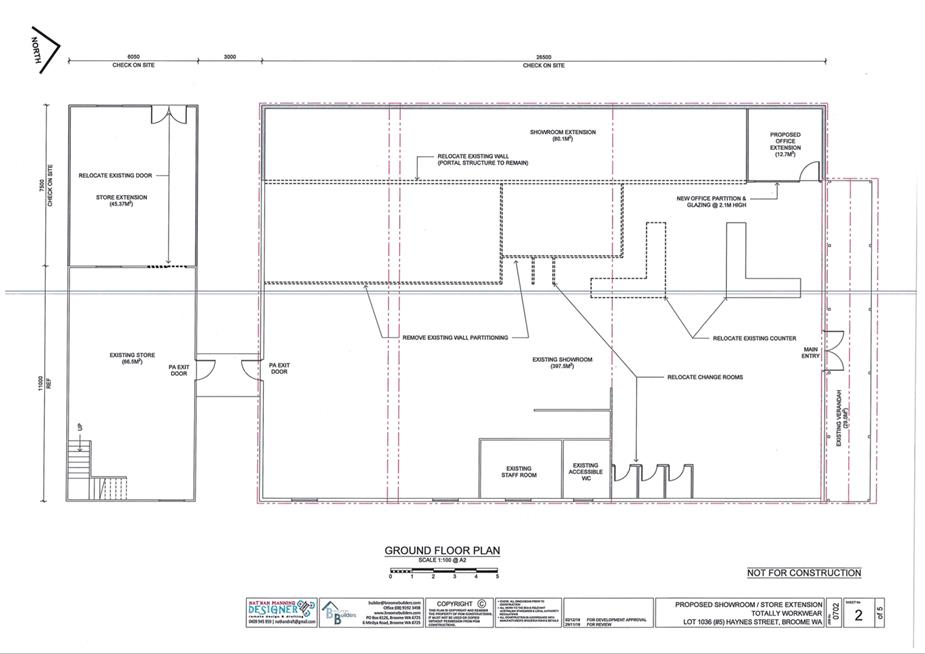
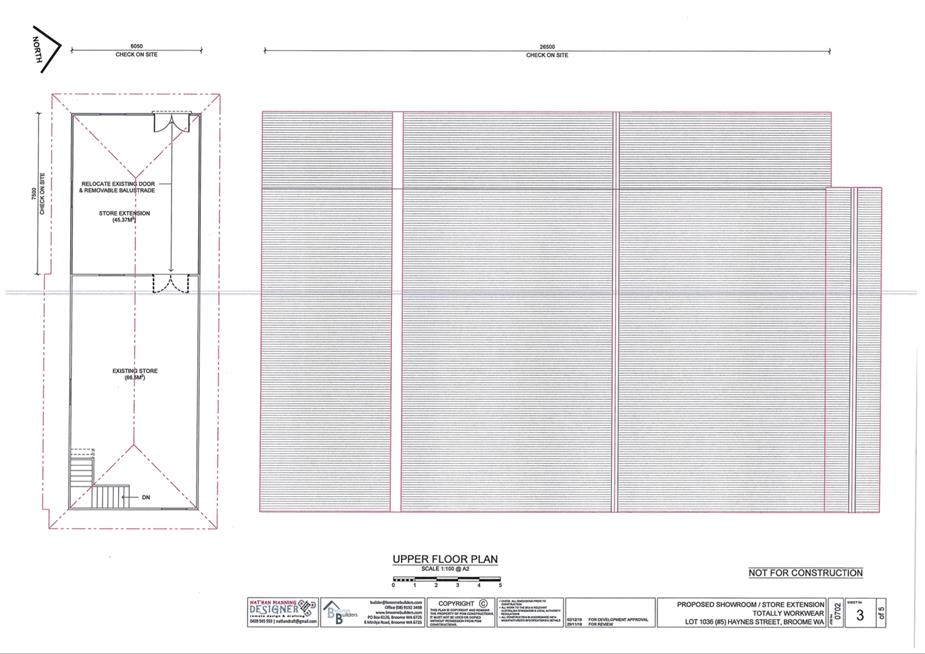
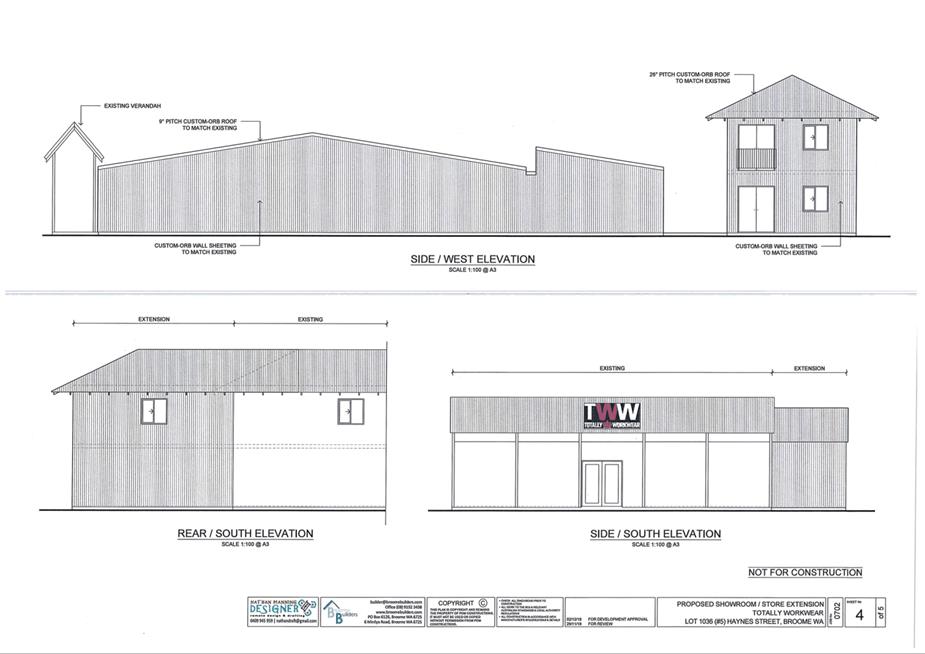
|
Item 9.2.4 - DEVELOPMENT APPLICATION 2019/104 EXTENSION TO SHOWROOM INCLUDING OFF-SITE CAR PARKING AT LOT 1036 (5) HAYNES STREET, BROOME |
Minutes – Ordinary Meeting of Council 27 February 2020 Page 1 of 2
|
SUMMARY: The Shire of Broome Local Planning Strategy was adopted in August 2014 and Local Planning Scheme No 6 (LPS6) was gazetted on the 30 January 2015. The Planning and Development (Local Planning Schemes) Regulations 2015 (the Regulations) requires local governments to carry out a review of their local planning schemes within six months of the five-year anniversary of the date the scheme was approved. The review of LPS6 is therefore due 30 July 2020. Part 6 of the Regulations require that a local government prepare a Report of Review, Council must approve the report by resolution and provide a copy of the report to the Western Australian Planning Commission (WAPC). The Report of Review is required to be prepared consistent with the WAPC format and must make recommendations as to whether the Local Planning Strategy and LPS6 are: · satisfactory in their existing form; · should be amended; or · should be repealed and a new scheme/strategy prepared in its place. This report recommends that Council approve the Report of Review and forward a copy of the Report to the WAPC. |
BACKGROUND
Previous Considerations
Nil.
The LPS6 was gazetted on the 30 January 2015 and is formed by the Scheme Text (which includes the Deemed Provisions) and Scheme maps. Local Governments are required to have local planning schemes under the Planning and Development Act 2005 (the Act) and the purpose of a Local Planning Scheme is to:
(a) set out the local government’s planning aims and intentions for the Scheme area; and (b) set aside land as local reserves for public purposes; and
(c) zone land within the Scheme area for the purposes defined in this Scheme; and
(d) control and guide development including processes for the preparation of structure plans, activity centre plans and local development plans; and
(e) set out procedures for the assessment and determination of development applications; and
(f) set out procedures for contributions to be made for the costs of providing infrastructure in connection with development through development contribution plans; and
(g) make provision for the administration and enforcement of this Scheme; and (h) address other matters referred to in Schedule 7 of the Act.
The Local Planning Scheme is the statutory planning instrument and forms the basis of which every subdivision or development application is assessed. Local Planning Scheme’s have the status of ‘subsidiary legislation’ which means that unlike policies and other planning instruments, Schemes have legislative effect and must be treated as ‘law’.
A major shift in the way Local Planning Scheme’s operate in Western Australia occurred on 19 October 2015 when the Regulations became operative. The Regulations introduce ‘Deemed Provisions’ meaning that they have direct effect and are to be read as if they formed part of an LPS. The deemed provisions largely relate to the administrative matters to provide consistency across the State and address matters such as the adoption of Local Planning Policies, Heritage Lists, and Structure Plans and prescribes procedures for dealing with development application, enforcement and forms. The Shire’s LPS6 was amended to be consistent with the Deemed Provisions.
The Regulations also introduced ‘Model Provisions’ which provides a template for how LPS’s are to be prepared. The Model Provisions include standard zones and reservations and land-use definitions. The Shire of Broome LPS6 was prepared under the previous ‘Model Scheme Text’ provisions and has not been ‘normalised’ to be consistent with the Model Provisions.
The Shire of Broome’s Local Planning Strategy was adopted by the WAPC in August 2014. The role of the Local Planning Strategy is to:
· set out the long-term planning directions for the local government;
· apply any State or regional planning policy that is relevant to the strategy; and
· provide the rationale for any zoning or classification of land under the local planning scheme
The objectives in the Local Planning Strategy are codified and implemented through the local planning scheme.
The Local Planning Strategy provides a strategic basis for land use planning. The Local Planning Strategy also provides guidance where there is a question as to whether a use or form of development should be approved, where such guidance is not provided by the Local Planning Scheme itself.
Full copies of both LPS6 and the Local Planning Strategy can be accessed here: https://www.dplh.wa.gov.au/broome.
COMMENT
The Regulations prescribe that local governments are required to perform a review of their Local Planning Scheme’s the fifth year after the Scheme was gazetted. This review is to be in the form of a Report of Review and WAPC Guidelines establish the format in how this is to occur (which can be accessed here: https://www.dplh.wa.gov.au/getmedia/e30310f3-79e8-4c5d-b5c0-caff7c29e665/PD_LPS_Manner_and_form_Scheme_Review).
Under the Regulations the Report of Review is to make recommendations on:
(a) whether the scheme —
(i) is satisfactory in its existing form; or
(ii) should be amended; or
(iii) should be repealed and a new scheme prepared in its place; and
(b) whether the local planning strategy for the scheme —
(i) is satisfactory in its existing form; or
(ii) should be reviewed; or
(iii) should be repealed and a new strategy prepared in its place.
A Report of Review for the Shire’s LPS6 and Local Planning Strategy has been prepared consistent with the requirement of the Regulations and the WAPC Guidelines. A copy of the Report of Review can be access in Attachment No 1 and it provides an overview of the amendments performed to the Scheme and Strategy, development activity, population analysis, officer comments and recommendations.
The review performed regarding development activity and population has demonstrated that both the Strategy and Scheme provide enough framework to cater for future growth projections. Regarding the Local Planning Strategy, while the Strategy is deemed to be sound, it is recommended that a review should be performed to:
1. Ensure consistency and alignment with the objectives and goals of the Shire’s Strategic Community Plan and the Broome Growth Plan;
2. Update to reflect review of informing planning documents including the three Development Strategies (Cable Beach, Old Broome and Chinatown), the CHRMAP and the Local Commercial Strategy.
3. Update references to zoning and reserves to be consistent with the model provisions contained within the Regulations.
4. Review the strategies and actions incorporated into the LPS to ensure consistency with Council and community expectations.
5. Review whether the pattern and form of development within the Local Planning Strategy is adequate to meet future needs of the Broome community and whether the planning framework adequately caters for sustainable land use patterns in the long-term.
Regarding LPS6, while the Scheme has been updated to incorporate the Deemed Provisions, the Scheme has not been updated to be consistent with the Model Provisions contained in the Regulations. Also, if a review of the Local Planning Strategy is supported, the Scheme similarly should be reviewed. Therefore, it is recommended that LPS6 is reviewed and repealed with a new scheme. This review would be guided by a comprehensive consultation process and would address the following:
1. Updates to legislation including the introduction of the Model Provisions.
2. Consequential changes attributed to the revision of the Local Planning Strategy including documents adopted by Council (e.g. CHRMAP, Local Commercial Strategy, etc).
3. Emerging issues (e.g. Short-stay accommodation land uses in the Residential zones.
If the above recommendation was adopted, the Report will be forwarded to the WAPC. The WAPC has a 90-day period to decide whether it agrees with the position formed by the local government. If the recommendation is supported, it will result in the preparation of a new Scheme and Strategy by the Shire.
The process involved in the preparation of a new Scheme and Strategy will be consistent with the Act and Regulations and will be guided by a comprehensive public consultation process. Once the WAPC has advised of the outcome of the Report of Review, a detailed and comprehensive Community Engagement Strategy will be presented to Council to guide the engagement that will occur in the process of reviewing the Strategy and Scheme.
CONSULTATION
The Regulations do not prescribe any consultation requirements as part of the preparation of the Report of Review.
Councillors were provided with a presentation at the August 2019 Councillor Workshop where a general update on the process of the Scheme Review was provided.
Officers have also consulted with staff at the Department of Planning Lands and Heritage in preparing the Report of Review.
Upon advice from the WAPC on the Report of Review, a detailed Community Engagement Plan will be prepared for consideration by Council. This Community Engagement Plan will guide engagement and consultation to be performed in completing the review of the Strategy and Scheme.
STATUTORY ENVIRONMENT
Planning and Development (Local Planning Schemes) Regulations 2015 – Part 4
65. Review of local planning scheme
(1) A local government must carry out a review of each local planning scheme prepared by the local government —
(a) in the 5th year after the scheme is published in the Gazette under section 87(3) of the Act; and
(b) in the 5th year after the completion of each review carried out under this Division.
(2) Sub regulation (1) applies to a local planning scheme that was published in the Gazette more than 5 years before the commencement of this regulation as if it were published in the Gazette on the day that is 3 years before the day on which this regulation comes into operation.
(3) The review must consider whether the local planning scheme is up-to-date and complies with these regulations.
(4) The review may be undertaken in conjunction with the preparation of a consolidation of a scheme under Part 5 Division 5 of the Act.
(1) The local government must, no later than 6 months after the requirement to carry out the review of a local planning scheme arises under regulation 65, or such longer period as the Commission allows —
(a) prepare a report of the review; and
(b) approve the report by resolution; and
(c) provide the approved report to the Commission.
(2) The report must be prepared in the manner and form approved by the Commission and must include the following information —
(a) the date on which the local planning scheme was published in the Gazette in accordance with section 87(3) of the Act;
(b) the date on which each amendment made to the scheme was published in the Gazette in accordance with section 87(3) of the Act;
(c) the date on which the scheme was last consolidated under Part 5 Division 5 of the Act;
(d) an overview of the subdivision and development activity, lot take‑up and population changes in the scheme area since the later of —
(i) the date on which the scheme was published in the Gazette in accordance with section 87(3) of the Act; and
(ii) the date on which the scheme was last reviewed;
(e) an overview of the extent to which the scheme has been amended to comply with the requirements of any relevant legislation, region planning scheme or State planning policy.
(3) The report must make recommendations as to —
(a) whether the scheme —
(i) is satisfactory in its existing form; or
(ii) should be amended; or
(iii) should be repealed and a new scheme prepared in its place;
and
(b) whether the local planning strategy for the scheme —
(i) is satisfactory in its existing form; or
(ii) should be reviewed; or
(iii) should be repealed and a new strategy prepared in its place.
(1) Within 90 days of receiving a report of a review of a local planning scheme, or such longer period as the Minister or an authorised person allows, the Commission must consider the report and —
(a) decide whether the Commission agrees or disagrees with the recommendations in the report; and
(b) notify the local government which prepared the report of the Commission’s decision.
(2) After receiving notification of the Commission’s decision on a report of a review of a local planning scheme the local government must —
(a) publish the report and notice of the Commission’s decision on the website of the local government or in any other manner approved by the Commission; and
(b) make the report and notice of the Commission’s decision available for inspection at the office of the local government.
POLICY IMPLICATIONS
Nil
FINANCIAL IMPLICATIONS
The Report of Review was prepared by officers. If the WAPC supports the recommendations of the report, there will be financial implications for the Shire to prepare a new Scheme and Strategy. The Corporate Business Plan provides for this and a budget allocation for the 19/20 financial year has been made for the Shire to engage a consultant to undertake the community engagement and prepare the updated Strategy and Scheme documents. A budget allocation will also be considered for the 20/21 financial year as the preparation will extend into the following financial year period.
RISK
The Regulations require that the local government must perform a review of its LPS within 6 months of the fifth year that the Scheme came into operation. If the Report of Review was not adopted, there is a risk that the Shire will not be compliant with the provisions of the Regulations.
It is important that the Shire has an up-to-date Local Planning Framework to ensure that it responding to the needs to the community and is consistent with State policy. As the Scheme and Strategy provide the basis for the guiding the development around the Shire, it must be kept relevant.
STRATEGIC IMPLICATIONS
Our People Goal – Foster a community environment that is accessible, affordable, inclusive, healthy and safe:
Accessible and safe community spaces
Our Place Goal – Help to protect the nature and built environment and cultural heritage of Broome whilst recognising the unique sense of the place:
Realistic and sustainable land use strategies for the Shire within state and national frameworks and in consultation with the community
A built environment that reflects tropical climate design principles and
A natural environment for the benefit and enjoyment of current and future generations
A preserved, historical and cultural heritage of Broome
Retention and expansion of Broome’s iconic tourism assets and reputation
Our Prosperity Goal – Create the means to enable local jobs creation and lifestyle affordability for the current and future population:
Affordable land for residential, industrial, commercial and community use
VOTING REQUIREMENTS
Simple Majority
|
Minute No. C/0220/019 Moved: Cr N Wevers Seconded: Cr C Mitchell That Council: 1. Pursuant to Regulation 66 (1) (b) of the Planning and Development (Local Planning Schemes) Regulations 2015 approve the Report of Review contained in Attachment No 1 and forward a copy of the Report to the Western Australian Planning Commission. 2. Pursuant to Regulation 66(3) of the Planning and Development (Local Planning Schemes) Regulations 2015 recommend to the Western Australian Planning Commission that: (a) The Shire of Broome Local Planning Strategy should be reviewed informed by a comprehensive consultation process; and (b) The Shire of Broome Local Planning Scheme No 6 requires review, a new Local Planning Scheme No 7 should be prepared and Local Planning Scheme No 6 be repealed upon gazettal of the new local planning scheme. |
|
Report of Review |
|
Item 9.2.5 - REPORT OF REVIEW - SHIRE OF BROOME LOCAL PLANNING STRATEGY AND LOCAL PLANNING SCHEME NO 6 |
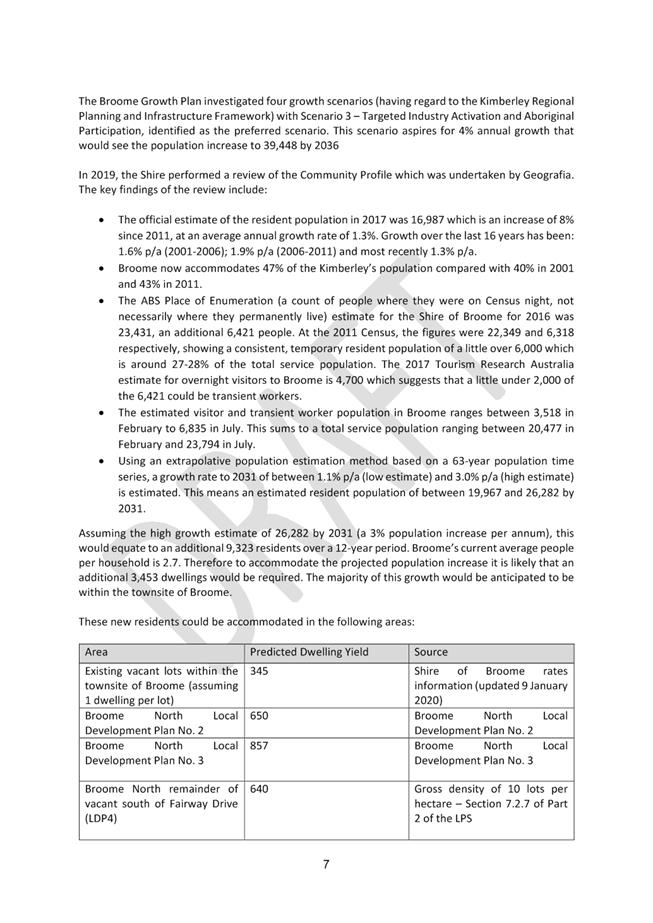
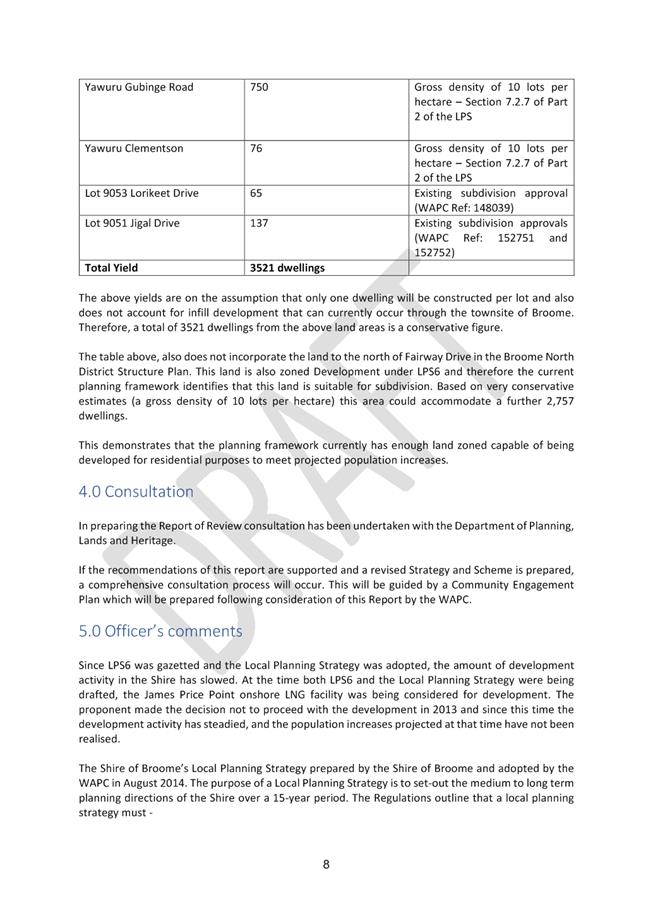
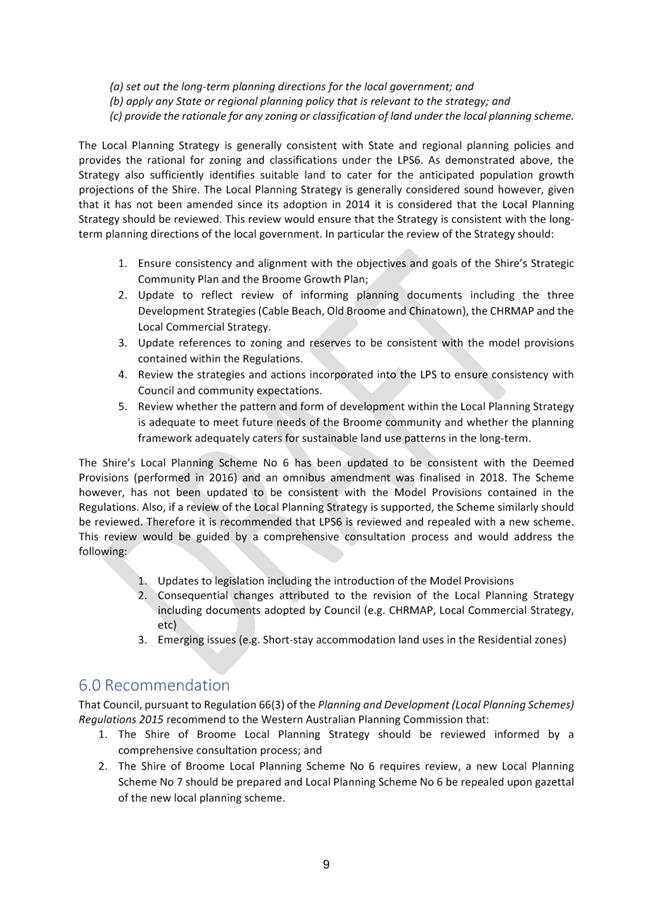
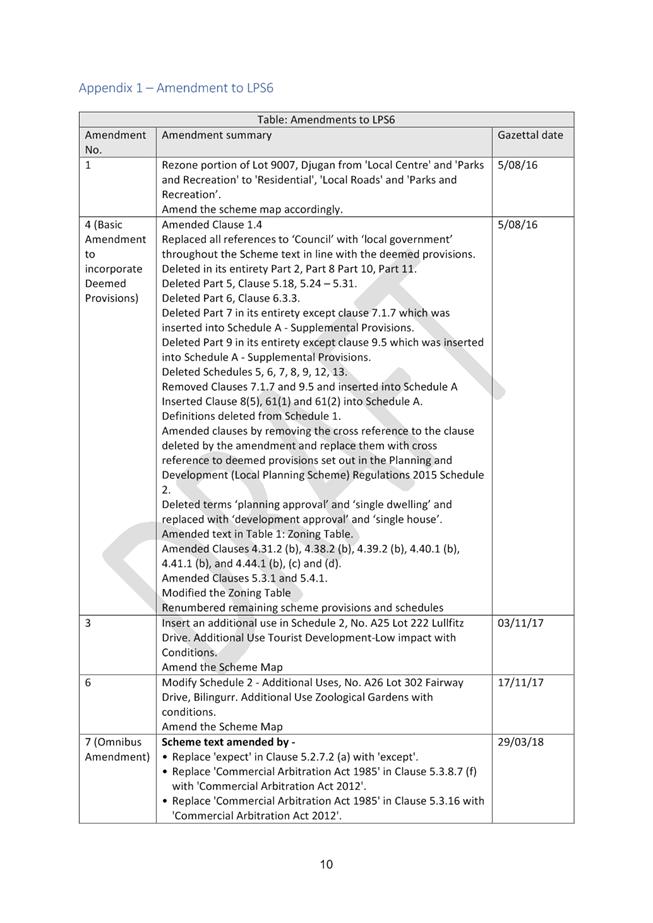
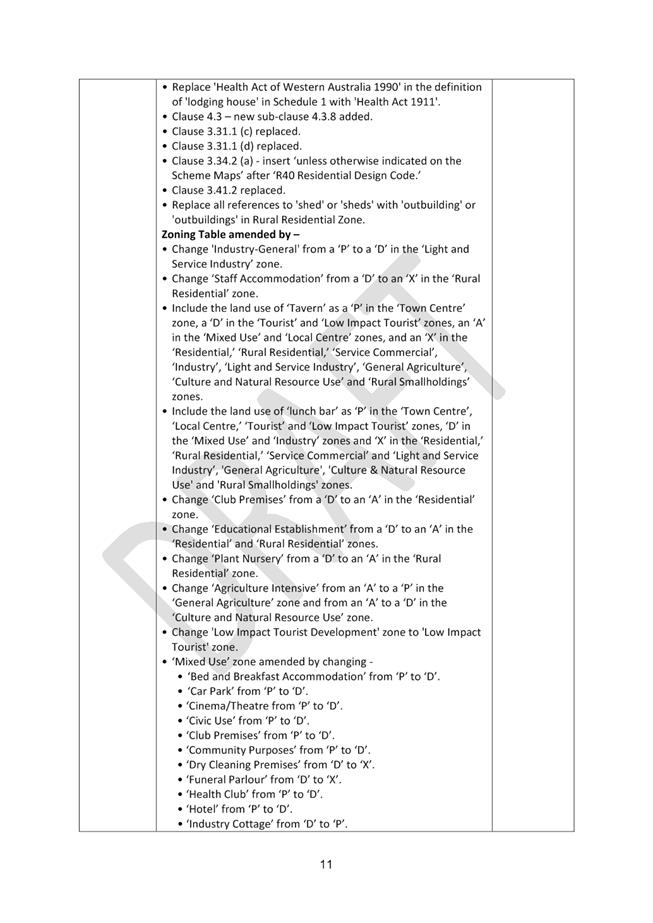
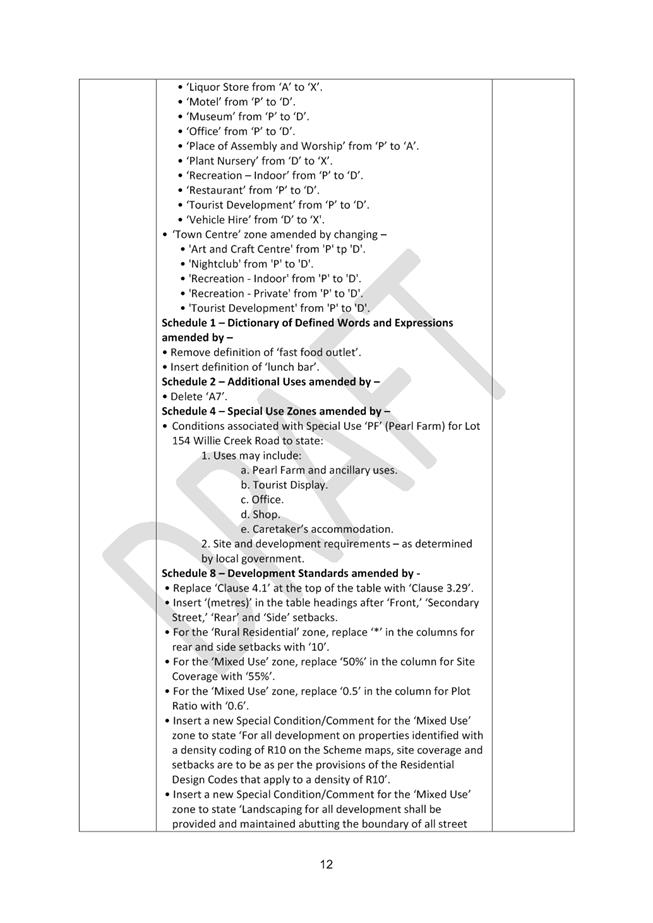
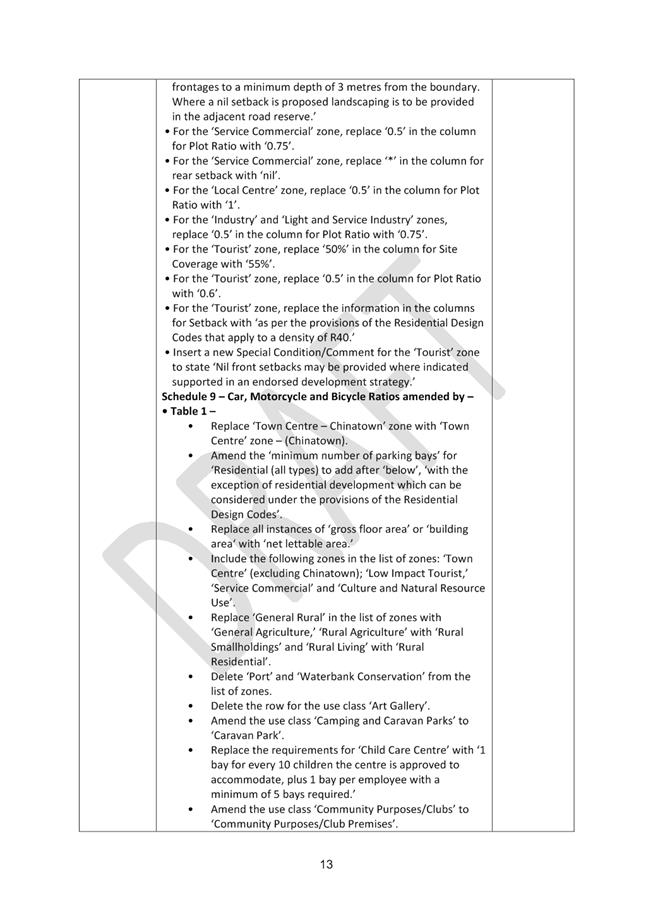
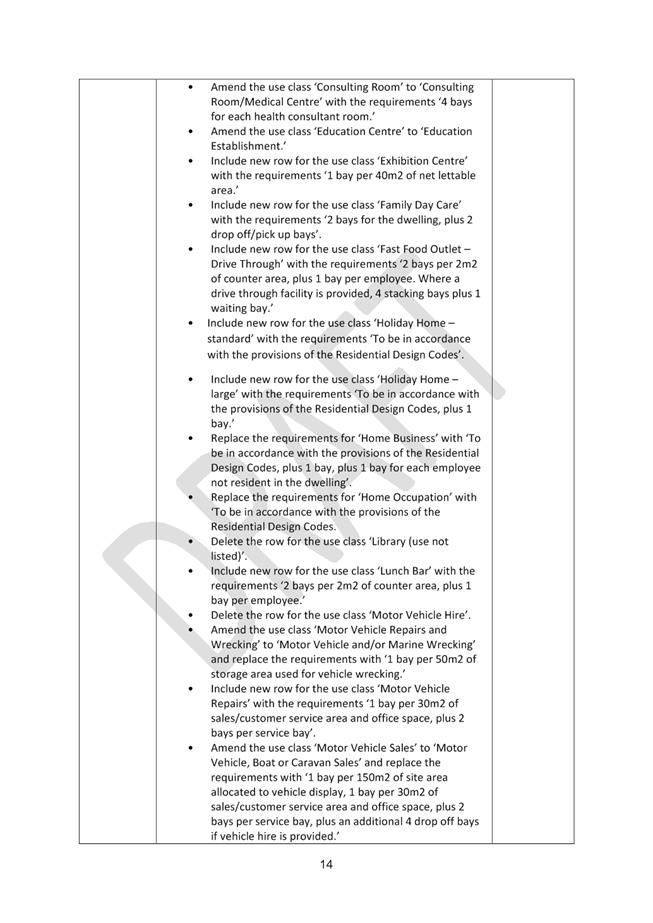
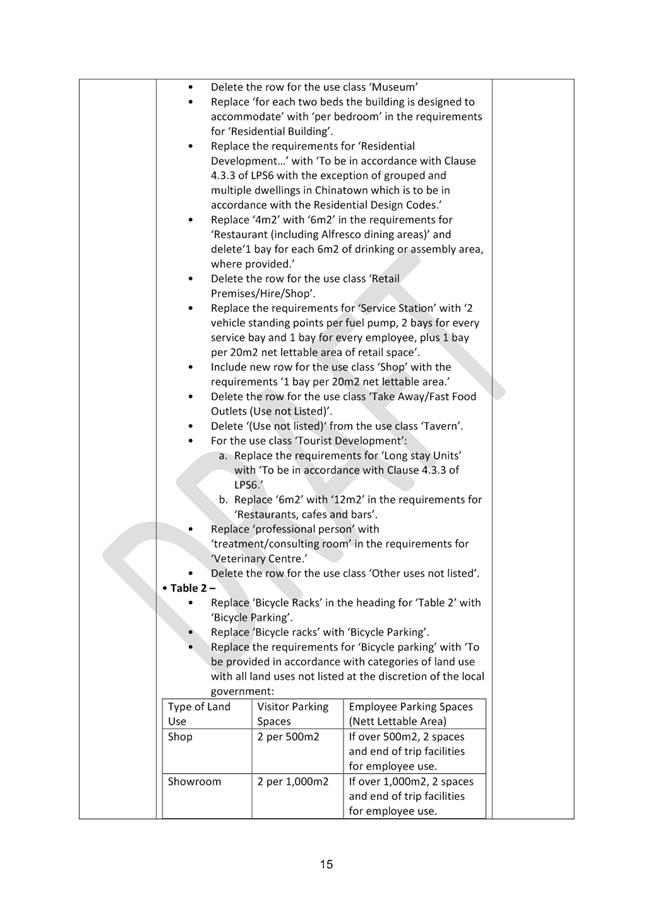
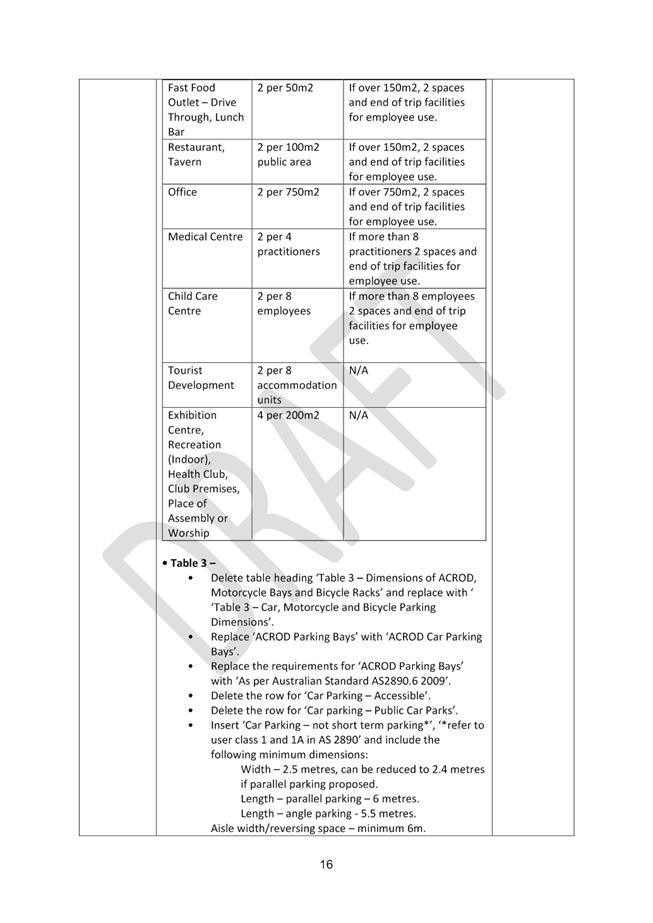
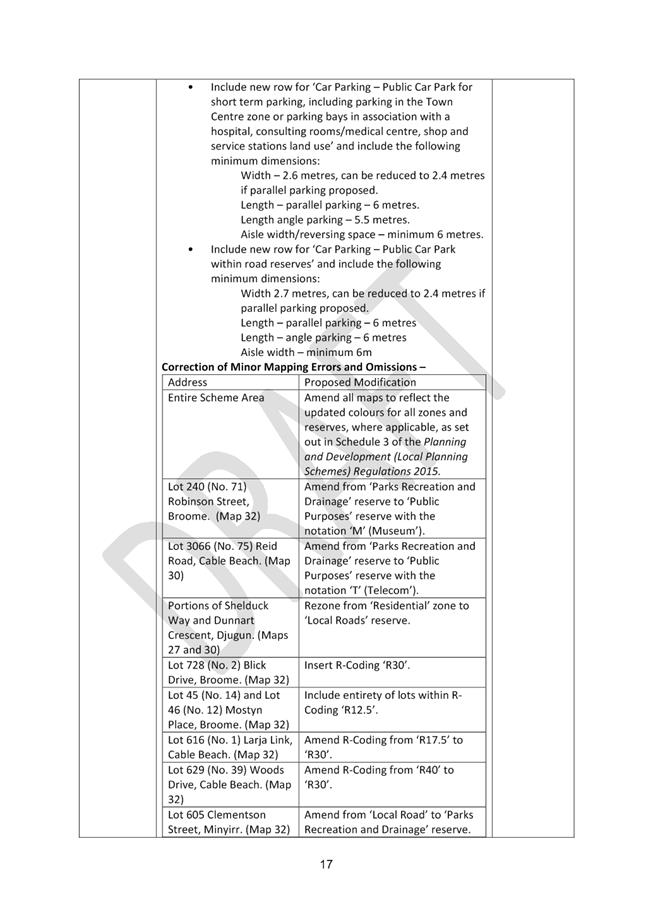
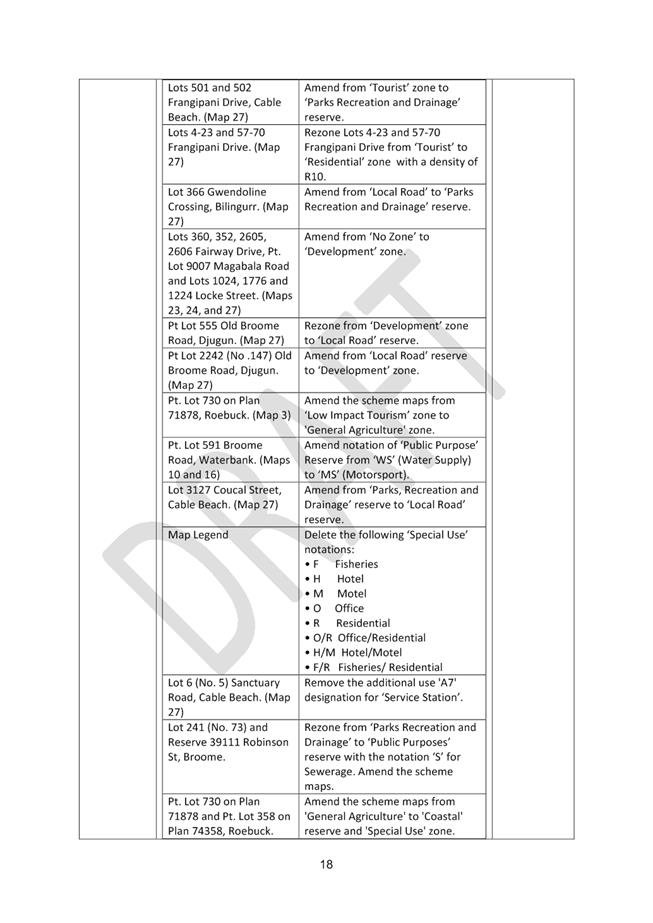
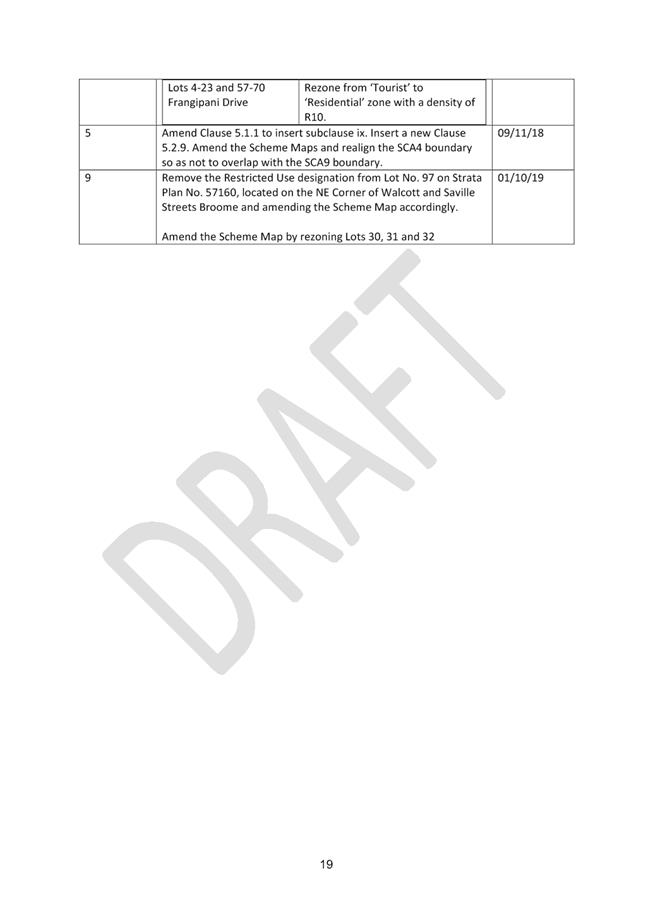
Minutes – Ordinary Meeting of Council 27 February 2020 Page 1 of 2
|
SUMMARY: The Broome Shire Health Local Law (2006) and Waste Policy 4.4.3 (2014) currently regulate waste activities within the Shire of Broome. A recent review of these documents highlighted the need to update the current regulations and have greater flexibility to enforce those regulations. WALGA has developed a template Waste Local Law that is currently being implemented by Councils across the state to allow for easy passage of a Waste Local Law. It is proposed that Broome Shire Council use this template to make the Broome Waste Local Law 2020. |
BACKGROUND
Historically, local governments, including the Shire of Broome, have regulated waste through Health Local Laws. Broome’s Local Health Law was introduced in 2006. To further provide a framework for waste and recycling services within the Shire, Waste Policy 4.4.3 was passed in 2014.
In 2007, the introduction of the Waste and Resource Recovery Act, gave local governments the power to make local laws to deal specifically with waste. Subsequently, WALGA created a Waste Local Law template to ensure the quick passage of the waste local law through the judicial system.
The introduction of the Container Deposit Scheme in Western Australia in June 2020 prompted a review of the current local laws and waste policy at the Shire of Broome. The review highlighted the need to update waste regulations.
COMMENT
The purpose of a Waste Local Law (WLL) is to regulate and control the storage, collection and disposal of waste and recycling material for the benefit of the community and protection of the environment. The effect of the local law is to establish obligations that owners and occupiers of premises must observe relating to the use, storage, cleanliness, maintenance and placement of receptacles.
Presently, waste-related offences and penalties are regulated through the Broome Health Local Health (2006) and the Broome Council Waste Policy 4.4.3. This policy and law have no prescribed form to issue infringements. The Health Local Law (2006) also contains outdated penalties.
The WLL is a template distributed through WALGA that has been subject to a specific inquiry by the Joint Standing Committee on Delegated Legislation (JSCDL) and consequently approved. The template was designed with the aim of ensuring easy passage through the judicial system following numerous Councils experiencing difficulty and delay in implementing a WLL. This WLL template is being adopted progressively by Councils across the State.
The development of a WLL will provide greater flexibility in authorising officers to perform the functions within the local law as currently the Health Local Laws can only be enforced by Environmental Health Officers. The proposed WLL could be enforced by any officers authorised for that purpose.
The introduction of the WLL at this time will also coincide with the introduction of the Container Deposit Scheme to Western Australia on 2 June 2020. The WLL will allow for the regulation of activities relating to kerbside bins and containers.
CONSULTATION
WALGA
Councillor workshop December 2019. Councillors present include Cr H Tracey, Cr P Matsumoto, Cr C Mitchell, Cr B Rudeforth, Cr P Taylor, Cr N Wevers and Cr F West.
STATUTORY ENVIRONMENT
Section 3.12 of the Local Government Act 1995 and Section 61of the Waste Avoidance and Resource Recovery Act 2007, enable local governments to make local laws dealing with waste.
In making a local law, a local government is required to follow the procedure prescribed in Section 3.12 of the Local Government Act 1995. The first stage of this process requires the Shire to give State-wide public notice of a proposal to make a local law and provide a period of at least six weeks for public submissions on the proposal. The Shire is also required to provide a copy of the proposed local law to the Minister responsible for administering the Act under which the local law is to be made.
Waste Avoidance and Resource Recovery Act 2007
Waste Avoidance and Resource Recovery Regulations 2008
Shire of Broome Health Local Law 2006
POLICY IMPLICATIONS
Policy 4.4.3 Waste Management to be reviewed and possible retired upon commencement of Waste Local Law 2020.
Remove the waste section from the Broome Health Local Law (2006) on review of the document.
FINANCIAL IMPLICATIONS
Potential minimal income from applied penalties.
Small administrative costs relating to advertising and gazettal.
RISK
STRATEGIC IMPLICATIONS
Our People Goal – Foster a community environment that is accessible, affordable, inclusive, healthy and safe:
A healthy and safe environment
VOTING REQUIREMENTS
Simple Majority
|
Minute No. C/0220/020 Moved: Cr C Mitchell Seconded: Cr N WeversThat Council: 1. Pursuant to section 3.12(3) and (3a) of the Local Government Act 1995, state-wide and local public notice be given stating that the Council intends to make the following local law: Waste Local Law 2020 Purpose – is to regulate the collection, disposal and storage of waste and recyclable materials. Effect – is to control the collection, disposal and storage of waste and recyclable materials for the benefits and health of the community and protection of the environment. 2. Requests the results of the public consultation to be presented to Council for consideration of any submissions received. |
|
Draft Waste Local Law 2020 |
|
SUMMARY: This report recommends that Council receives the list of payments made under delegated authority, as per the attachment to this report, for the month of December 2019. |
COMMENT
The Chief Executive Officer (CEO) has delegated authority to make payments from the Municipal and Trust funds in accordance with budget allocations.
The Shire provides payments to suppliers by either Electronic Funds Transfer (EFT & BPAY), cheque, credit card or direct debit.
Attached is a list of all payments processed under delegated authority during the month of December 2019.
CONSULTATION
Nil.
STATUTORY ENVIRONMENT
Local Government (Financial Management) Regulations 1996
13. Payments from municipal fund or trust fund by CEO, CEO’s duties as to etc.
(1) If the local government has delegated to the CEO the exercise of its power to make payments from the municipal fund or the trust fund, a list of accounts paid by the CEO is to be prepared each month showing for each account paid since the last such list was prepared —
(a) the payee’s name;
(b) the amount of the payment; and
(c) the date of the payment; and
(d) sufficient information to identify the transaction.
(2) A list of accounts for approval to be paid is to be prepared each month showing —
(a) for each account which requires council authorisation in that month —
(i) the payee’s name; and
(ii) the amount of the payment; and
(iii) sufficient information to identify the transaction; and
(b) the date of the meeting of the council to which the list is to be presented.
(3) A list prepared under sub regulation (1) or (2) is to be —
(a) presented to the council at the next ordinary meeting of the council after the list is prepared; and
(b) recorded in the minutes of that meeting.
POLICY IMPLICATIONS
Nil.
FINANCIAL IMPLICATIONS
List of payments made in accordance with budget and delegated authority. Payments can also be analysed as follows:
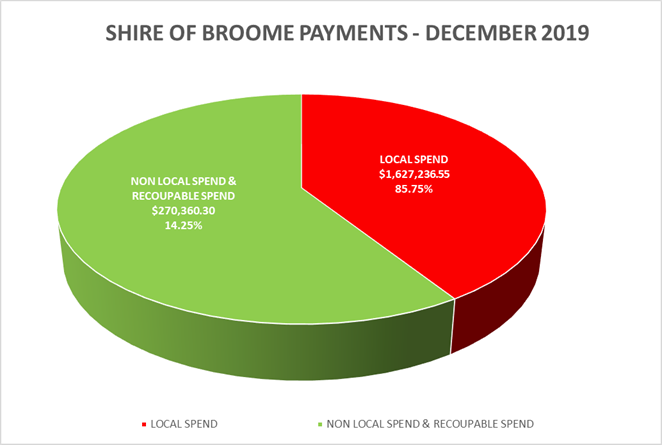
The above graph shows the percentage of local spend in comparison to non-local and recoupable spend for the month of December 2019 after $1,575,122.49 in personnel payments, $890,372.34 in utilities and other non-local sole suppliers have been excluded.
RISK
The risk of Council not adopting this report is extreme as this will result in non-compliance with Regulation 13 of the Local Government (Financial Management) Regulations 1996.
The likelihood of this ever occurring is rare due to the CEO’s implementation of procedures to ensure payment details are disclosed to Council in a timely manner, as well as Procurement and Purchasing policies which ensure these payments are made in accordance with budget and delegated authority and comply with Local Government (Financial Management) Regulations 1996.
STRATEGIC IMPLICATIONS
Our Organisation Goal – Continually enhance the Shire’s organisational capacity to service the needs of a growing community:
An organisational culture that strives for service excellence
Responsible resource allocation
Effective community engagement
Improved systems, processes and compliance
VOTING REQUIREMENTS
Simple Majority
|
Minute No. C/0220/021 Moved: Cr D Male Seconded: Cr N Wevers That Council: 1. Receives the list of payments made from the Municipal and Trust Accounts in December 2019 totalling $4,363,091.68 (Attachment 1) in accordance with the requirements of Regulation 12 of the Local Government (Financial Management) Regulations 1996 covering: a. EFT Vouchers 53980 - 54284 totalling $3,767,351.59; b. Municipal Cheque Vouchers 57622 – 57623 totalling $760.06; c. Trust Cheque Vouchers 000 – 000 totalling $0.00; and d. Credit Card Payments and Municipal Direct Debits DD273541.1 - DD27463.32A totalling $594,980.03. 2. Notes the local spend of $1,627,236.55 included in the amount above, equating to 85.75% of total payments excluding personnel, utility and other external sole supplier costs.
|
|
Monthly Payment December 2019 |
|
|
Local Spend Payment Listing December 2019 |
Minutes – Ordinary Meeting of Council 27 February 2020 Page 1 of 2
|
SUMMARY: This report recommends that Council receives the list of payments made under delegated authority, as per the attachment to this report, for the month of January 2020. |
COMMENT
The Chief Executive Officer (CEO) has delegated authority to make payments from the Municipal and Trust funds in accordance with budget allocations.
The Shire provides payments to suppliers by either Electronic Funds Transfer (EFT & BPAY), cheque, credit card or direct debit.
Attached is a list of all payments processed under delegated authority during the month of January 2020.
CONSULTATION
Nil.
STATUTORY ENVIRONMENT
Local Government (Financial Management) Regulations 1996
13. Payments from municipal fund or trust fund by CEO, CEO’s duties as to etc.
(1) If the local government has delegated to the CEO the exercise of its power to make payments from the municipal fund or the trust fund, a list of accounts paid by the CEO is to be prepared each month showing for each account paid since the last such list was prepared —
(a) the payee’s name;
(b) the amount of the payment; and
(c) the date of the payment; and
(d) sufficient information to identify the transaction.
(2) A list of accounts for approval to be paid is to be prepared each month showing —
(a) for each account which requires council authorisation in that month —
(i) the payee’s name; and
(ii) the amount of the payment; and
(iii) sufficient information to identify the transaction; and
(b) the date of the meeting of the council to which the list is to be presented.
(3) A list prepared under sub regulation (1) or (2) is to be —
(a) presented to the council at the next ordinary meeting of the council after the list is prepared; and
(b) recorded in the minutes of that meeting.
POLICY IMPLICATIONS
Nil.
FINANCIAL IMPLICATIONS
List of payments made in accordance with budget and delegated authority. Payments can also be analysed as follows:
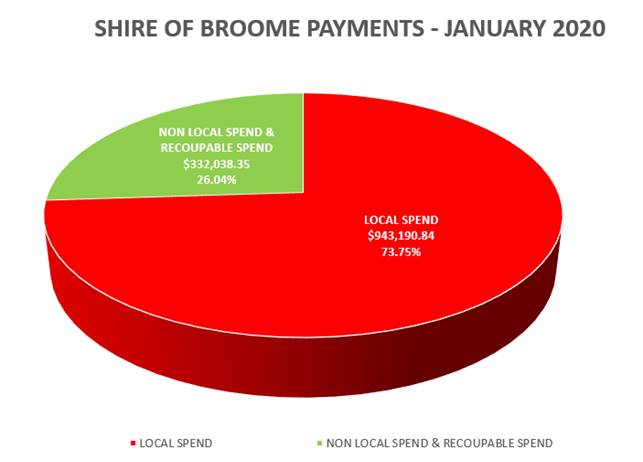
The above graph shows the percentage of local spend in comparison to non-local and recoupable spend for the month of January 2020 after $1,493,238.42 in personnel payments, $536,377.43 in utilities and other non-local sole suppliers have been excluded.
RISK
The risk of Council not adopting this report is extreme as this will result in non-compliance with Regulation 13 of the Local Government (Financial Management) Regulations 1996.
The likelihood of this ever occurring is rare due to the CEO’s implementation of procedures to ensure payment details are disclosed to Council in a timely manner, as well as Procurement and Purchasing policies which ensure these payments are made in accordance with budget and delegated authority and comply with Local Government (Financial Management) Regulations 1996.
STRATEGIC IMPLICATIONS
Our Organisation Goal – Continually enhance the Shire’s organisational capacity to service the needs of a growing community:
An organisational culture that strives for service excellence
Responsible resource allocation
Effective community engagement
Improved systems, processes and compliance
VOTING REQUIREMENTS
Simple Majority
|
Minute No. C/0220/022 Moved: Cr C Mitchell Seconded: Cr N Wevers That Council: 1. Receives the list of payments made from the Municipal and Trust Accounts in January 2020 totalling $3,304,845.04 (Attachment 1) in accordance with the requirements of Regulation 12 of the Local Government (Financial Management) Regulations 1996 covering: a. EFT Vouchers 54285 - 54563 totalling $3,143,740.57; b. Municipal Cheque Vouchers 57624 - 57624 totalling $545.20; c. Trust Cheque Vouchers 000 – 000 totalling $0.00; and d. Credit Card Payments and Municipal Direct Debits DD27502.1 - DD27581.33A totalling $160,559.27. 2. Notes the local spend of $943,190.84 included in the amount above, equating to 73.75% of total payments excluding personnel, utility and other external sole supplier costs.
|
|
Monthly Payment January 2020 |
|
|
Local Spend Payment Listing January 2020 |
Minutes – Ordinary Meeting of Council 27 February 2020 Page 1 of 2
|
SUMMARY: Council is required by legislation to consider and adopt the Monthly Statement of Financial Activity Report for the period ended 31 December 2019, as required by Regulation 34(1) of the Local Government (Financial Management) Regulations 1996 (FMR). Council is further provided with a General Fund Summary of Financial Activity (Schedules 2 to 14) which provides comprehensive information on Council’s operations by Function and Activity. |
BACKGROUND
Previous Considerations
Council is provided with the Monthly Financial Activity Report which has been developed in line with statutory reporting standards and provides Council with a holistic overview of the operations of the Shire of Broome.
Supplementary information has been provided in the form of Notes to the Monthly Report and a General Fund Summary of Financial Activity, which discloses Council’s Revenue and Expenditure in summary form, by Programme (Function and Activity).
Disclosure and supply of appropriate explanations for variances presented in the Statement of Financial Activity, is mandatory under FMR 34(2)(b) as stated in Policy 2.2.2 Materiality in Financial Reporting.
FMR 34(5) requires a local government to adopt a percentage or value, calculated in accordance with the Australian Accounting Standards (AAS) and Council’s adopted risk management matrix thresholds, to be used in statements of financial activity for reporting material variances.
COMMENT
The 2019/20 Annual Budget was adopted at the Ordinary Meeting of Council on 27 June 2019.
The following are key indicators supporting the year to-date budget position with respect to the Annual Forecast Budget:
Budget Year elapsed 50.27%
Total Rates Raised Revenue 100% (of which 78.87% has been collected)
Total Other Operating Revenue 40%
Total Operating Expenditure 41%
Total Capital Revenue 22%
Total Capital Expenditure 28%
Total Sale of Assets Revenue 32%
More detailed explanations of variances are contained in Note 2 of the Monthly Statement of Financial Activity. The commentary identifies material variations between the expected year-to-date budget position and the position at the reporting date.
Based on the 2019/20 Annual Budget presented at the Ordinary Meeting of Council on 27 June 2019, Council adopted a balanced budget to 30 June 2020.
CONSULTATION
Nil.
STATUTORY ENVIRONMENT
Local Government (Financial Management) Regulations 1996
34. Financial activity statement report — s. 6.4
(1A) In this regulation —
“committed assets” means revenue unspent but set aside under the annual budget for a specific purpose.
(1) A local government is to prepare each month a statement of financial activity reporting on the sources and applications of funds, as set out in the annual budget under regulation 22(1)(d), for that month in the following detail —
(a) annual budget estimates, taking into account any expenditure incurred for an additional purpose under section 6.8(1)(b) or (c);
(b) budget estimates to the end of the month to which the statement relates;
(c) actual amounts of expenditure, revenue and income to the end of the month to which the statement relates;
(d) material variances between the comparable amounts referred to in paragraphs (b) and (c); and
(e) the net current assets at the end of the month to which the statement relates
(2) Each statement of financial activity is to be accompanied by documents containing —
(a) an explanation of the composition of the net current assets of the month to which the statement relates, less committed assets and restricted assets;
(b) an explanation of each of the material variances referred to in sub regulation (1)(d); and
(c) such other supporting information as is considered relevant by the local government.
(3) The information in a statement of financial activity may be shown —
(a) according to nature and type classification;
(b) by program; or
(c) by business unit.
(4) A statement of financial activity, and the accompanying documents referred to in sub regulation (2), are to be —
(a) presented at an ordinary meeting of the council within 2 months after the end of the month to which the statement relates; and
(b) recorded in the minutes of the meeting at which it is presented.
(5) Each financial year, a local government is to adopt a percentage or value, calculated in accordance with the AAS, to be used in statements of financial activity for reporting material variances.
Local Government Act 1995
6.8. Expenditure from municipal fund not included in annual budget
(1) A local government is not to incur expenditure from its municipal fund for an additional purpose except where the expenditure —
(a) is incurred in a financial year before the adoption of the annual budget by the local government;
(b) is authorised in advance by resolution*; or
(c) is authorised in advance by the mayor or president in an emergency.
* Absolute majority required.
(1a) In subsection (1) —
“additional purpose” means a purpose for which no expenditure estimate is included in the local government’s annual budget.
(2) Where expenditure has been incurred by a local government —
(a) pursuant to subsection (1)(a), it is to be included in the annual budget for that financial year; and
(b) pursuant to subsection (1)(c), it is to be reported to the next ordinary meeting of the council.
POLICY IMPLICATIONS
2.2.2 Materiality in Financial Reporting
FINANCIAL IMPLICATIONS
The adoption of the Monthly Financial Report is retrospective. Accordingly, the financial implications associated with adopting the Monthly Financial Report are nil.
RISK
The Financial Activity report is presented monthly and provides a retrospective picture of the activities at the Shire. Contained within the report is information pertaining to the financial cost and delivery of strategic initiatives and key projects.
In order to mitigate the risk of budget over-runs or non-delivery of projects, the Chief Executive Officer has implemented internal control measures such as regular Council and management reporting and the quarterly Finance and Costing Review (FACR) process to monitor financial performance against budget estimates. Materiality reporting thresholds have been established at half the adopted Council levels, which equate to $5,000 for operating budget line items and $10,000 for capital items, to alert management prior to there being irreversible impacts.
It should also be noted that there is an inherent level of risk of misrepresentation of the financials through either human error or potential fraud. The establishment of control measures through a series of efficient systems, policies and procedures, which fall under the responsibility of the CEO as laid out in the Local Government (Financial Management Regulations) 1996 regulation 5, seek to mitigate the possibility of this occurring. These controls are set in place to provide daily, weekly and monthly checks to ensure that the integrity of the data provided is reasonably assured.
STRATEGIC IMPLICATIONS
Our Prosperity Goal – Create the means to enable local jobs creation and lifestyle affordability for the current and future population:
Affordable and equitable services and infrastructure
Affordable land for residential, industrial, commercial and community use
Key economic development strategies for the Shire which are aligned to regional outcomes working through recognised planning and development groups/committees
Our Organisation Goal – Continually enhance the Shire’s organisational capacity to service the needs of a growing community:
An organisational culture that strives for service excellence
Sustainable and integrated strategic and operational plans
Responsible resource allocation
Effective community engagement
Improved systems, processes and compliance
VOTING REQUIREMENTS
Simple Majority
|
Minute No. C/0220/023 Moved: Cr D Male Seconded: Cr C Mitchell That Council: 1. Adopts the Monthly Financial Activity Report for the period ended 31 December 2019; and 2. Receives the General Fund Summary of Financial Activity (Schedules 2-14) for the period ended 31 December 2019. |
|
Monthly Statement of Financial Activity Report December 2019 |
|
|
Schedule 2 |
|
|
Schedule 3 to 16 |
Minutes – Ordinary Meeting of Council 27 February 2020 Page 1 of 2
|
SUMMARY: Council is required by legislation to consider and adopt the Monthly Statement of Financial Activity Report for the period ended 31 January 2020, as required by Regulation 34(1) of the Local Government (Financial Management) Regulations 1996 (FMR).
Council is further provided with a General Fund Summary of Financial Activity (Schedules 2 to 14) which provides comprehensive information on Council’s operations by Function and Activity. |
BACKGROUND
Previous Considerations
Council is provided with the Monthly Financial Activity Report which has been developed in line with statutory reporting standards and provides Council with a holistic overview of the operations of the Shire of Broome.
Supplementary information has been provided in the form of Notes to the Monthly Report and a General Fund Summary of Financial Activity, which discloses Council’s Revenue and Expenditure in summary form, by Programme (Function and Activity).
Disclosure and supply of appropriate explanations for variances presented in the Statement of Financial Activity, is mandatory under FMR 34(2)(b) as stated in Policy 2.2.2 Materiality in Financial Reporting.
FMR 34(5) requires a local government to adopt a percentage or value, calculated in accordance with the Australian Accounting Standards (AAS) and Council’s adopted risk management matrix thresholds, to be used in statements of financial activity for reporting material variances.
COMMENT
The 2019/20 Annual Budget was adopted at the Ordinary Meeting of Council on 27 June 2019.
The following are key indicators supporting the year to-date budget position with respect to the Annual Forecast Budget:
Budget Year elapsed 58.74%
Total Rates Raised Revenue 100% (of which 86.34% has been collected)
Total Other Operating Revenue 45%
Total Operating Expenditure 48%
Total Capital Revenue 24%
Total Capital Expenditure 29%
Total Sale of Assets Revenue 32%
More detailed explanations of variances are contained in Note 2 of the Monthly statement of Financial Activity. The commentary identifies material variations between the expected year-to-date budget position and the position at the reporting date.
Based on the 2019/20 Annual Budget presented at the Ordinary Meeting of Council on 27 June 2019, Council adopted a balanced budget to 30 June 2020.
CONSULTATION
Nil.
STATUTORY ENVIRONMENT
Local Government (Financial Management) Regulations 1996
34. Financial activity statement report — s. 6.4
(1A) In this regulation —
“committed assets” means revenue unspent but set aside under the annual budget for a specific purpose.
(1) A local government is to prepare each month a statement of financial activity reporting on the sources and applications of funds, as set out in the annual budget under regulation 22(1)(d), for that month in the following detail —
(a) annual budget estimates, taking into account any expenditure incurred for an additional purpose under section 6.8(1)(b) or (c);
(b) budget estimates to the end of the month to which the statement relates;
(c) actual amounts of expenditure, revenue and income to the end of the month to which the statement relates;
(d) material variances between the comparable amounts referred to in paragraphs (b) and (c); and
(e) the net current assets at the end of the month to which the statement relates.
(2) Each statement of financial activity is to be accompanied by documents containing —
(a) an explanation of the composition of the net current assets of the month to which the statement relates, less committed assets and restricted assets;
(b) an explanation of each of the material variances referred to in sub regulation (1)(d); and
(c) such other supporting information as is considered relevant by the local government.
(3) The information in a statement of financial activity may be shown —
(a) according to nature and type classification;
(b) by program; or
(c) by business unit.
(4) A statement of financial activity, and the accompanying documents referred to
in sub regulation (2), are to be —
(a) presented at an ordinary meeting of the council within 2 months after the end of the month to which the statement relates; and
(b) recorded in the minutes of the meeting at which it is presented.
(5) Each financial year, a local government is to adopt a percentage or value, calculated in accordance with the AAS, to be used in statements of financial activity for reporting material variances.
Local Government Act 1995
6.8. Expenditure from municipal fund not included in annual budget
(1) A local government is not to incur expenditure from its municipal fund for an additional purpose except where the expenditure —
(a) is incurred in a financial year before the adoption of the annual budget by the local government;
(b) is authorised in advance by resolution*; or
(c) is authorised in advance by the mayor or president in an emergency.
* Absolute majority required.
(1a) In subsection (1) —
“additional purpose” means a purpose for which no expenditure estimate is included in the local government’s annual budget.
(2) Where expenditure has been incurred by a local government —
(a) pursuant to subsection (1)(a), it is to be included in the annual budget for that financial year; and
(b) pursuant to subsection (1)(c), it is to be reported to the next ordinary meeting of the council.
POLICY IMPLICATIONS
Nil.
FINANCIAL IMPLICATIONS
The adoption of the Monthly Financial Report is retrospective. Accordingly, the financial implications associated with adopting the Monthly Financial Report are nil.
RISK
The Financial Activity report is presented monthly and provides a retrospective picture of the activities at the Shire. Contained within the report is information pertaining to the financial cost and delivery of strategic initiatives and key projects.
In order to mitigate the risk of budget over-runs or non-delivery of projects, the Chief Executive Officer has implemented internal control measures such as regular Council and management reporting and the quarterly Finance and Costing Review (FACR) process to monitor financial performance against budget estimates. Materiality reporting thresholds have been established at half the adopted Council levels, which equate to $5,000 for operating budget line items and $10,000 for capital items, to alert management prior to there being irreversible impacts.
It should also be noted that there is an inherent level of risk of misrepresentation of the financials through either human error or potential fraud. The establishment of control measures through a series of efficient systems, policies and procedures, which fall under the responsibility of the CEO as laid out in the Local Government (Financial Management Regulations) 1996 regulation 5, seek to mitigate the possibility of this occurring. These controls are set in place to provide daily, weekly and monthly checks to ensure that the integrity of the data provided is reasonably assured.
STRATEGIC IMPLICATIONS
Our Prosperity Goal – Create the means to enable local jobs creation and lifestyle affordability for the current and future population:
Affordable and equitable services and infrastructure
Affordable land for residential, industrial, commercial and community use
Key economic development strategies for the Shire which are aligned to regional outcomes working through recognised planning and development groups/committees
Our Organisation Goal – Continually enhance the Shire’s organisational capacity to service the needs of a growing community:
An organisational culture that strives for service excellence
Sustainable and integrated strategic and operational plans
Responsible resource allocation
Effective community engagement
Improved systems, processes and compliance
VOTING REQUIREMENTS
Simple Majority
|
Minute No. C/0220/024 Moved: Cr P Matsumoto Seconded: Cr N Wevers That Council: 1. Adopts the Monthly Financial Activity Report for the period ended 31 January 2020; and 2. Receives the General Fund Summary of Financial Activity (Schedules 2-14) for the period ended 31 January 2020. |
|
Monthly Statement of Financial Activity Report January 2020 |
|
|
Schedule 2 |
|
|
Schedule 3 to 16 |
Minutes – Ordinary Meeting of Council 27 February 2020 Page 1 of 2
|
SUMMARY: The purpose of this report is for Council to: · review and consider its delegations to the Chief Executive Officer (CEO), · to adopt the reviewed Delegations of Authority Register; and · retire council policy – Keeping of 3 – 6 Dogs. |
BACKGROUND
The Instrument of Delegation Register was last presented to Council for review on 28 February 2019.
Section 5.46(2) of the Local Government Act (the Act) requires that a local government keep a register of delegations of authority made under the Act and that these are reviewed at least once every financial year.
In simple terms the need for a delegation occurs where the legislation refers to “the local government may” do something. In the absence of a delegation from Council a Council decision would be required each time. Functions able to be delegated are administrative in nature and a function of the CEO in accordance with section 5.41(d) of the Act.
A practical example of this is section 3.47A(1)of the Act which states;
“If an impounded animal is ill or injured to such an extend that treating it is not practicable the local government may humanely destroy the animal and dispose of the carcass.”
In this case a delegation is provided to the CEO who then has the power to sub-delegate to the appropriate staff members within the Shire to undertake this function on behalf of the local government.
COMMENT
The CEO, Directors and responsible officers have reviewed the current delegations. The Instrument of Delegation Register, with proposed amendments marked, forms an attachment to this report.
It should be noted that section 5.44 of the Act allows for the CEO to sub-delegate to any employee of the local government the exercise of any of the CEO’s powers or the discharge of any of the CEO’s duties under the Act, other than the power of delegation. Sub delegations are included in the Shire of Broome Instrument of Delegation Register for consolidation purposes only and are not a matter for Council consideration.
Reporting Requirements Removal
Each delegation currently has a monthly reporting requirement in the Councillor Information Bulletin. It is recommended that this be removed from all delegations. This will remove a large administrative overhead and is consistent with Council focusing on providing strategic leadership and the CEO being responsible for day to day operations.
Activities such as planning and building approvals which may be of ongoing interest to Councillors can still be provided outside the current information bulletin reporting and is consistent with other Local Governments.
The delegations are listed below and are categorised into ‘Reviewed’ and in the order of the relevant legislation, and ‘Recommended for Withdrawal’ for ease of reference.
Reviewed
Local Government Act 1995
· LGA1 Activities Requiring Approval
Reviewed - remove reference to retired policy and amendments to sub delegations as a result of customer service assuming responsibility for Category 1 events.
· LGA2 Administering the Local Government (Miscellaneous Provisions) Act 1960
Reviewed – remove reference to s450 as this is mandatory and not a delegable activity. Remove s464 as changes to fees and charges requires an absolute majority
· LGA5 Approval of Signage within Active Reserves
Reviewed – remove refences to retired policy.
· LGA6 Approval to use Council Property for Activities Involving the Sale, Supply and Consumption of Liquor
Reviewed – no changes proposed.
· LGA7 Approve Applications for Public Health Initiatives
Reviewed – no changes proposed.
· LGA10 Waiving and refunding of fees for applications administered by Development Services
Reviewed – no changes proposed.
· LGA11 Cape Leveque Road, Wet Season Closure and Load Limits
Reviewed – remove reference to retired policy.
· LGA13 Declaring a Vehicle to be an Abandoned Vehicle Wreck
Reviewed - no changes proposed.
· LGA14 Disposal and Acquisition of Assets (Other than Land)
Reviewed – remove reference to Deputy Chief Executive Officer.
· LGA15 Disposal of Impounded Vehicles and Goods
Reviewed – no changes proposed.
· LGA16 Disposing of Sick or Injured Impounded Animals
Reviewed – no changes proposed.
· LGA19 Investment of Surplus Funds
Reviewed – no changes proposed.
· LGA20 Local Government (Uniform Local Provisions) Regulations 1996, Consent Permission or Approvals
Reviewed – no changes proposed.
· LGA22 Municipal/Trust Fund, Authorisation of Payments, including Creditors
Reviewed – no changes proposed.
· LGA23 Operational – Authorised Officers, Appointment of
Reviewed – no changes proposed.
· LGA24 Operational – Community Sponsorship Program
Reviewed – no changes proposed.
· LGA27 Permits, Road Trains and Extra Mass
Reviewed – remove reference to retired policy.
· LGA30 Rates and Service Charges - Agreements
Reviewed – no changes proposed.
· LGA32 Rating and Service Charges, Caveat
Reviewed – no changes proposed.
· LGA33 Rating and Service Charges, Legal Action for Recovery
Reviewed – no changes proposed.
· LGA34 Recovery of Rates and Service Charges – Leased Properties
Reviewed – no changes proposed.
· LGA35 Road Closures, General and Temporary
Reviewed – remove reference to retired policy.
· LGA37 Tenders for Goods and Services
Reviewed - threshold for CEO’s authority to award contracts was increased to $250,000 excluding GST at the last delegations review. An Administrative error saw the limit remain at $150,000 under the Conditions Imposed section which has prevented CEO from using the increased delegation. Executive staff sub-delegations aligned.
· LGA38 Trading Licenses
Reviewed – minor amendment with sub delegation being provided to the Coordinator Planning Services position.
· LGA39 Write Off of Debts Up to $1,000
Reviewed – no changes proposed.
· LGA41 Panels of Pre-qualified Suppliers
Reviewed – minor amendment to sub delegations to align for all directors.
Building Act 2011
· BA1 Administering the Building Act 2011
Reviewed – no changes proposed.
· BA2 Encroachment, Access and Works on Shire Owned or Managed Land
Reviewed – no changes proposed.
· BA3 Seeking Consent to Affect Other Land
Reviewed – no changes proposed.
Bush Fires Act 1995
· BFA1 Administering the Bush Fires Act 1954
Reviewed – no changes proposed.
Cat Act 2011
· CA1 Administering the Cat Act 2011
Reviewed – no changes proposed.
Dog Act 1976
· DA1 Administering the Dog Act 1976
Reviewed – minor amendment to align delegation with Council Policy – Keeping of 3 – 6 Dogs. Change allows the Policy to be retired.
Food Act 2008
· FA1 Administering the Food Act 2008
Reviewed - minor change to remove existing sub-delegations which are not permitted under the Food Act 2008. At the next review the WALGA delegations template to be adopted will create a number of Food Act 2008 delegations with delegation direct to the appropriate responsible officers.
Public Health Act 2016
· PHA1 Public Health Act 2016 – Appointment of Authorised Officers
Reviewed – no changes proposed.
Planning and Development Act 2005 & Local Planning Scheme No 6
· PLA1 Built Strata Certificate of Approval – Forms 24 & 26
Reviewed – minor amendment with sub delegation being provided to the Coordinator Planning Services position.
· PLA4 Delegation to Waive/Refund Planning Fees
Reviewed – minor amendment with sub delegation being provided to the Coordinator Planning Services position.
· PLA5 Determine Development Application
Reviewed – minor amendment with sub delegation being provided to the Coordinator Planning Services position.
· PLA7 Issue of Stop, Direction, Works Notices – Planning
Reviewed – no changes proposed.
· PLA8 Local Development Plans
Reviewed – no changes proposed.
· PLA9 Structure Plans
Reviewed – minor amendment with sub delegation being provided to the Coordinator Planning Services position.
· PLA10 Subdivision and Amalgamation Applications & Clearance
Reviewed – minor amendment with sub delegation being provided to the Coordinator Planning Services position.
· PLA11 Submit Responsible Authority Report
Reviewed – no changes proposed.
Recommended for Withdrawal
Local Government Act 1995
· LGA18 Insurance
Not a delegation. Insurance expense is approved by Council as part of the Annual Budget process. Function of the CEO to manage procurement and review of insurance arrangements. Tender exemption applies to Local Government Insurance Services (LGIS)
· LGA26 Operational – Legal Representation, Costs Indemnification
Legal Representation Costs Indemnification Policy updated in December 2019 replacing the term “delegation” with authorisation. Delegation no longer applicable.
· LGA28 Private Works
Not a delegation. Function of the CEO as part of daily operations.
· LGA40 Lease Agreements – Community Storage Facility and Staff Housing
Not a delegable function. These lease types are exempt from s3.58 Disposing of property provisions by Regulation 30(2)(b)(i) & 30 (2)(d).
Control of Vehicles (Off Road Areas) Act 1978
· CVA1 Vehicular Access to Prohibited Areas of Cable Beach
The gazettal in 2013 was incorrectly interpreted as providing the CEO with a delegated authority. The Control of Vehicles (Off Roads Areas) Act does not provide Local Government with a power of delegation.
The gazettal notice provides a Ministerial exemption that has the effect of exempting a person from committing an offence by driving on Cable Beach, provided the person does so with the approval of the Shire of Broome.
The CEO currently authorises all applications for access to the prohibited areas of Cable Beach. A Council Policy will be developed to formalise this arrangement in the absence of a delegation. This will provide a decision-making framework allowing the majority of applications to continue to be dealt with administratively and where an application varies from the policy the matter would be referred to Council for a decision.
Health (Miscellaneous Provisions) Act 1911
· HA1 Health (Miscellaneous Provisions) Act 1911 – Appointment of Deputy to Meet Functions and Responsibilities of the Act
This Act was superseded by the Public Health Act 2016. Delegation replaced by PHA1 – Public Health Act 2016 – Appointment of Authorised Officers.
CONSULTATION
WALGA and responsible officers.
STATUTORY ENVIRONMENT
Local Government Act 1995
5.42 Delegation of some powers and duties to CEO
(1) A local government may delegate* to the CEO the exercise of any of its powers or the discharge of any of its duties under –
(a) this Act other than those referred to in section 5.43; or
(b) the Planning and Development Act 2005 section 214(2), (3) or (5).
* Absolute majority required.
5.46. Register of, and records relevant to, delegations to CEO and employees
(1) The CEO is to keep a register of the delegations made under this Division to the CEO and to employees.
(2) At least once every financial year, delegations made under this Division are to be reviewed by the delegator.
(3) A person to whom a power or duty is delegated under this Act is to keep records in accordance with regulations in relation to the exercise of the power or the discharge of the duty.
POLICY IMPLICATIONS
Relevant policies are cross referenced throughout the Instrument of Delegation Register.
The Keeping of 3 – 6 Dogs Policy is to be retired following an update to delegation – DA1: Administering the Dog Act 1976.
FINANCIAL IMPLICATIONS
Nil.
RISK
The Instrument of Delegation Register was last presented to Council for review on 28 February 2019. Council are therefore required to endorse the reviewed delegations prior to 30 June 2020 to ensure ongoing compliance with legislation.
STRATEGIC IMPLICATIONS
Our Organisation Goal – Continually enhance the Shire’s organisational capacity to service the needs of a growing community:
An organisational culture that strives for service excellence
Improved systems, processes and compliance
VOTING REQUIREMENTS
Absolute Majority
|
Minute No. C/0220/025 Moved: Cr C Mitchell Seconded: Cr B Rudeforth That Council: 1. Notes the review of the delegations; 2. Adopts the delegations as detailed in the attached Instrument of Delegation Register inclusive of the amendments outlined within this report; 3. Withdraws the following delegations: a) LGA18 – Insurance; b) LGA26 – Operational – Legal Representation, Costs Indemnification; c) LGA28 – Private Works; d) LGA40 – Lease Agreements – Community Storage Facility and Staff Housing; e) CVA1 – Vehicular Access to Prohibited Areas of Cable Beach f) HA1 – Health (Miscellaneous Provisions) Act 1911 – Appointment of Deputy to Meet Functions and Responsibilities of the Act. 4. Endorse the transition of the Delegations Register to the WALGA format at the next review; and 5. Retires policy 3.3.8 – Keeping of 3 – 6 Dogs. |
|
Delegations Register February 2020 |
|
|
Keeping of 3 - 6 Dogs Policy - Retired |
10. Reports of Committees
With regard to Item 10.1 Yawuru Park Council Meeting Minutes 20 November 2019 Cr P Matsumoto declared an Indirect Financial Interest as “PBC Director and Native Title Holder”.
Cr P Matsumoto left the Chambers at 6:10 pm.
|
SUMMARY: This report presents Council with a progress report for the Yawuru Park Council (YPC), comprising the draft minutes and associated recommendations of the YPC meeting held on 20 November 2019. |
BACKGROUND
The Yawuru Park Council (YPC) has been formed in accordance with the two Yawuru Indigenous Land Use Agreements (ILUAs) and is comprised of Yawuru Registered Native Title Body Corporate (Yawuru RNTBC)/Nyamba Buru Yawuru Representatives (Yawuru), delegates from the Department of Biodiversity, Conservation and Attractions (DBCA) and Shire of Broome representatives. Through the YPC, these three organisations are responsible for jointly managing land within the Yawuru Conservation Estate in accordance with the ILUAs.
The following table outlines the four land/sea management areas within the Conservation Estate, including the bodies with direct management responsibility for each area:
|
Conservation Estate Area |
Management responsibility |
|
Minyirr Buru (Townsite Areas) |
Yawuru and the Shire
|
|
Guniyan Binba (located approximately 600 metres north of the rocks at Cable Beach) (Cable Beach Intertidal Zone) |
Yawuru, the Shire and DBCA
|
|
Birragun (Out of town Areas)
|
Yawuru and DBCA |
|
Nagulagun (Marine Park Areas) |
Yawuru and DBCA
|
The following are the current representatives on the YPC:
Yawuru Representatives: Debra Pigram (Chair), Maxine Charlie and Dean Mathews.
Yawuru Proxies: Michael Corpus, Susan Edgar, Rosemary Coffin, Ben Dolby, Eduardo Maher and Darren Puertollano.
Shire Representatives: Cr Harold Tracey (Shire President), Sam Mastrolembo (Chief Executive Officer) and Nathan Cain (Director Development and Community Services).
Shire Proxies: Cr Elsta Foy, Cr N Wevers, Coordinator Strategic Planning for Director Development and Community, and Land Tenure Officer for Chief Executive Officer.
DBCA Representatives: Alan Byrne, Darren Stevens and Daniel Balint.
DBCA Proxies: Anthony Richardson, Craig Olejnik, Luke Puertollano, Jason Richardson and Jason Fong
The Joint Management Agreement and Assistant Agreement form part of the ILUA’s. In accordance with section 9.3 of the Management Agreement, the Parties (Yawuru RNTBC, DBCA and Shire of Broome) must ensure their Representative Members and proxies are available and authorised to carry out their functions as set out in the Joint Management Agreement and the Terms of Reference, therefore, Minutes are for Council’s noting.
YPC minutes were last presented to Council for noting at the Ordinary Meeting of Council (OMC) on 26 September 2019 which included minutes for the YPC meeting held on 21 August 2019. Since the OMC on 26 September 2019, the YPC met on 20 November 2019.
COMMENT
4 Minyirr Buru (In-Town Conservation Estate) (Yawuru & Shire)
4.1 Simpson’s Beach drainage design supported by YPC Working Group and Yawuru Law Bosses (Drawing C-010 Rev 4 Attachment 3) presented to the YPC for endorsement.
Preferred design is more aesthetically appealing to previous designs (30m wide facing onto Simpson’s beach). Design C-010 Rev 4 will require a maintenance program as includes drop-down swale, safety grates will need to be cleared at least annually (prior to wet season) and the silt trap monitored and cleared as required.
Maintenance will be scheduled as part of the Yawuru Conservation Estate terrestrial program.
|
Minyirr Buru
REPORT RECOMMENDATION:
That Yawuru Park Council endorses Drawing C-010 Rev 4 (Attachment 1) as the preferred option for Simpson’s Beach drainage under the West Australian Natural Disaster Relief and Recovery Arrangements (WANDRRA).
Moved: ND Seconded: Craig O Olejnik |
5 Guniyan Binba (Northern Intertidal Zone) (Yawuru, Shire and DBCA)
5.1 Quad Bike policy.
Over recent years, there has been a number of enquires / applications for trading licences for quad bikes in the Guniyan Binba. To date, none have been supported by the YPC.
In an effort to have some clear guidance to potential applicants seeking a trading licence and to manage expectations, this report recommends that the Yawuru Park Council adopt a position that trading licence for quad bikes in the Guniyan Binba will not be supported due to the cultural and environmental significance of the area.
The YPC agreed to extend the resolution to all of the Yawuru Conservation Estate.
DBCA to circulate resolution to tourism and concessions departments of agency and SoB to circulate resolution to Environmental Health officers.
|
Guniyan Binba (Northern Intertidal Zone Conservation Park)
REPORT RECOMMENDATION:
That Yawuru Park Council has determined that as a matter of policy relating to the effective management of the Yawuru Conservation Estate it will not support commercial trading licences for quad bikes or all terrain vehicles (ATV) in the Yawuru Conservation Estate, as these activities are not considered consistent with the cultural and environmental significance of the areas.
Moved: Craig Olejnik Seconded: Eduardo Maher
|
7.1 Financial Statement
Royalties for Regions (Operational) October 2019:
· YTD Actual $324,426
· YTD Budget $1,100,014
· YTD percentage spend 29%
Yawuru Trust Account (Capital) October 2019:
· YTD Actual $-1,859 ($-6,322 – 4,463)
· YTD Budget no budget – pending prioritisation of capital projects
· YTD percentage spend 0%
DBCA advised $18,170 of Turtle Monitoring funds incorrectly deposited into Trust Account. Agreed funds to stay in Trust Account. DBCA to create new line item to capture costs and report on a regular basis.
Other matters - Shire officer representation
At the OMC of 28 June 2018, Council resolved to appoint additional Shire officer proxies for the YPC to ensure adequate Shire representatives at YPC meetings. Council resolved:
|
COUNCIL RESOLUTION (REPORT RECOMMENDATION):
That Council:
1. Notes the minutes of the Yawuru Park Council meeting held on 25 May 2018. 2. Appoints the following additional Yawuru Park Council Shire proxies: · Chief Executive Officer: Proxy – Land Tenure Officer · Director Development and Community: Proxy – Coordinator Strategic Planning.
|
This report seeks to amend the Shire officer proxy for the Director of Development and Community from Coordinator Strategic Planning to the Manager Planning and Building Services, as the position of Coordinator Strategic Planning no longer exists.
CONSULTATION
STATUTORY ENVIRONMENT
5.23 Meetings generally open to public
(1) Subject to subsection (2), the following are to be open to members of the public -
(a) all council meetings; and
(b) all meetings of any committee to which a local government power or duty has been delegated.
(2) If a meeting is being held by a council or by a committee referred to in subsection (1)(b), the council or committee may close to members of the public the meeting, or part of the meeting, if the meeting or the part of the meeting deals with any of the following —
(a) a matter affecting an employee or employees; and
(b) the personal affairs of any person; and
(c) a contract entered into, or which may be entered into, by the local government and which relates to a matter to be discussed at the meeting; and
(d) legal advice obtained, or which may be obtained, by the local government and which relates to a matter to be discussed at the meeting; and
(e) a matter that if disclosed, would reveal —
(i) a trade secret; or
(ii) information that has a commercial value to a person; or
(iii) information about the business, professional, commercial or financial affairs of a person,
where the trade secret or information is held by, or is about, a person other than the local government; and
(f) a matter that if disclosed, could be reasonably expected to —
(i) impair the effectiveness of any lawful method or procedure for preventing, detecting, investigating or dealing with any contravention or possible contravention of the law; or
(ii) endanger the security of the local government’s property; or
(iii) prejudice the maintenance or enforcement of a lawful measure for protecting public safety;
and
(g) information which is the subject of a direction given under section 23(1a) of the Parliamentary Commissioner Act 1971; and
(h) such other matters as may be prescribed.
(3) A decision to close a meeting or part of a meeting and the reason for the decision are to be recorded in the minutes of the meeting.
POLICY IMPLICATIONS
Nil.
FINANCIAL IMPLICATIONS
Nil.
RISK
Nil.
STRATEGIC IMPLICATIONS
Our People Goal – Foster a community environment that is accessible, affordable, inclusive, healthy and safe:
Effective communication
Accessible and safe community spaces
A healthy and safe environment
Our Place Goal – Help to protect the nature and built environment and cultural heritage of Broome whilst recognising the unique sense of the place:
Realistic and sustainable land use strategies for the Shire within state and national frameworks and in consultation with the community
Retention and expansion of Broome’s iconic tourism assets and reputation
Our Organisation Goal – Continually enhance the Shire’s organisational capacity to service the needs of a growing community:
Sustainable and integrated strategic and operational plans
Responsible resource allocation
Effective community engagement
VOTING REQUIREMENTS
Simple Majority
|
Minute No. C/0220/026 Moved: Cr D Male Seconded: Cr N Wevers That Council: 1. Notes the minutes of the Yawuru Park Council meeting held on 20 November 2019. 2. Appoints the Manager Planning and Building Services as proxy for the Director of Development and Community. |
Cr P Matsumoto returned to the Chambers at 6:11pm and the Chair read aloud the resolution.
|
YPC Agenda 20 November 2019 and Agenda Items |
|
|
Draft Minutes Meeting 44 |
|
|
Drawing C-010 Rev 4 Simpsons Beach |
Minutes – Ordinary Meeting of Council 27 February 2020 Page 1 of 2
|
SUMMARY: This report presents the minutes and associated recommendations of the Local Emergency Management Committee meeting held on 11 December 2019 for Council’s consideration. In January 2020, advertisements from the Shire of Broome called for Expressions of Interest for community representatives from the Town of Broome, Coconut Well, Skuthorpe and Twelve Mile to be appointed to the Local Emergency Management Committee. This report also presents the expressions of interest for Council’s consideration and recommends the appointment of community representatives to the committee. |
BACKGROUND
Previous Considerations
Nil.
The Local Emergency Management Committee (LEMC) is established by Council under section 38 of the Emergency Management Act 2005 (Act). In accordance with section 39 of the Act, the functions of the LEMC are:
(a) to advise and assist the local government in assuring that local emergency management arrangements are established for its district;
(b) to liaise with public authorities and other persons in the development, review and testing of local emergency management arrangements; and
(c) to carry out other emergency management activities as directed by the State Emergency Management Committee or prescribed by the Emergency Management Regulations 2006.
LEMC meets quarterly to advise Council on matters relating to local emergency management arrangements.
The LEMC is a Committee of Council that usually includes representatives from various Federal and State agencies and relevant community organisations and individual community members as deemed appropriate.
The membership term of the current committees has expired and an Expression of Interest (EOI) period was run to obtain nominations for potential members from around the Shire of Broome to sit on BFAC and LEMC from March 2020. The EOI period ran from 6 January 2020 to 13 February 2020.
COMMENT
The minutes of the LEMC meeting held on 11 December 2019 are included as Attachments 1 to 3 of this report.
At the meeting, the LEMC discussed the following:
Item 5.1 Local Emergency Management (LEMC) Document Updates
The current contact list was reviewed with members providing updates where applicable. Members were reminded to send any further changes/additions to the LEMC Secretariat for the 2019 LEMC Contact List and advise of any proxies over the Christmas period (Attachment 2).
Item 5.2 Expressions of Interest Community Representatives
The Committee was advised that the current term of community member representation on the Local Emergency Management Committee has expired. An expressions of interest process for nominations for Committee membership was opened on 6 January 2020 and closed on 13 February 2020.
Item 5.3 Notice of Adoption to LEMC – WA Country Health Service – Kimberley Population Health Unit
The Committee was advised of Council’s approval to include a representative from WA Country Health service on the Local Emergency Management Committee.
Item 5.4 Status Report
The status of actions from previous LEMC meetings were circulated and discussed (Attachment 3).
Item 5.5 Local Emergency Management Arrangements Review 18 November 2019
Further to the LEMC Emergency Management Review workshop held in November, the Shire of Broome will undertake the review in-house with the support of DFES and LEMC. The review will be incorporated into the first two meetings of LEMC in March and June, with one out of session workshop.
Item 6.1 LEMC Meeting Dates for 2019
In accordance with current practice, the LEMC holds quarterly meetings (4 meetings per annum). The purpose of this report was to set the meeting dates for 2020. As a result of the LEMA review the committee resolved to start the first meeting of the year an hour early to accommodate a review workshop.
Report Recommendation:
That the Local Emergency Management Committee adopts the following meeting dates for 2020 commencing at 10:00am in the Shire of Broome Function Room:
· Wednesday 11 March 2020
· Wednesday 10 June 2020
· Wednesday 9 September 2020
· Wednesday 9 December 2020
|
Committee REsolution:
Moved: Ms J Lynch Seconded: Ms M Spence That the Local Emergency Management Committee adopts the following meeting dates for 2020 in the Shire of Broome Function Room with the Wednesday 11 March 2020 meeting to start at 9.00am and all other meetings commencing at 10.00am: · Wednesday 11 March 2020 · Wednesday 10 June 2020 · Wednesday 9 September 2020 · Wednesday 9 December 2020
CARRIED UNANIMOUSLY 16/0 |
Reason: Committee decided to amend the start time of the March meeting to allow for a risk assessment workshop that needs to be conducted for the Local Emergency Recovery Plan.
A roundtable discussion was held and is documented in the meeting Minutes (Attachment 1).
Local Emergency Management Committee EOI
The Shire received a total of four (4) community member nominations for LEMC membership during the EOI period. The nominees were:
|
NAME |
LOCATION |
EXPERIENCE |
|
Trevor Fish |
Twelve Mile |
Previous LEMC member |
|
Ivan Davie |
Town of Broome |
Previous LEMC member |
|
John Davidson |
Town of Broome |
New nominee with experience in the electrical industry |
|
Tania Baxter |
Bidyadanga |
Previous LEMC member |
The current LEMC Terms of Reference only allows for one community member representative from each location. Officers have assessed the community member nominations and recommend Trevor Fish and Ivan Davie be appointed as members of the LEMC.
The Shire received a total of three (3) organisation representative member nominations for LEMC membership during the EOI period. The nominees were:
|
NAME |
LOCATION |
ORGANISATION |
|
Scott Beckwith; Jodie Lynch |
Town of Broome |
Representing Horizon Power |
|
Megan Spence |
Town of Broome |
Representing Department of Communities |
|
Liz Hatton |
Town of Broome |
Representing Department of Communities |
Officers have assessed the nominations and recommend that all organisation nominations be appointed as members of the LEMC.
CONSULTATION
Local Emergency Management Committee members
STATUTORY ENVIRONMENT
Emergency Management Act 2005
Section 36 Functions of local government
It is a function of a local government —
(a) subject to this Act, to ensure that effective local emergency management arrangements are prepared and maintained for its district;
(b) to manage recovery following an emergency affecting the community in its district; and
(c) to perform other functions given to the local government under this Act.
38 Local emergency management committees
(1) A local government is to establish one or more local emergency management committees for the local government’s district.
(2) If more than one local emergency management committee is established, the local government is to specify the area in respect of which the committee is to exercise its functions.
(3) A local emergency management committee consists of —
(a) a chairman and other members appointed by the relevant local government in accordance with subsection (4); and
(b) if the local emergency coordinator is not appointed as chairman of the committee, the local emergency coordinator for the local government district.
(4) Subject to this section, the constitution and procedures of a local emergency management committee, and the terms and conditions of appointment of members, are to be determined by the SEMC.
39 Functions of local emergency management committees
The functions of a local emergency management committee are, in relation to its district or the area for which it is established —
(a) to advise and assist the local government in ensuring that local emergency management arrangements are established for its district;
(b) to liaise with public authorities and other persons in the development, review and testing of local emergency management arrangements; and
(c) to carry out other emergency management activities as directed by the SEMC or prescribed by the regulations.
Section 41 Emergency management arrangements in local government district
(1) A local government is to ensure that arrangements (local emergency management arrangements) for emergency management in the local government’s district are prepared.
(2) The local emergency management arrangements are to set out —
(a) the local government’s policies for emergency management;
(b) the roles and responsibilities of public authorities and other persons involved in emergency management in the local government district;
(c) provisions about the coordination of emergency operations and activities relating to emergency management performed by the persons mentioned in paragraph (b);
(d) a description of emergencies that are likely to occur in the local government district;
(e) strategies and priorities for emergency management in the local government district;
(f) other matters about emergency management in the local government district prescribed by the regulations; and
(g) other matters about emergency management in the local government district the local government considers appropriate.
(3) Local emergency management arrangements are to be consistent with the State emergency management policies and State emergency management plans.
(4) Local emergency management arrangements are to include a recovery plan and the nomination of a local recovery coordinator.
(5) A local government is to deliver a copy of its local emergency management arrangements, and any amendment to the arrangements, to the SEMC as soon as is practicable after they are prepared.
Section 42 Reviewing and renewing local emergency management arrangements
(1) local government is to ensure that its local emergency management arrangements are reviewed in accordance with the procedures established by the SEMC.
(2) Local emergency management arrangements may be amended or replaced whenever the local government considers it appropriate.
Section 43 Local emergency management arrangements to be available for inspection
(1) A local government is to keep a copy of its local emergency management arrangements at the offices of the local government.
(2) The arrangements are to be available for inspection, free of charge, by members of the public during office hours.
(3) The arrangements may be made available in written or electronic form.
Local Government Act 1995
5.8. Committee members, appointment of
(1) A committee is to have as its members —
(a) persons appointed* by the local government to be members of the committee (other than those referred to in paragraph (b)); and
(b) persons who are appointed to be members of the committee under subsection (4) or (5).
*Absolute majority required.
(2) At any given time each council member is entitled to be a member of at least one committee referred to in section 5.9(2)(a) or (b) and if a council member nominates himself or herself to be a member of such a committee or committees, the local government is to include that council member in the persons appointed under subsection (1)(a) to at least one of those committees as the local government decides.
(3) Section 52 of the Interpretation Act 1984 applies to appointments of committee members other than those appointed under subsection (4) or (5) but any power exercised under section 52(1) of that Act can only be exercised on the decision of an absolute majority of the local government
(4) If at a meeting of the council a local government is to make an appointment to a committee that has or could have a council member as a member and the mayor or president informs the local government of his or her wish to be a member of the committee, the local government is to appoint the mayor or president to be a member of the committee.
(5) If at a meeting of the council a local government is to make an appointment to a committee that has or will have an employee as a member and the CEO informs the local government of his or her wish —
(a) to be a member of the committee; or
(b) that a representative of the CEO be a member of the committee,
the local government is to appoint the CEO or the CEO’s representative, as the case may be, to be a member of the committee.
5.11A. Deputy committee members
(1) The local government may appoint* a person to be a deputy of a member of a committee and may terminate such an appointment* at any time.
* Absolute majority required.
(2) A person who is appointed as a deputy of a member of a committee is to be —
(a) if the member of the committee is a council member — a council member; or
(b) if the member of the committee is an employee — an employee; or
(c) if the member of the committee is not a council member or an employee — a person who is not a council member or an employee; or
(d) if the member of the committee is a person appointed under section 5.10(5) — a person nominated by the CEO.
(3) A deputy of a member of a committee may perform the functions of the member when the member is unable to do so by reason of illness, absence or other cause.
(4) A deputy of a member of a committee, while acting as a member, has all the functions of and all the protection given to a member.
[Section 5.11A inserted by No. 17 of 2009 s. 20.]
5.9. Committee membership, tenure of
(1) Where a person is appointed as a member of a committee under section 5.10(4) or (5), the person’s membership of the committee continues until —
(a) the person no longer holds the office by virtue of which the person became a member, or is no longer the CEO, or the CEO’s representative, as the case may be; or
(b) the person resigns from membership of the committee; or
(c) the committee is disbanded; or
(d) the next ordinary elections day, whichever happens first.
(2) Where a person is appointed as a member of a committee other than under section 5.10(4) or (5), the person’s membership of the committee continues until —
(a) the term of the person’s appointment as a committee member expires; or
(b) the local government removes the person from the office of committee member, or the office of committee member otherwise becomes vacant; or
(c) the committee is disbanded; or
(d) the next ordinary elections day, whichever happens first.
POLICY IMPLICATIONS
Nil.
FINANCIAL IMPLICATIONS
Nil.
RISK
Nil.
STRATEGIC IMPLICATIONS
Our People Goal – Foster a community environment that is accessible, affordable, inclusive, healthy and safe:
Effective communication
Affordable services and initiatives to satisfy community need
A healthy and safe environment
Our Organisation Goal – Continually enhance the Shire’s organisational capacity to service the needs of a growing community:
Sustainable and integrated strategic and operational plans
Responsible resource allocation
Effective community engagement
VOTING REQUIREMENTS
Absolute Majority
|
Minute No. C/0220/027 Moved: Cr C Mitchell Seconded: Cr N Wevers That Council: 1. Receives the minutes of the Local Emergency Management Committee meeting held on 11 December 2019, and endorses the recommendations put forward by the Local Emergency Management Committee; 2. Appoint the following persons as community representatives to the Local Emergency Management Committee: (a) Trevor Fish (Twelve Mile) (b) Ivan Davie (Town of Broome) (c) Tania Baxter (Bidyadanga) 3. Appoint the following persons as organisation representatives to the Local Emergency Management Committee: (a) Scott Beckwith and Jodie Lynch (Horizon Power (b) Megan Spence and Liz Hatton (Department of Communities) |
|
Unconfirmed Minutes of the Local Emergency Management Committee meeting 11 December 2019 |
|
|
LEMC Contact List (Confidential to Councillors and Directors Only) This attachment is confidential in accordance with section 5.23(2) of the Local Government Act 1995 section 5.23(2)(b) as it contains “the personal affairs of any person”. |
|
|
LEMC Status Report |
|
Item 10.2 - LOCAL EMERGENCY MANAGEMENT COMMITTEE MEETING MINUTES - 11 DECEMBER 2019 AND EXPRESSIONS OF INTEREST FOR COMMUNITY REPRESENTATIVES |
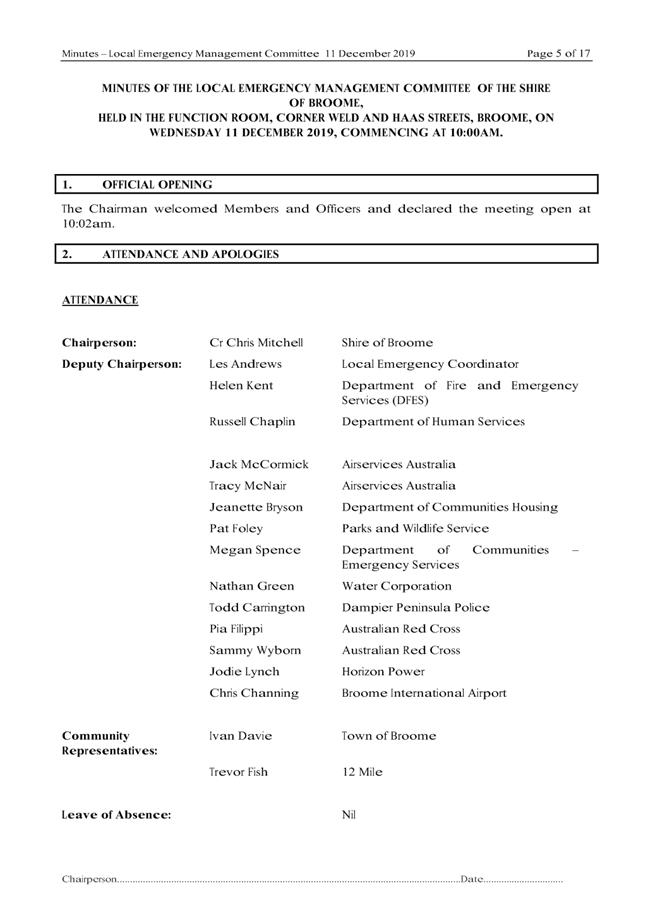
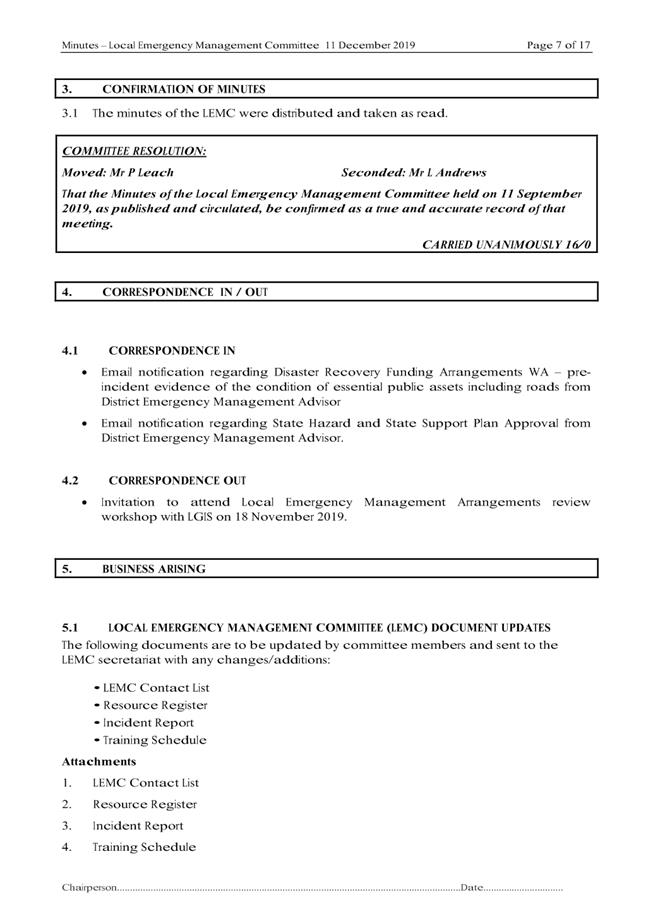
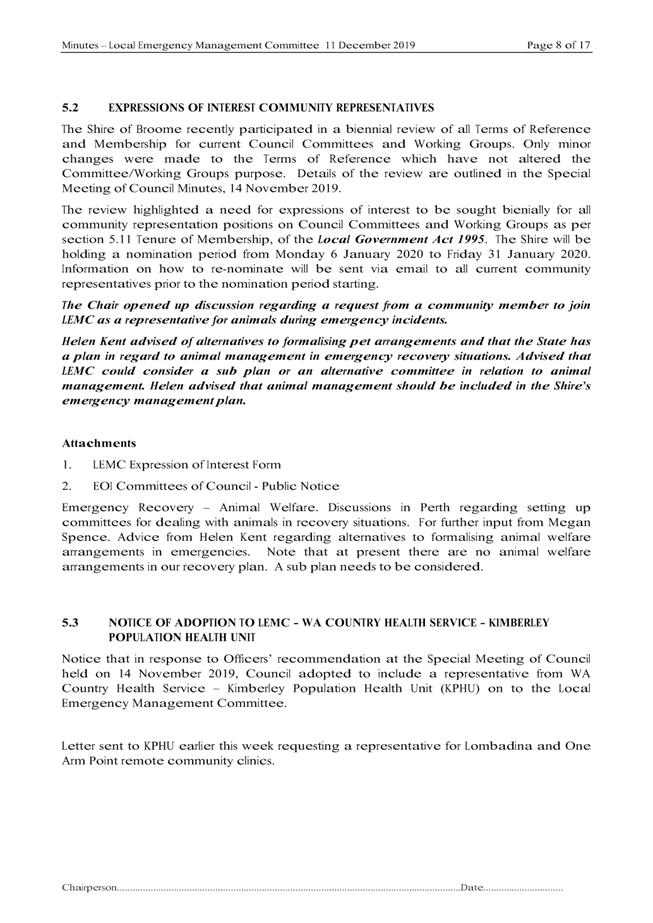
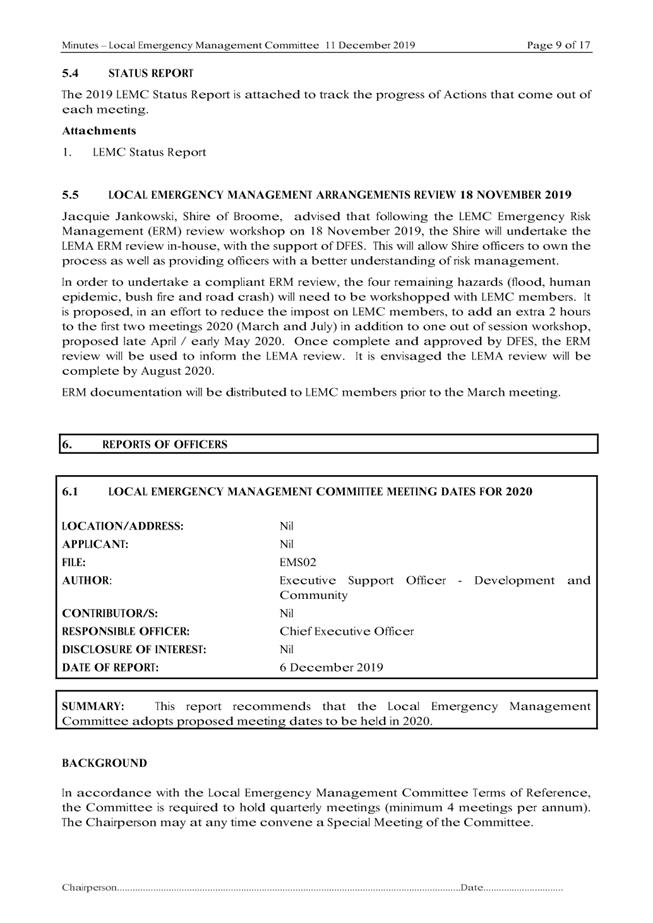
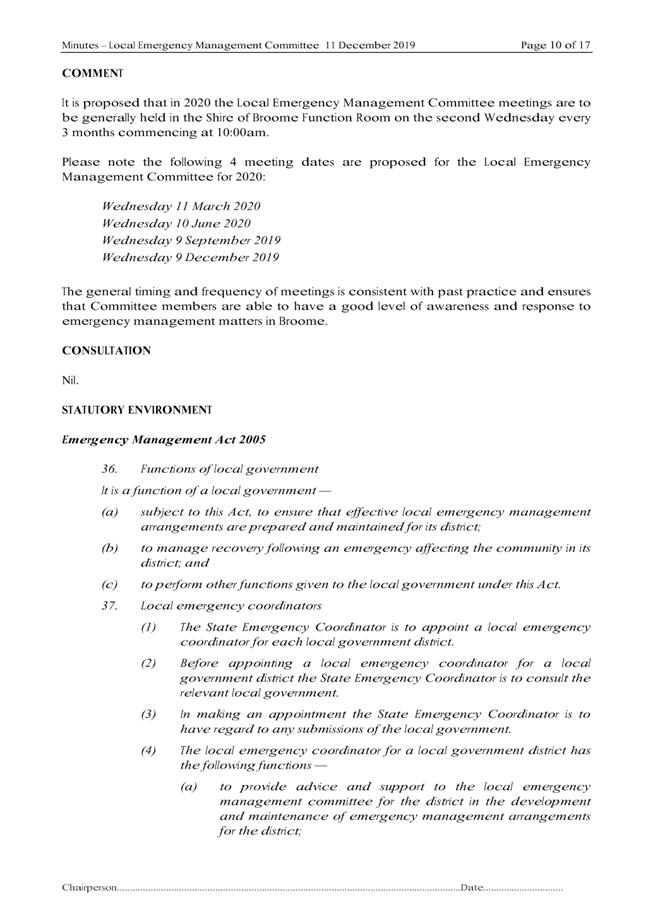
|
Item 10.2 - LOCAL EMERGENCY MANAGEMENT COMMITTEE MEETING MINUTES - 11 DECEMBER 2019 AND EXPRESSIONS OF INTEREST FOR COMMUNITY REPRESENTATIVES |
Minutes – Ordinary Meeting of Council 27 February 2020 Page 1 of 2
|
10.3 Minutes and Recommendations from Audit and Risk Committee Meeting held on 11 February 2020 FILE: AUTHOR: Senior Finance Officer RESPONSIBLE OFFICER: Director Corporate Services DATE OF REPORT: |
|
SUMMARY: This report presents for Council the outcomes of the Audit and Risk Committee meeting held on 11 February 2020 and seeks adoption of the recommendations pertaining to the Compliance Audit Return 2019 and the Quarter 2 Finance and Costing Review (FACR). |
Background
Previous Considerations
2019 Compliance Audit Return
Local governments are required to complete a compliance audit for the previous calendar year by the 31 March. The DLGSC provides the questions each year with the compliance audit being an in-house self audit that is undertaken by the appropriate responsible officer.
In accordance with Regulation 14 of the Local Government (Audit) Regulations 1996 the ARC is to review the CAR and is to report to Council the results of that review. The CAR is to be:
1. presented to an Ordinary Meeting of Council
2. adopted by Council; and
3. recorded in the minutes of the meeting at which it is adopted.
Following the adoption by Council of the CAR, a certified copy of the return, along with the relevant section of the minutes and any additional information detailing the contents of the return are to be submitted to the DLGSC by 31 March 2020.
The return requires the Shire President and the Chief Executive Officer to certify that the statutory obligations of the Shire of Broome have been complied with.
2nd Quarter Finance and Costing Review 2019-20
OMC 27 June 2019 Item 9.4.2
OMC 17 October 2019 Item 12.1
OMC 21 November 2019 Item 9.2.3
OMC 21 November 2019 Item 12.1
The Shire of Broome has carried out its 2nd Quarter FACR for the 2019/20 Financial Year. This Review of the 2019-2020 Annual Budget is based on actuals and commitments for the first six months of the year from 1 July 2019 to 31 December 2019, and forecasts for the remainder of the financial year.
This process aims to highlight over and under expenditure of funds and over and under achievement of income targets for the benefit of Executive and Responsible Officers to ensure good fiscal management of their projects and programs.
Once this process is completed, a report is compiled identifying budgets requiring amendments to be adopted by Council. A summary is provided detailing the financial impact of all proposed budget amendments to the Shire of Broome’s adopted end-of-year forecast.
It should be noted that the 2019/20 Annual Budget was adopted at the Ordinary Meeting of Council on 27 June 2019 as a balanced budget. There have been further amendments adopted by Council as part of the Annual Financial Statements for the use of additional carried forward surplus.
2019 COMPLIANCE AUDIT RETURN (5.1)
The DLGSC continues to focus on high risk areas of compliance and statutory reporting as prescribed in Regulation 13 of the Local Government (Audit) Regulations 1996.
The CAR for the period 1 January to 31 December 2019 comprises a total of 104 questions, up from 94 questions the previous year. The increase is attributed to three new disclosure of interest questions following the legislative changes in June 2019, two election questions, three additional optional questions and two additional tender questions.
The key focus areas covered in the CAR are as follows:
· Commercial Enterprises by Local Governments (5)
· Delegation of Power/Duty (13)
· Disclosure of Interest (19)
· Disposal of Property (2)
· Finance (16)
· Integrated Planning and Reporting (7)
· Local Government Employees (5)
· Official Conduct (6)
· Optional Questions (4)
· Tenders for Providing Goods and Services (29).
The 2019 CAR has been completed by the responsible officer for each focus area and reviewed by the Executive Management Group and the Chief Executive Officer.
A compliance rating of 100% has been reported.
This continues the Shire’s strong history of compliance with minimal non compliances reported over the last 5 years and none of a significant risk nature.
It is important to note that the CAR only covers the Local Government Act (1995) and related regulations.
Local Governments are also required to comply with upwards of 200 other pieces of legislation. To provide improved compliance assurance, a Cloud based compliance system is being implemented during 2020. This will provide prioritised legislative monitoring ability that will significantly improve the Shire’s compliance framework and reporting capability. The system will also assist in addressing the emphasised compliance focus of the Office of the Auditor General since taking over responsibility for Local Government audits.
2ND QUARTER FINANCE AND COSTING REVIEW 2019-20 (5.2)
It should be noted that the 2019/20 Annual Budget was adopted at the Ordinary Meeting of Council on 27 June 2019 as a balanced budget. There have been further amendments adopted by Council as part of the Annual Financial Statements for the use of additional carried forward surplus.
The result of all amendments prior to the 2nd Quarter FACR is a $311,617 deficit upon the Shire of Broome’s forecast end of year position. This $311,617 of opening deficit relates to the following adopted budget amendments to date:
· $124,000 additional contribution towards a Broome Visitor Centre funding package;
· $187,617 deficit arising from the Q1 FACR which included several high value amendments:
· $160,000 in additional rates due to the omission of 5 properties from the GRV roll provided by Landgate;
· $106,000 in additional Chinatown project management costs including shade lighting design, and predicted expenses for ongoing Defects Period and Dispute resolution;
· $70,000 for improvements to Ranger and Health business systems to increase efficiencies and payment methods;
· $50,000 for the recruitment of a 6-month ICT Project Officer to progress the backlog of ICT projects due to staff vacancies, and assist with business system improvements;
· $42,000 decrease in actual Federal Assistance Grants (FAGS) received.
The above figure represents a budget forecast should all expenditure and income occur as expected. It does not represent the actual end-of-year position which can only be determined as part of the normal annual financial processes at the end of the financial year.
A comprehensive list of accounts (refer to Attachment 1) has been included for perusal by the committee and summarised by Directorate.
A summary of the results follows:
|
|
SHIRE OF BROOME SUMMARY REPORT |
|||||||
|
BUDGET IMPACT |
||||||||
|
2019/20 Adopted Budget |
FACR Q2 |
FACR Q2 |
FACR Q2 |
YTD Adopted Budget Amendts |
YTD Impact |
|||
|
Executive |
0 |
31,400 |
26,400 |
5,000 |
17,000 |
22,000 |
||
|
Corporate Services |
0 |
(371,334) |
(371,334) |
0 |
(19,000) |
(19,000) |
||
|
Development and Community |
0 |
(116,446) |
(58,040) |
(58,406) |
68,369 |
9,963 |
||
|
Infrastructure |
0 |
31,461 |
34,297 |
(2,836) |
121,248 |
118,412 |
||
|
Impact of Council approved Budget Amendments |
0 |
0 |
0 |
0 |
124,000 |
124,000 |
||
|
|
|
|
0,000* |
(424,919) |
(368,677) |
(56,242) |
311,617† |
255,375 |
CONSULTATION
2019 Compliance Audit Return
Nil.
2nd Quarter Finance and Costing Review 2019/20
All amendments have been proposed after consultation with Executive and Responsible Officers at the Shire.
STATUTORY ENVIRONMENT
Local Government (Audit) Regulations 1996
14. Compliance audits by local governments
(1) A local government is to carry out a compliance audit for the period 1 January to 31 December in each year.
(2) After carrying out a compliance audit the local government is to prepare a compliance audit return in a form approved by the Minister.
(3A) The local government’s audit committee is to review the compliance audit return and is to report to the council the results of that review.
(3) After the audit committee has reported to the council under subregulation (3A), the compliance audit return is to be —
(a) presented to the council at a meeting of the council; and
(b) adopted by the council; and
(c) recorded in the minutes of the meeting at which it is adopted.
[Regulation 14 inserted in Gazette 23 Apr 1999 p. 1724‑5; amended in Gazette 30 Dec 2011 p. 5580-1.]
15. Compliance audit return, certified copy of etc. to be given to Departmental CEO
(1) After the compliance audit return has been presented to the council in accordance with regulation 14(3) a certified copy of the return together with —
(a) a copy of the relevant section of the minutes referred to in regulation 14(3)(c); and
(b) any additional information explaining or qualifying the compliance audit,
is to be submitted to the Departmental CEO by 31 March next following the period to which the return relates.
Local Government (Financial Management) Regulation 1996
r33A. Review of Budget
(1) Between 1 January and 31 March in each financial year a local government is to carry out a review of its annual budget for that year.
(2A) The review of an annual budget for a financial year must —
(a) consider the local government’s financial performance in the period beginning on 1 July and ending no earlier than 31 December in that financial year; and
(b) consider the local government’s financial position as at the date of the review; and
(c) review the outcomes for the end of that financial year that are forecast in the budget.
(2) Within 30 days after a review of the annual budget of a local government is carried out it is to be submitted to the council.
(3) A council is to consider a review submitted to it and is to determine* whether or not to adopt the review, any parts of the review or any recommendations made in the review.
*Absolute majority required.
(4) Within 30 days after a council has made a determination, a copy of the review and determination is to be provided to the Department.
Local Government Act 1995
6.8. Expenditure from municipal fund not included in annual budget
1) A local government is not to incur expenditure from its municipal fund for an additional purpose except where the expenditure —
(a) is incurred in a financial year before the adoption of the annual budget by the local government;
(b) is authorised in advance by resolution*; or
(c) is authorised in advance by the mayor or president in an emergency.
(1a) In subsection (1) —
“additional purpose” means a purpose for which no expenditure estimate is included in the local government’s annual budget.
POLICY IMPLICATIONS
2019 Compliance Audit Return
Nil.
2nd Quarter Finance and Costing Review 2019-20
Nil.
FINANCIAL IMPLICATIONS
2019 Compliance Audit Return
Nil.
2nd Quarter Finance and Costing Review 2019-20
The net result of the Quarter 2 FACR estimates indicate that there will be a budget deficit position of $255,375 to 30 June 2020.
RISK
2019 Compliance Audit Return
There is a reputational risk with the DLGSC should the CAR not be completed on time or if significant non compliances are reported.
The likelihood of this occurring is rare.
2nd Quarter Finance and Costing Review 2019/20
The Finance and Costing Review (FACR) seeks to provide a best estimate of the end-of-year position for the Shire of Broome at 30 June 2020. Contained within the report are recommendations of amendments to budgets which have financial implications on the estimate of the end-of-year position.
The review does not, however, seek to make amendments below the materiality threshold unless strictly necessary. The materiality thresholds are set at $10,000 for operating budgets and $20,000 for capital budgets. Should a number of accounts exceed their budget within these thresholds, it poses a risk that the predicted final end-of-year position may be understated.
In order to mitigate this risk, the CEO enacted the FACRs to run quarterly and Executive examine each job and account to ensure compliance. In addition, the monthly report provides variance reporting highlighting any discrepancies against budget.
It should also be noted that should Council decide not to adopt the recommendations, it could lead to some initiatives being delayed or cancelled in order to offset the additional expenditure associated with running the Shire’s operations.
STRATEGIC IMPLICATIONS
Our People Goal – Foster a community environment that is accessible, affordable, inclusive, healthy and safe:
Effective communication
Affordable services and initiatives to satisfy community need
Our Prosperity Goal – Create the means to enable local jobs creation and lifestyle affordability for the current and future population:
Affordable and equitable services and infrastructure
Our Organisation Goal – Continually enhance the Shire’s organisational capacity to service the needs of a growing community:
An organisational culture that strives for service excellence
Sustainable and integrated strategic and operational plans
Responsible resource allocation
Improved systems, processes and compliance
VOTING REQUIREMENTS
Simple Majority
The recommendations from the Audit and Risk Committee meeting held on 11 February 2020 appear below for Council consideration.
10.3.1 COMPLIANCE AUDIT RETURN 2019 (5.1)
|
Minute No. C/0220/028 Moved: Cr D Male Seconded: Cr C Mitchell That Council: 1. Adopt the attached 2019 Compliance Audit Return as the official return for the Shire of Broome; and 2. Requests the Chief Executive Officer to submit the certified return and a copy of the minutes relative to this report to the Department of Local Government, Sport and Cultural Industries prior to 31 March 2020. |
10.3.2 2ND QUARTER FINANCE AND COSTING REVIEW 2019-20 (5.2)
Absolute Majority
|
Minute No. C/0220/029 Moved: Cr D Male Seconded: Cr C Mitchell That Council: 1. Receives the Quarter 2 Finance and Costing Review Report for the period ended 31 December 2019; 2. Adopts the operating and capital budget amendment recommendations for the year ended 30 June 2020 as attached; 3. Notes a forecast end-of-year position to 30 June 2020 of a $255,375 deficit position; and 4. Approves a budget transfer to the Public Open Space Reserve of $368,677 to quarantine potential surplus funds at the end of the financial year towards the Town Beach Jetty project. |
|
Minutes and Recommendations from Audit and Risk Committee Meeting held on 11 February 2020 |
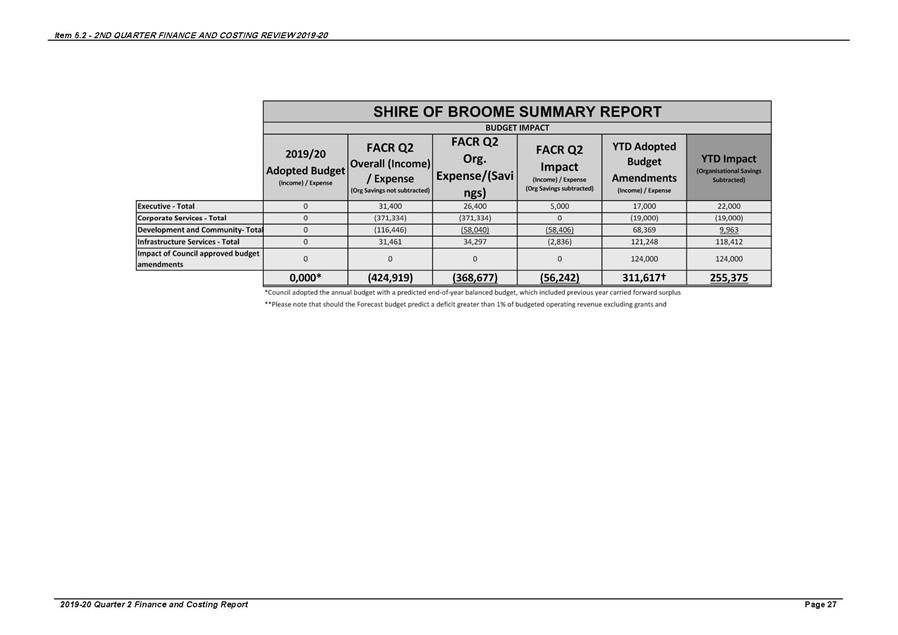
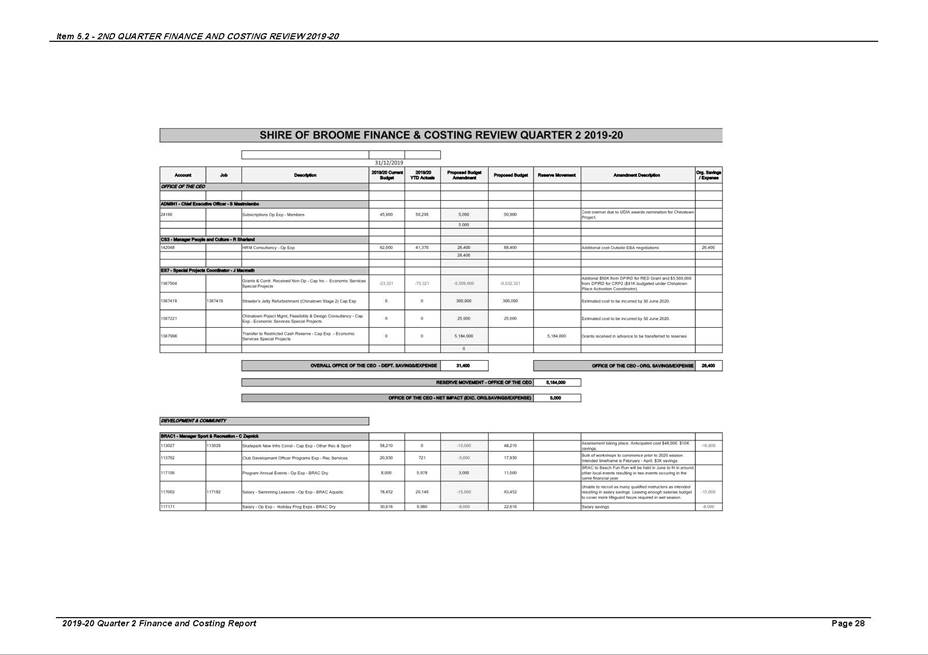
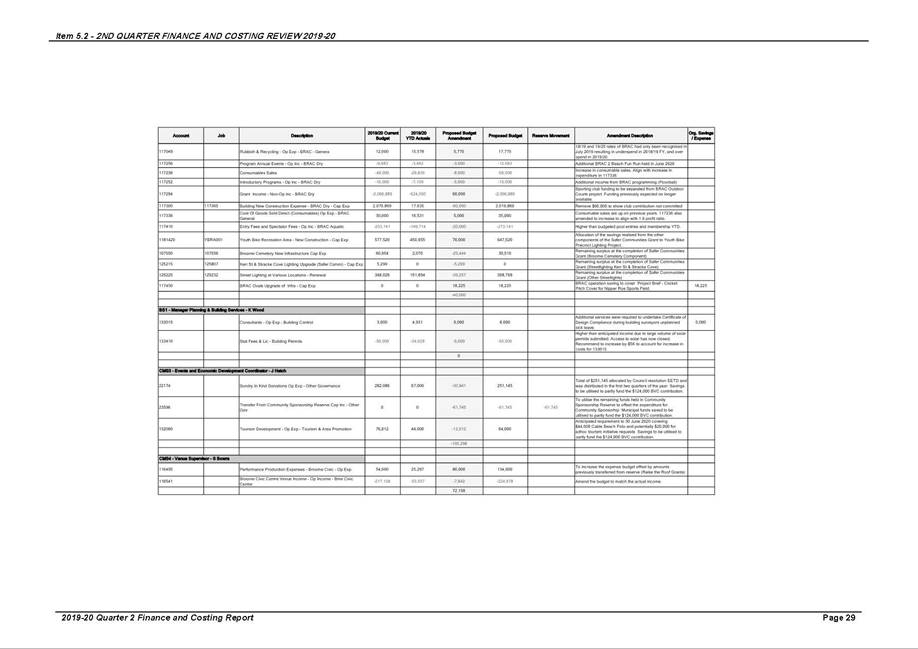
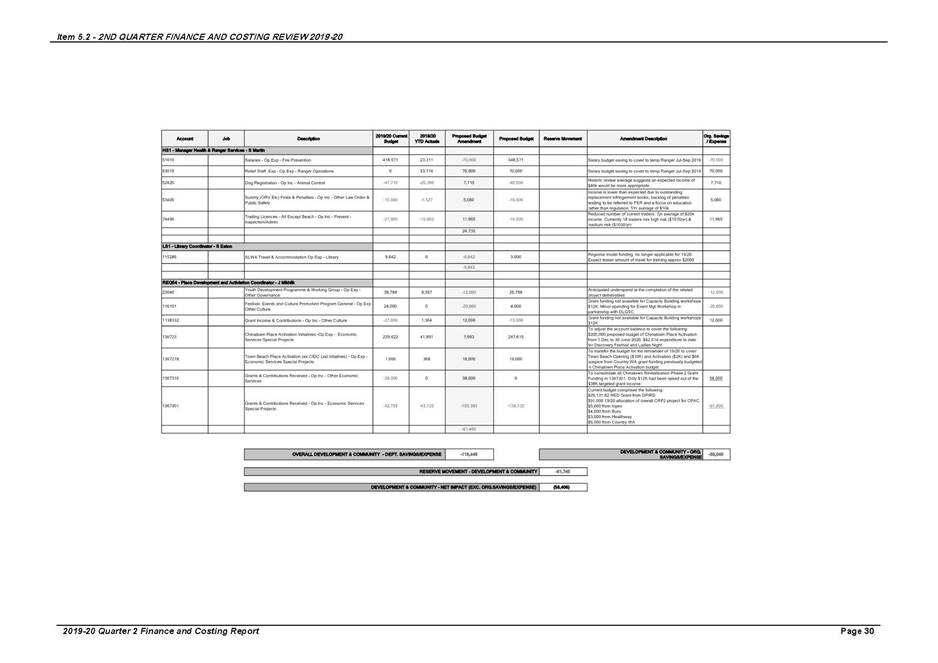
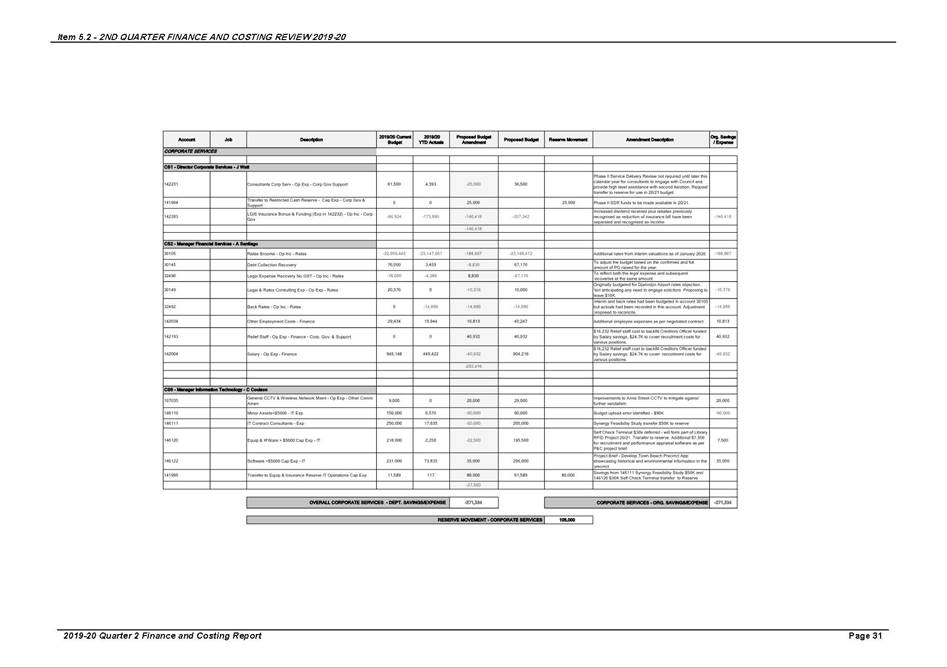
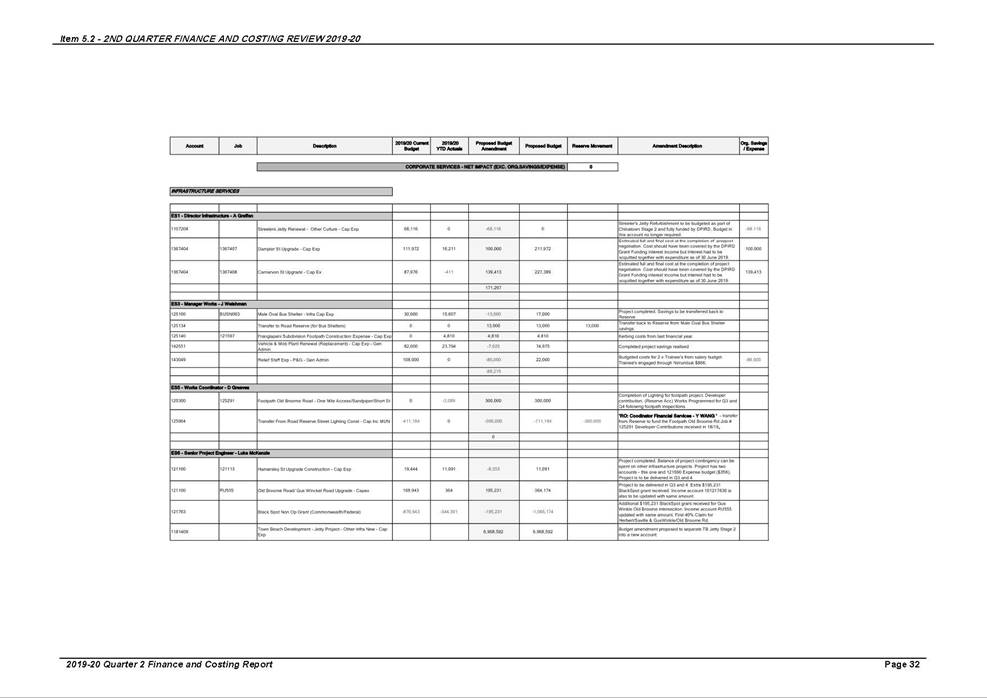
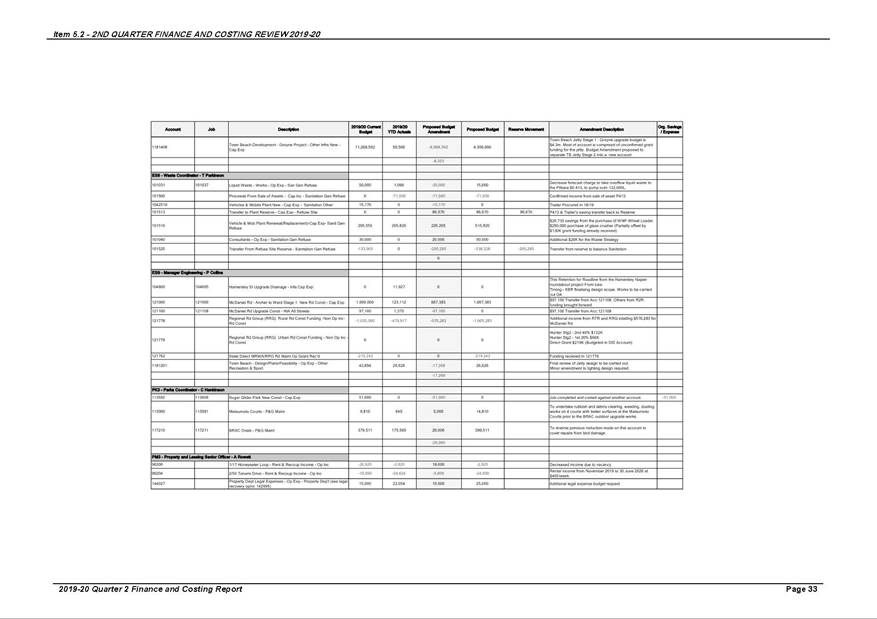

Minutes – Ordinary Meeting of Council 27 February 2020 Page 1 of 2
|
SUMMARY: This report presents the minutes and associated recommendations of the Bush Fire Advisory Committee meeting held on 11 December 2019 for Council’s consideration. In January 2020, advertisements from the Shire of Broome called for Expressions of Interest for community representatives from the Town of Broome, Coconut Well, Skuthorpe and Twelve Mile to be appointed to the Bush Fire Advisory Committee (BFAC) and Local Emergency Management Committee. This report also presents the expressions of interest for Council’s consideration and recommends the appointment of community representatives to the committee. |
BACKGROUND
Previous Considerations
Appointment of Members to the Bush Fire Advisory Committee
SMC 14 November 2019
The Bush Fire Advisory Committee (BFAC) meets quarterly to provide advice to the Shire of Broome on:
1. All matters relating to the prevention, controlling and extinguishing of bushfires.
2. The planning and layout of fire breaks in the district.
3. Prosecutions for breaches of the Bush Fires Act 1956.
4. The formation of Bush Fire Brigades.
5. Coordination and cooperation between agencies within the district.
The BFAC is a Committee of Council that usually includes representatives from various Federal and State agencies and relevant community organisations and individual community members as deemed appropriate.
The membership term of the current committees has expired and an Expression of Interest (EOI) period was run to obtain nominations for potential members from around the Shire of Broome to sit on BFAC from March 2020. The EOI period ran from 6 January 2020 to 13 February 2020.
COMMENT
The minutes of the BFAC meeting held on 11 December 2019 are included as Attachments 1 to 3 of this report.
At the meeting, the BFAC discussed the following items:
Item 5.1 Bush Fire Advisory Committee Contact List
The Contact List was updated prior to the meeting and members were reminded to send any further changes/additions to the BFAC Secretariat for the 2019 BFAC Contact List and advise of any proxies over the Christmas period (see confidential Attachment 2).
Item 5.2 Status Report
The 2019 Status Report was presented with nil to report (see Attachment 3).
Item 5.3 Updates from BFAC members
A round table discussion was conducted allowing Committee members to give an update on their agencies, and any relevant matters.
Shire of Broome Coordinator Rangers proposed changes to the 2020 Fire Break and Fuel Hazard Reduction Notice. After lengthy discussion the Committee resolved that an item be presented to Council at the February Ordinary Meeting of Council to propose amendments to the draft 2020 Fire Break and Fuel Hazard Reduction Notice. The amendments were to detail recommended compliance obligations regarding access to dwellings by emergency services vehicles, width of fire breaks and boundary corners as well as permissible material on fire breaks.
A review of the information provided in the BFAC meeting minutes did not provide enough detail of what specific changes were being proposed. It is the officers’ opinion that the committee recommendation should be returned to the BFAC to enable further consultation with the committee, the community, impacted property owners and other involved agencies for additional justification and detail of the BFAC proposed changes to the Fire Break and Fuel Hazard Reduction Notice before an item is put to Council for consideration.
Item 5.4 Expressions of Interest Community Representatives
The Committee was advised that the current term of community member representation on the Bush Fire Advisory Committee has expired. An expressions of interest process for nominations for Committee membership was opened on 6 January 2020 and closes on 13 February 2020.
Item 6.1 Bush Fire Advisory Committee Meeting Dates for 2020
The purpose of this report was to set the meeting dates for 2020.
The current Terms of Reference for the BFAC require quarterly meetings.
Committee Resolution:
(Report Recommendation)
Moved: Mr P Foley Seconded: Mr P Leach
That meetings are convened for the Bush Fire Advisory Committee on the following dates in 2020 commencing at 11:00am in the Shire of Broome Function Room:
· Wednesday 11 March 2020
· Wednesday 10 June 2020
· Wednesday 9 September 2020
· Wednesday 9 December 2020
CARRIED UNANIMOUSLY 9/0
Summary
Bush Fire Advisory Committee EOI
A total of four (4) community member nominations were received for BFAC membership during the EOI period. The nominees were:
|
NAME |
LOCATION |
EXPERIENCE |
|
Trevor Fish |
Twelve Mile |
Previous BFAC member |
|
Derren Greenhill |
Skuthorpe |
Previous BFAC member |
|
Tania Baxter |
Bidyadanga |
Previous BFAC member |
|
Caitlin Westlake |
Waterbank/ Coconut Well |
New nominee with experience in bush fire management in a pastoral environment |
Patrick Foley also submitted a nomination to represent the Department of Biodiversity, Conservation and Attraction (Parks & Wildlife).
Officers have assessed the nominations and recommend that all nominations be appointed as members of the BFAC.
CONSULTATION
Bush Fire Advisory Committee members
STATUTORY ENVIRONMENT
Bush Fires Act 1956
Section 67. – Advisory committees
1. A Local Government may at any time appoint such persons as it thinks fit as a Bush Fire Advisory Committee for the purpose of advising the Local Government regarding all matters relating to the prevention, controlling and extinguishing of bush fires, the planning of the layout of firebreaks in the district, prosecutions for breaches of this Act, the formation of bush fire brigades and the grouping thereof under group brigade officers, the ensuring of co-operation and co-ordination of bush fire brigades in their efforts and activities, and any other matter relating to bush fire control whether of the same kind, as, or a different kind from, those specified in this subsection.
2. A committee appointed under this section shall include a member of the Council of the Local Government nominated by it for that purpose as a member of the committee, and the committee shall elect one of their number to be Chairman thereof.
3. In respect to a committee so appointed, the Local Government shall fix the quorum for the transaction of business at meetings of the committee and may: -
(a) make rules for the guidance of the committee;
(b) accept the resignation in writing of, or remove, any member of the committee, appoint a person to fill that vacancy.
(c) where for any reason a vacancy occurs in the office of a member of the committee, appoint a person to fill that vacancy.
4. A committee appointed under this section: -
(a) may from time to time meet and adjourn as the committee thinks fit;
(b) shall not transact business at a meeting unless the quorum fixed by the Local Government is present;
(c) is answerable to the Local Government and shall, as and when required by the Local Government, report fully on its activities.
Local Government Act 1995
5.8. Committee members, appointment of
(1) A committee is to have as its members —
(a) persons appointed* by the local government to be members of the committee (other than those referred to in paragraph (b)); and
(b) persons who are appointed to be members of the committee under subsection (4) or (5).
*Absolute majority required.
(2) At any given time each council member is entitled to be a member of at least one committee referred to in section 5.9(2)(a) or (b) and if a council member nominates himself or herself to be a member of such a committee or committees, the local government is to include that council member in the persons appointed under subsection (1)(a) to at least one of those committees as the local government decides.
(3) Section 52 of the Interpretation Act 1984 applies to appointments of committee members other than those appointed under subsection (4) or (5) but any power exercised under section 52(1) of that Act can only be exercised on the decision of an absolute majority of the local government
(4) If at a meeting of the council a local government is to make an appointment to a committee that has or could have a council member as a member and the mayor or president informs the local government of his or her wish to be a member of the committee, the local government is to appoint the mayor or president to be a member of the committee.
(5) If at a meeting of the council a local government is to make an appointment to a committee that has or will have an employee as a member and the CEO informs the local government of his or her wish —
(a) to be a member of the committee; or
(b) that a representative of the CEO be a member of the committee,
the local government is to appoint the CEO or the CEO’s representative, as the case may be, to be a member of the committee.
5.11A. Deputy committee members
(1) The local government may appoint* a person to be a deputy of a member of a committee and may terminate such an appointment* at any time.
* Absolute majority required.
(2) A person who is appointed as a deputy of a member of a committee is to be —
(a) if the member of the committee is a council member — a council member; or
(b) if the member of the committee is an employee — an employee; or
(c) if the member of the committee is not a council member or an employee — a person who is not a council member or an employee; or
(d) if the member of the committee is a person appointed under section 5.10(5) — a person nominated by the CEO.
(3) A deputy of a member of a committee may perform the functions of the member when the member is unable to do so by reason of illness, absence or other cause.
(4) A deputy of a member of a committee, while acting as a member, has all the functions of and all the protection given to a member.
[Section 5.11A inserted by No. 17 of 2009 s. 20.]
5.9. Committee membership, tenure of
(1) Where a person is appointed as a member of a committee under section 5.10(4) or (5), the person’s membership of the committee continues until —
(a) the person no longer holds the office by virtue of which the person became a member, or is no longer the CEO, or the CEO’s representative, as the case may be; or
(b) the person resigns from membership of the committee; or
(c) the committee is disbanded; or
(d) the next ordinary elections day, whichever happens first.
(2) Where a person is appointed as a member of a committee other than under section 5.10(4) or (5), the person’s membership of the committee continues until —
(a) the term of the person’s appointment as a committee member expires; or
(b) the local government removes the person from the office of committee member, or the office of committee member otherwise becomes vacant; or
(c) the committee is disbanded; or
(d) the next ordinary elections day, whichever happens first.
POLICY IMPLICATIONS
Nil
FINANCIAL IMPLICATIONS
Current financial and human resources allow for the Bush Fire Advisory Committee meetings to be held quarterly.
RISK
Community representation aims to ensure that BFAC, and therefore Council, are advised on any local issues or omissions regarding Bush Fire Management. The absence of a representative from distinct geographical areas therefore brings the risk that key issues may not be identified. However, in this case the risk may be lessened due to the representation on BFAC of government and non-government service delivery organisations that are heavily involved in the Shire of Broome area. Therefore, the overall risk is considered ‘Low’.
STRATEGIC IMPLICATIONS
Our People Goal – Foster a community environment that is accessible, affordable, inclusive, healthy and safe:
Effective communication
Affordable services and initiatives to satisfy community need
Accessible and safe community spaces
A healthy and safe environment
Our Organisation Goal – Continually enhance the Shire’s organisational capacity to service the needs of a growing community:
Sustainable and integrated strategic and operational plans
Responsible resource allocation
Effective community engagement
Improved systems, processes and compliance
VOTING REQUIREMENTS
Absolute Majority
|
Council Resolution: Minute No. C/0220/030
Moved: Cr E Foy Seconded: Cr N Wevers That Council: 1. Receives the minutes of the Bush Fire Advisory Committee meeting held on 11 December 2019, and endorses the recommendations put forward by the Bush Fire Advisory Committee; 2. Appoint the following persons as community representatives to the Bush Fire Advisory Committee: a. Trevor Fish (Twelve Mile) b. Darren Greenhill (Skuthorpe) c. Tania Baxter (Bidyadanga) d. Caitlin Westlake (Waterbank / Coconut Well); and 3. Appoint the following persons as organisation representative to the Bush Fire Advisory Committee: a. Patrick Foley (Department of Biodiversity, Conservation and Attractions). CARRIED UNANIMOUSLY BY ABSOLUTE MAJORITY 8/0 |
|
Unconfirmed minutes of the Bush Fire Advisory Committee - 11 December 2019 |
|
|
BFAC Contact List (Confidential to Councillors and Directors Only) This attachment is confidential in accordance with section 5.23(2) of the Local Government Act 1995 section 5.23(2)(b) as it contains “the personal affairs of any person”. |
|
|
BFAC Status Report |
|
Item 10.4 - BUSH FIRE ADVISORY COMMITTEE MEETING MINUTES 11 DECEMBER 2019 AND EXPRESSIONS OF INTEREST FOR APPOINTMENT AS COMMUNITY REPRESENTATIVES |
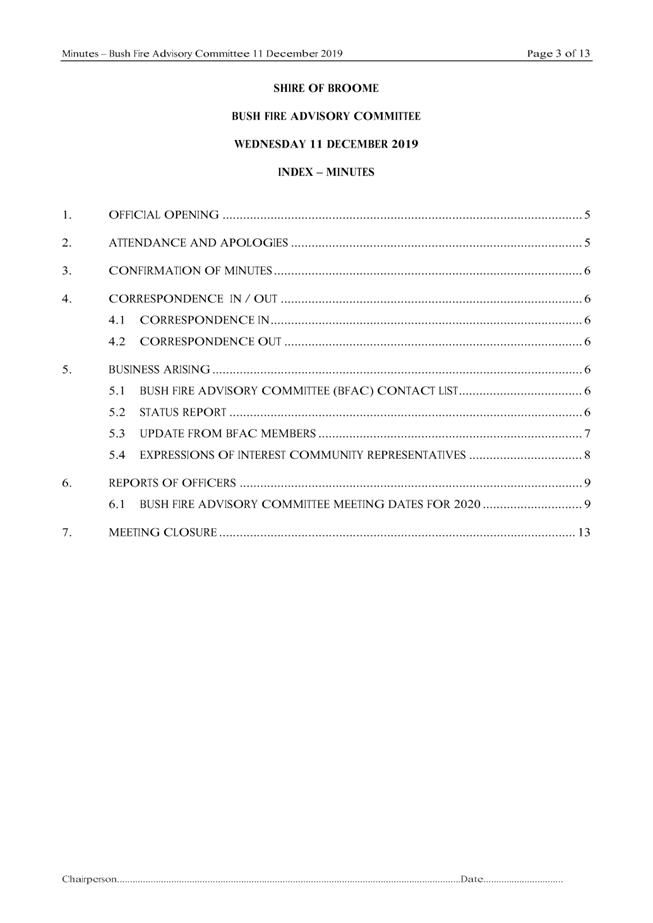
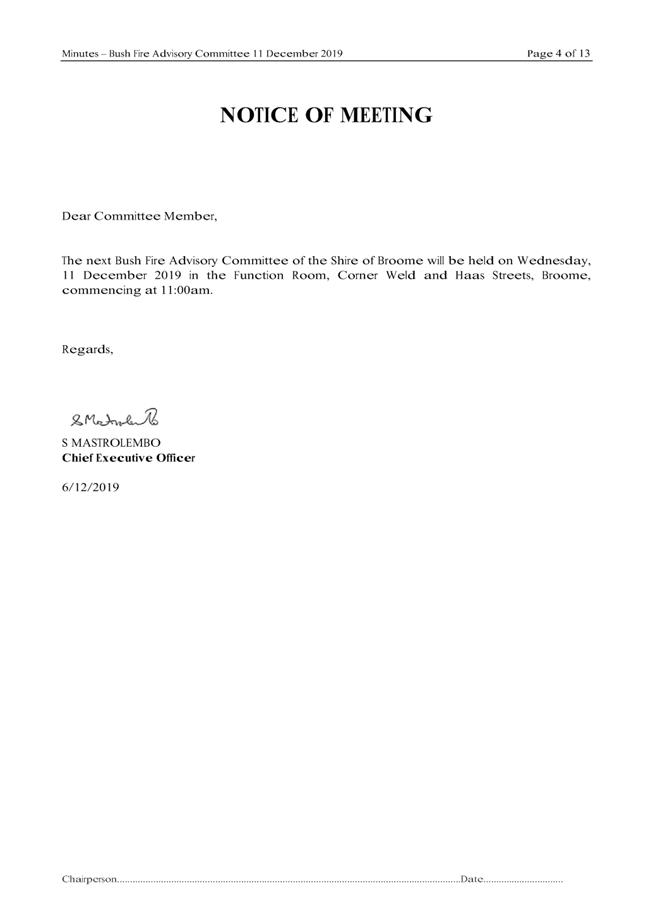
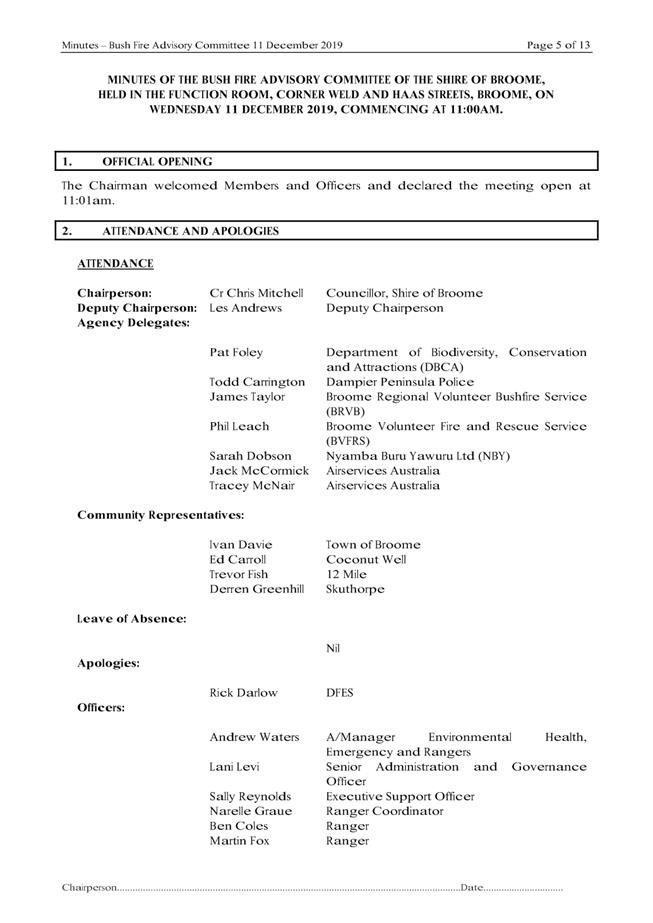
|
Item 10.4 - BUSH FIRE ADVISORY COMMITTEE MEETING MINUTES 11 DECEMBER 2019 AND EXPRESSIONS OF INTEREST FOR APPOINTMENT AS COMMUNITY REPRESENTATIVES |
Nil.
Nil.
Nil.
Nil.
There being no further business the Chair declared the meeting closed at 6:15PM.
|
These minutes were confirmed at a meeting held Thursday, 26 March 2020, and signed below by the Presiding Person, at the meeting these minutes were confirmed.
Signed:
|